Infographic on Our Malecón

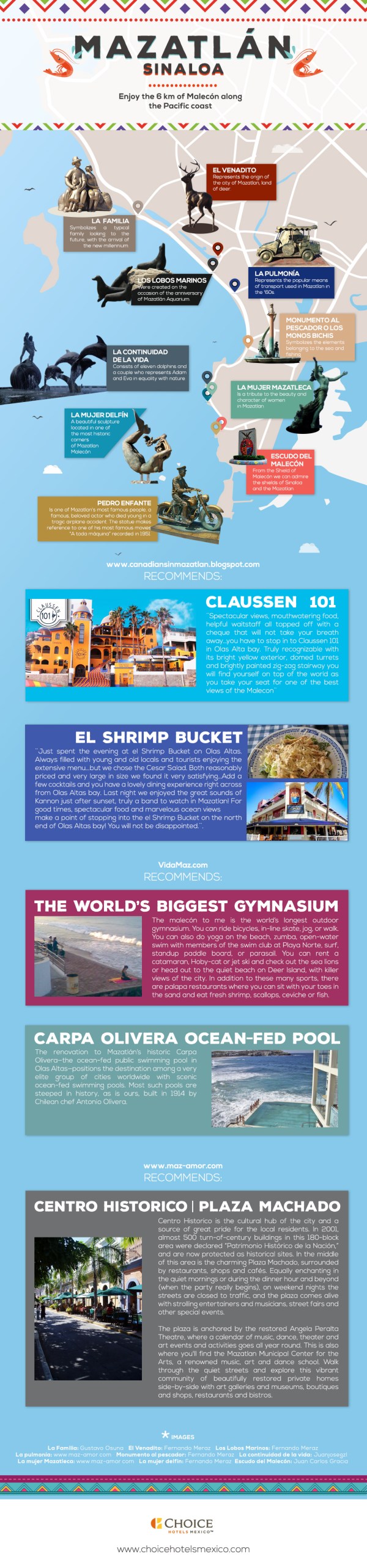
A few weeks ago a lady from a marketing company contacted me, asking for information about our beloved malecón. She said she was tasked with making an infographic for a new hotel in town.

It’s always fun when someone asks you about something you love, and Lord knows I absolutely adore our malecón. It’s one of Mazatlán’s greatest treasures. I don’t know where this lady is based, but my guess is she knows nothing about Mazatlán, but was given this task. She was very nice.

A week or two later, I heard from Janet Blaser, M! Magazine, that she’d been contacted as well, and liked what the lady showed her I’d said about our malecón being the world’s largest gym.

Turns out the infographic is for the new Choice hotel, Quality Inn Mazatlán. The marketing company gave me permission to share the infographic with you. It’s pretty cool. I hope it’ll show up so that you can zoom in and read it easily.

Mazatlan_choice_EN-FINAL-v2

I rather like it. Cool to have an infographic on Mazatlán. I would have preferred a good picture of our three gorgeous islands in the bay and the killer views, but… Please let us know what you think. You may remember I did perhaps Mazatlán’s very first infographic a few years ago, about our Carnavál.

Of course, when we give input on these things, there’s never enough room for everything. Infographics are summaries. Interested in what I told the lady? Here’s my note:

My apologies, Ana; we have been traveling in Colombia for work and didn’t have a chance to respond.

The malecón to me is the world’s longest outdoor gymnasium. You can ride bicycles, in-line skate, jog, or walk. You can also do yoga on the beach, zumba, open-water swim with members of the swim club at Playa Norte, surf, standup paddle board, or parasail. You can rent a catamaran, Hoby-cat or jet ski and check out the sea lions or head out to the quiet beach on Deer Island, with killer views of the city. In addition to these many sports, there are palapa restaurants where you can sit with your toes in the sand and eat fresh shrimp, scallops, ceviche or fish.

https://vidamaz.com/2009/10/04/el-gimnasio-mas-grande-del-mundothe-worlds-biggest-gymnasium/

Carpa Olivera is one of the world’s very few ocean-fed public swimming pools, free of charge and extremely scenic.

https://vidamaz.com/2015/05/01/carpa-olivera-ocean-fed-pool-positions-mazatlan-among-worlds-elite/

Once a year locals swim out to Deer Island in the Travesía Anual:

https://vidamaz.com/2013/03/03/la-travesia-anual-annual-community-swim-from-playa-norte-to-deer-island-mazatlan/

During Carnavál, the world’s third largest, two parades go down the full length of the malecón.

https://vidamaz.com/2013/02/18/street-view-carnaval-de-mazatlan-2013-desfile-principal/

https://vidamaz.com/2012/02/22/carnaval-parade-preparations/

During the Maratón Internacional del Pacífico, there are fireworks set off from a dozen places along the malecón, making for an incredible sight.

https://vidamaz.com/2015/11/29/festival-de-la-luz-2015/

Enjoy! Have a wonderful summer, everyone!

Are You My Mother?

51Zu5zbzWDL

You have read of the lovely rosy finch families that have nested on our deck the past 5-6 years. First it was one family, then two, and now up to three families nest on our eleventh floor terrace each spring. We love it! Click on any photo to enlarge it or view a slideshow.

Every year we are blessed to wake up to their bird song, and to hear it throughout the day. We watch as the mother and father make their nest, then as they feed their babies. They zoom in and out the windows, they dance on the railing, and they poop a LOT. The family below had three babies this year. Aren’t they cute? They climb on top of each other in order to peer out. Once in a while one or the other will get his feathers stuck on the edge. They grow so very quickly.

Then, suddenly, one day, the nest is empty. We hear no more singing, and we are sad. In the process, we usually lose one of our plants, because we stop watering it while the birds are nesting.

DSC_0728©

This year, however, two unusual things have happened. First, one family of nesters left an egg that never hatched. How very sad! It is so, so tiny, and oh-so-precious!

Then, last night, Greg was awoken at 2 a.m. One of the small birds in the second set of nesters had either fallen or flown from the nest. He was standing on the tile floor right in front of our sliding glass door, looking in at us, and chirping his heart out! “Are you my Mommy,” he seemed to be asking.

Greg googled at 2 a.m. to read that the parents were no doubt nearby, and would take care of the bird; that we shouldn’t worry. We should just leave him alone. So we did. And he chirped all night long. Well into the morning.

Just before I left for church, we read on the Internet that it’s a wive’s tale that birds will abandon their young if humans pick them up and return them to the nest. The article cautioned, however, that young birds have parasites and germs, so it’s best to pick them up and move them with a container.

I used an old yoghurt container to gently take our baby bird and replace him in his nest. Twenty minutes later, he was down again, this time inside a pot of aloe. Again, he was chirping his heart out. I went to church, and Greg went running.

By the time we returned, our young friend was again out on the deck, looking in at us and crying. We were worried. It would appear his mother had died; we hadn’t seen her since yesterday. Then, miraculously, Daddy showed up!

DSC_0118©

Our guess is that Mom has, sadly, disappeared. Thank goodness that this father isn’t an absentee Dad! He seems to be taking good care of the two remaining in the nest and, the one hyper-active child who keeps thinking he can fly before he’s ready.

Bridging Cultures—Those Within Me

P1030588Readers of this blog may know that I spent quite a few formative years in Japan, living there most of the time from seventeen to 32 years of age. It is one of three countries I consider “home:” USA, Japan, and Mexico. Wherever I am, I miss the other two dearly.

So what’s a global nomad to do? Share, of course. With those I love.

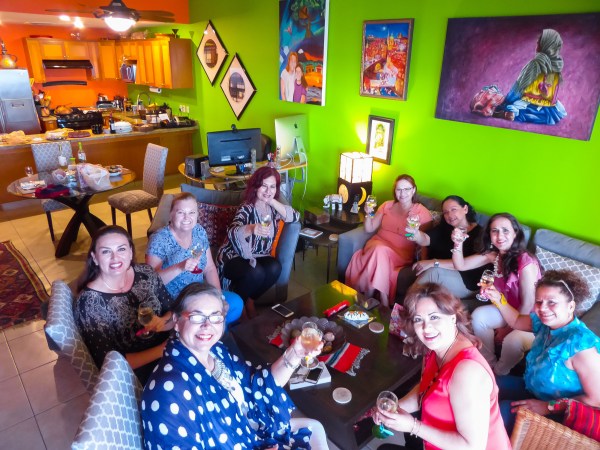
I am blessed here, after eight years full-time, with a couple of groups of incredibly talented, intelligent, loving and fun-loving girlfriends. I thank God for them every day; they are truly amazing. It took me a long while to find them, these soul sisters. They are artists, cooks, business women, housewives, teachers.

I wanted to cook them some authentic Japanese food, share with them a taste of my other self. It’s really hard to find some of the ingredients here in Mazatlán, so when Greg and I went to Tucson over MotoWeek I bought some of the ingredients I’d need—dried seaweed, dried bonito flakes, renkon or lotus root, dried shiitake.

I invited my beloved girlfriends to come on Monday, the day between US Mother’s Day and Mexican Mother’s Day. I would celebrate them. We were all excited. I cooked most of the day on Sunday, enjoying myself immensely. I also cooked all afternoon Monday. I made:

  • Ebi-shinjo, or shrimp balls.
  • Two kinds of stock: shrimp and tuna, the latter flavored with shiitake as well.
  • Nimono, stewed veggies, using the tuna stock. I cut the carrots into flower shapes, I soaked and peeled the celery, I soaked and trimmed the shiitake, I got creative and used palmitos as I didn’t have take-no-ko or baby bamboo. Japanese food is nothing if not putzy.
  • Chawan-mushi, steamed egg custard, using the shrimp stock, and adding root veggies (goboh, renkon), fish, shrimp and shiitake. It’s one of my favorite dishes. Making and steaming 13 little cups took a lot of time on my little stove!
  • Ohitashi, boiled spinach, squeezed and trimmed, then covered with sesame seeds.
  • Nasubi-yaki, grilling the cutest little baby eggplants that I’d bought at the Farmers’ Market, then covering them with bonito flakes or katsuo-bushi.
  • Sake no miso-yaki, or salmon grilled in miso sauce. This was the easiest to cook, and is something I make often, though usually not using salmon. It’s a family favorite.
  • Kani, kyuuri to wakame no sunomono, or pickled crab, cucumber and seaweed salad. This is what my Japanese mother always makes for me when I come home. Just the thought of it warms my heart, say nothing of the taste!

Click any photo to enlarge it or view a slideshow.

My, did I have fun! However, on Sunday evening, towards the tail-end of my first round of cooking, I suddenly realized, “My friends are going to hate this food!” I love it; it’s near and dear to my heart. It’s part of me. But they like food that pops in your mouth, full of flavor. Japanese traditional home cooking is subtle, the flavors are comforting, perhaps indistinguishable to a Mazatlecan palate. And this sort of Japanese cooking is not so colorful: it has lots of dark browns (shiitake) and greys (root veggies), with a splash of orange carrot or bright green spinach here and there. Oh dear.

Cooking Japanese is a lot of work. I didn’t cook gourmet; I made home cooking. But, with the difficulty getting the ingredients here in Mazatlán, and the hours it takes to make the stocks, trim the veggies, fish and seafood just so, and put together six small dishes for each of 13 guests… Well, I realized I was cooking this for ME, not for THEM! This was my Mother’s Day gift to myself: showing my girlfriends a very important part of who I am, how I came to be. Of course they wouldn’t have the decades of emotion behind the food I was offering them; they’d just be tasting what I put in front of them. But they love me, and they know I love it, so, they’ll enjoy it even if it’s not their favorite.

When the big night came, my girlfriends arrived bearing gifts of all sorts: two kinds of incredible pies, a pot of delicious cocido, wine, rolls, cookies, ice cream… Normally when we get together, everyone brings something to share; that makes it easier for everyone and we can just focus on enjoying ourselves, catching up, laughing, and not fussing. Normally, I love it. But tonight would be different.

Greg poured the wine as they came in, and I had set out some dried pickled plums—umeboshi. I figured they wouldn’t like them. Oh was I wrong! They were a hit! We ate sour plums and drank our wine as we watched the sun set.

image

Photo by Patty Pazos

Afterwards, we were ready to eat. I recruited several girlfriends to help me serve, as we would have to load all those different dishes in individual plates and bowls, one for each of us. The girls seemed to enjoy this part.

Once everything was served, I explained to them how Japanese put their chopsticks horizontally, and Chinese put them vertically. I shared with them a bit about Japanese cooking: that you tend to have something raw, something boiled/stewed, something grilled, something sour or pickled, something steamed. Two of my girlfriends have been to Japan; they know all about this. I explained that they could pick up the dishes, hold them up to their mouths—that such was polite, the custom in Japan. They listened carefully, and thanked me profusely for all the effort I’d put in.

And that was that. The Japanese meal and customs were interesting, but the main course was our enjoying one another’s company. Love trumps knowledge. We ate, laughed, told stories, moaned, commiserated, learned and taught. And, we drank. We discussed our kids, who we want to be, and our summer plans. The night was warm and fresh, the stars were plentiful, the moon was a deep orange. We watched the various fishermen in the bay, bobbing up and down with their lights. We were happy.

13220948_1608708659445703_5529972228681168284_n

Didn’t turn out so bad for a handheld shot…

So, did they like the meal? First off, most everyone asked for forks. No need for those chopsticks. They absolutely loved the salmon, asking me for the recipe. Most of them tasted the chawan-mushi, and left it sitting there. It was a huge bust. 😦 They ate the pickled cucumbers, but not the seaweed. Pieces of the nimono were eaten, but most was left untouched. I’m sure the problem was the color. And the texture. I very much enjoyed eating the rest of it over the next few days, so it didn’t go to waste.

Everyone said it was just too much food. And it was. But, also, it wasn’t to their liking. Oh well. I had fun making it. And the night was great. We enjoyed a gorgeous sunset, and the ocean breeze kept us cool while we laughed, talked, and later ate our dessert.

I’m glad I did it. Probably won’t do it again. The experience reminded me that the purpose of getting together is to enjoy one another’s company. One or two Japanese dishes would have been plenty.

Girlfriends, thank you for your friendship. Thank you for smiling and giving it your best shot. I love you. And for you, dear readers, here’s the miso fish recipe:
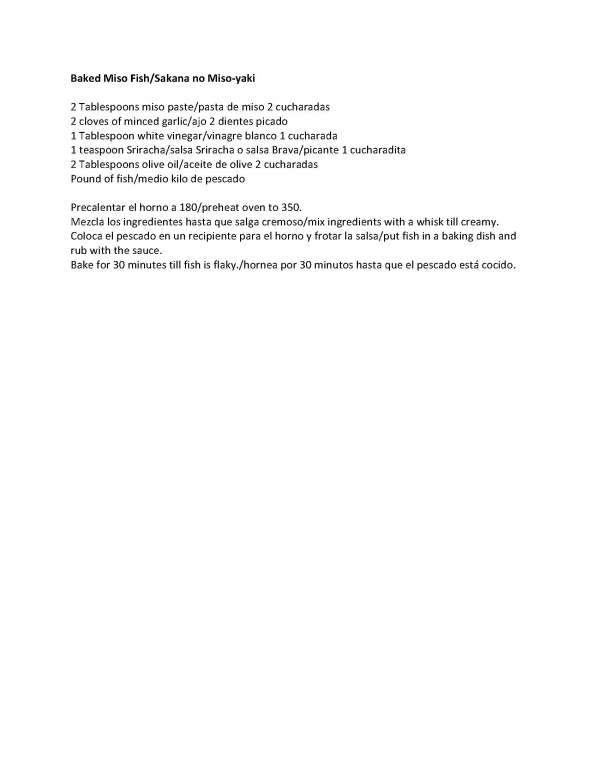
Baked Miso Fish

The Crying Screens

IMG_2984I remember the first time it happened. I walked up to the screen door, and saw the water droplets. I thought maybe Greg had watered the plants outside and splashed the door. Nope. Maybe someone in another apartment had done so, and the water flew on the ocean breeze and caught us? Lord knows it hadn’t rained.
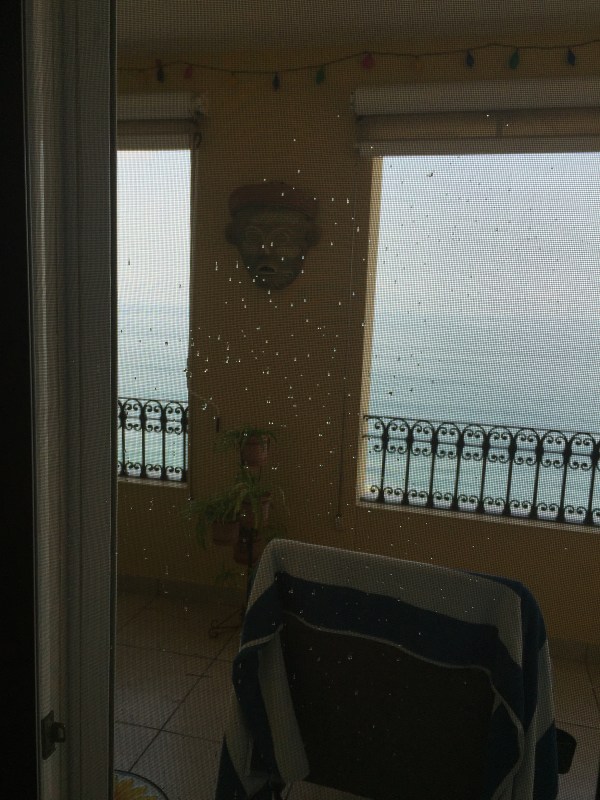

I cleaned the screens, and several hours later there was more water. I looked up to the ceiling. Maybe the water was coming from a leak upstairs? No; the ceiling was clean and dry. Could it be that the ocean breeze coming through the door is to blame?!

Indeed. In Mazatlán we have all sorts of seasons that I never knew when I lived up north or in Japan. And one of them is the “season of the crying screen.” It’s now, that time of year when the heat has begun but the rains haven’t.

Living directly on the ocean, we are blessed with many things, including the fact that in our house we haven’t yet really felt the heat that everyone has started complaining about. If we keep the windows open, the ocean breeze keeps our place pleasantly—at least for another few weeks or more. Of course, it also corrodes every metal object in its path, but that’s another story.

With the windows open, however, and the change of temperature from hot in the daytime to cool at night, the salt air condenses on our screens and forms sticky drops of salt water. They are kind of pretty. They don’t run; they are thick and gel-like. I suppose they are formed by the same type of phenomenon that generates the rain that will soon visit our port.

IMG_2985

Mazatlán vs. Cartagena

images-1

Cartagena de las Indias, Bolívar, Colombia

images

Mazatlán, Sinaloa, México

You know that Mazatlán bills itself as a “colonial city on the beach.” It was never a colonial city in the historical meaning of that term—major European settlement came with the gold rush in the 1800s—but it does have gorgeous architecture and an interesting history, so we’ll give Tourism some leeway.

The other major Latin American “colonial city on the beach” that I know of is Cartagena. I’ve long wondered how it compares to my beloved Mazatlán. A few years ago, when I first traveled to Bogotá for work, I’d hoped to make it to the Caribbean city. Well, it’s taken me till now, but Greg and I made it. So, here’s the down-low on the comparison.

There are so many similarities between these two cities it’s eerie. The people are warm and friendly. Hot water with a steady flow is very difficult to find. There is a malecón/oceanside promenade, lots of great seafood, fishing boats, strolling vendors of every sort, panzones/big bellies, beautiful women, litter, beautiful historic architecture and beaches in both places. Whether in the Pacific coast port or the Caribbean port, you’d better watch where you walk: sidewalks, when they exist, are broken, have sink holes, pot holes and uncovered man holes. Both cities have skyscrapers that house condominiums owned by wealthy foreigners who only live in them some weeks of the year. Both are open-air cities: restaurants, bars, cafes. Both have nearby islands, mangoes, pineapple, coconut.

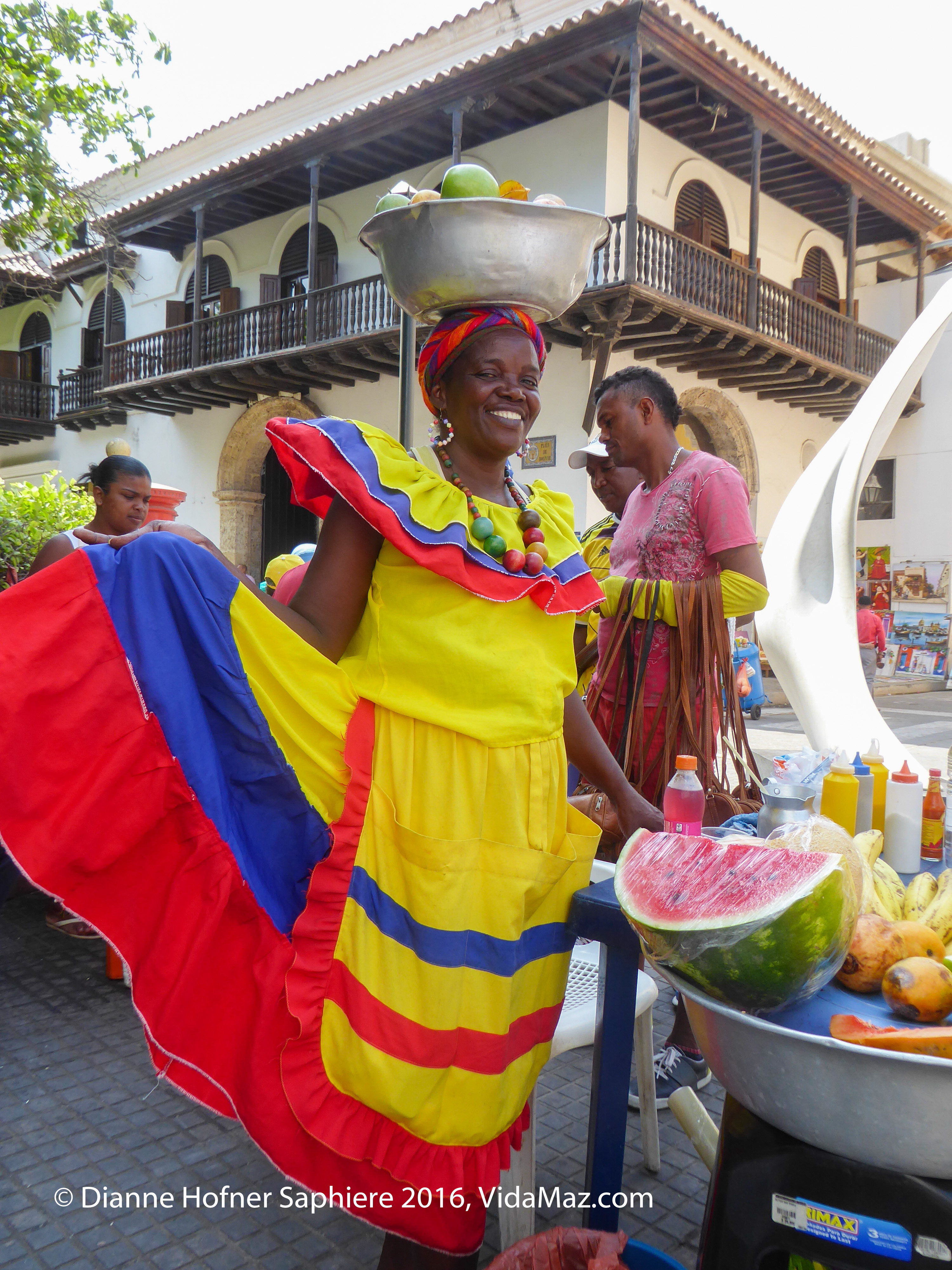
Una palenquera, María, a fruit seller from Palenque, Colombia

Una palenquera, María, a fruit seller from Palenque, Colombia

What are the differences? Cartagena has a decidedly more European (narrow winding streets, the al fresco dining in the plazas, architecture) and Caribbean (Afro-Colombians, colorful dress, music, plantains) feel. The WIND that we’ve experienced here is absolutely unbelievable, and makes dining or drinking seaside an irritating endeavor, in our opinion. Supposedly the wind will stop once the rains come, but we’re told it’s been windy like this since January—that’s four months! Mazatlán has more beggars and vagrants in the tourist zone. Cartagena generally includes a 10% tip on all food and beverage served; by law, consumers can add or reduce on that base. The food is generally not spicy in Cartagena, and we didn’t find any hangouts that were primarily for foreigners; the city seems more integrated. In Cartagena we were told that “gringo” means any foreigner. Mazatlán is noisier, thanks to the pulmonías, ahorigas and wandering street musicians.

And, drum roll please… Mazatlán is overall cleaner than Cartagena! Hard to believe? We are so eager to educate Mazatlecos and visitors to our port about putting litter in its place, about getting people to use permanent water bottles rather than plastic, and to never again serve something on styrofoam. Our son spent five years of his life repeatedly cleaning out Estero del Infiernillo, getting so discouraged at how one week later the locals again had it filled with their garbage. But, honestly, Greg and I have seen more litter here in Cartagena in the past four days than I thought was humanly possible. Having said that, the walled city itself is cleaner and tidier than our Centro Histórico.

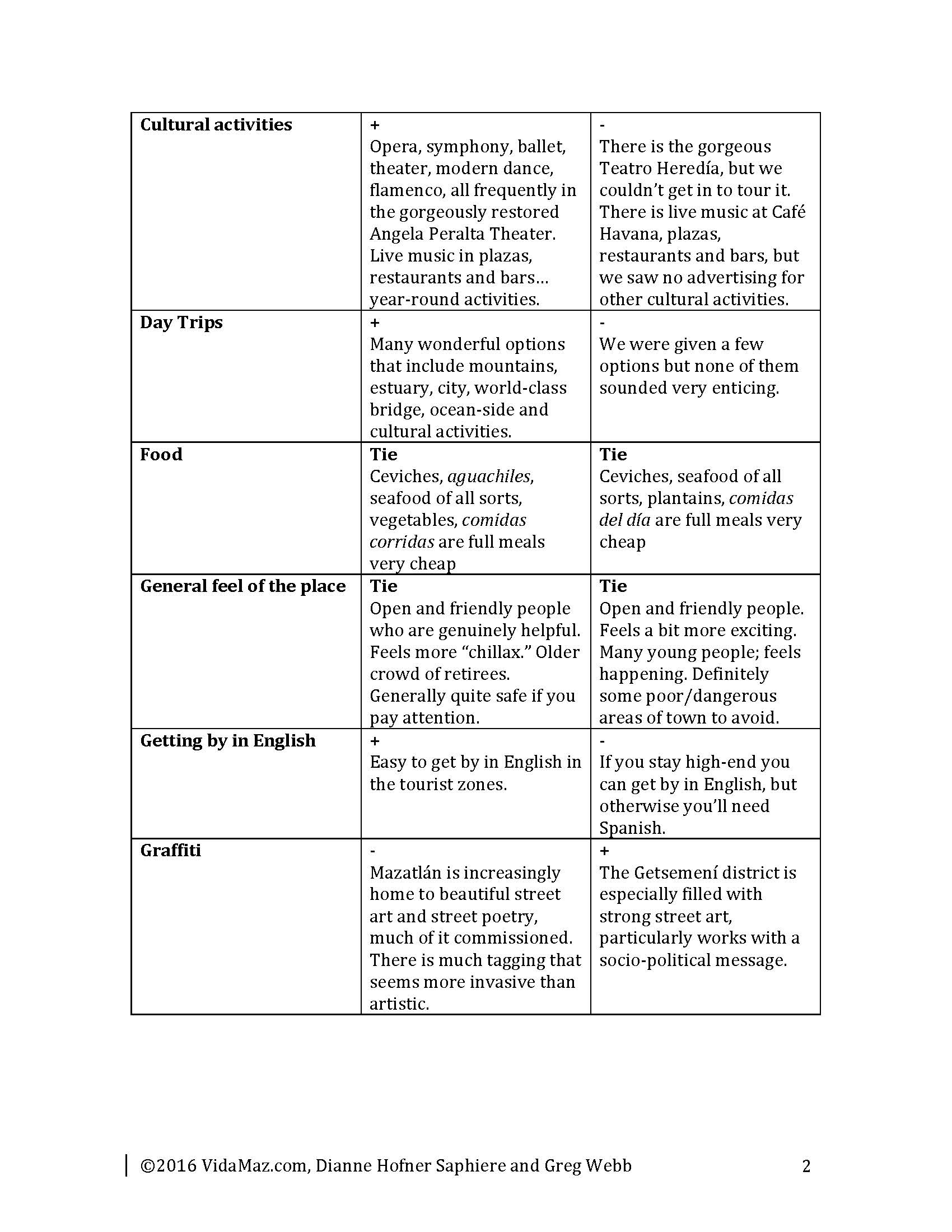
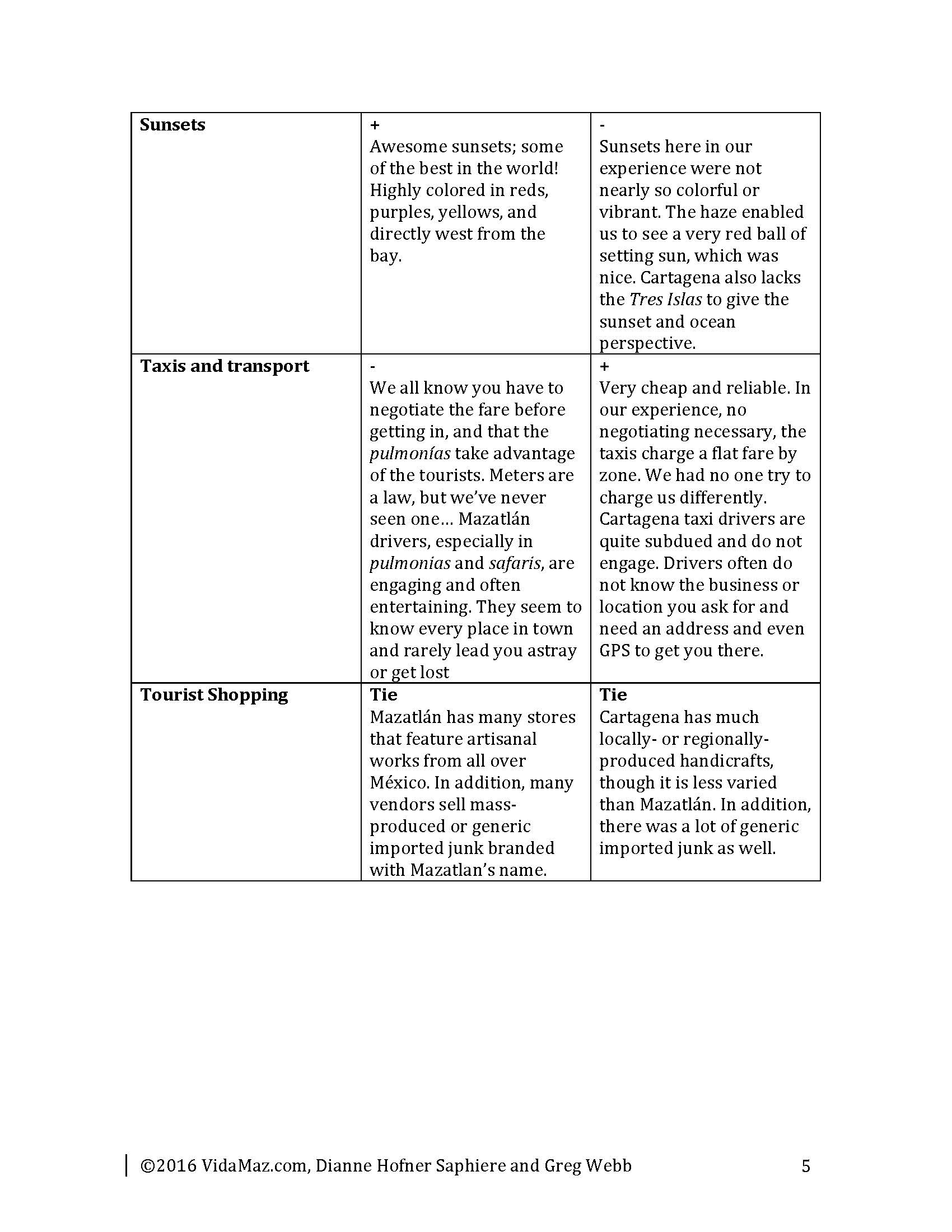
We’ve worked up a table to show you our ratings. Obviously this is completely subjective, and it’s not fair, either. We’ve lived in Mazatlán for eight years and have traveled there for 35; we’ve just spent four days in Cartagena. So, we welcome input from those more experienced with the Colombian city.


Mazatlán vs Cartagena table_Page_1Mazatlán vs Cartagena table_Page_2Mazatlán vs Cartagena table_Page_3.jpg

Mazatlán vs Cartagena table_Page_4Mazatlán vs Cartagena table_Page_5Mazatlán vs Cartagena table_Page_6

Colombianos, you have a gorgeous city in Cartagena, it’s true. And, I urge you to come visit us in Mazatlán! I think you will be surprised! And, municipal governments of Mazatlán and Cartagena, I would urge you to initiate a special task force, so that you can learn from one another! Your situations are incredibly similar, and your strengths and weaknesses are complimentary—lots to learn from one another!