We were very pleased to be invited last night to the second annual taquiza party which takes over the street in front of our friends’ Cathy and Bill’s house. This year we celebrated Cathy’s retirement. They must have had 100 friends show up, all locals. It is so wonderful to see how generous these two are to their friends, and how much their friends here care about them. One of them set up a disco móvil, the neighbors grilled carne asada, and the state police offered to shut down the street to make us more comfortable, so we were well taken care of.
After dinner, we were surprised to see a very familiar face: Marco Antonio Solis. No, not really. But he sure did look like El Buki! He is a friend of the mechanics next door, and he was more than happy to entertain us by singing karaoke to a few El Buki hits.
Above is a video of him singing. Unfortunately the photos and video are taken with a cell phone in the darkness outside, but you’ll get the idea. This is what I love about living here. You think you’re going to a low-key event where you’ll get to dine outside under the stars, spend quality time with some very cool people, and you end up also being entertained by a rock star.
I had to get my photo taken with him; you never know when I’ll have that chance again, lol!
Our third stop on Meseta de Cacaxtla today was Los Llanitos. (Links to blog post 1/Chicayota or blog post 2/Guillermo Prieto) By the time we got there we had already decided we had had a terrific day. And it only got better! What a gorgeous place this was, by far the most economically successful, and the people were so much fun!
What stood out for me right away were the stories of jaguar in the area. I do hope that some day I might get to see one!
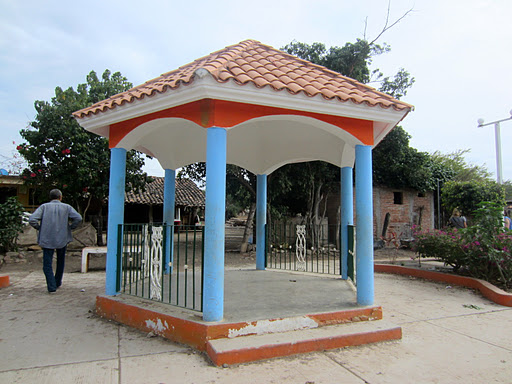
Los Llanitos was so fancy, after our previous two stops, that it even had a little kiosk in the plaza in the center of town! Very charming.
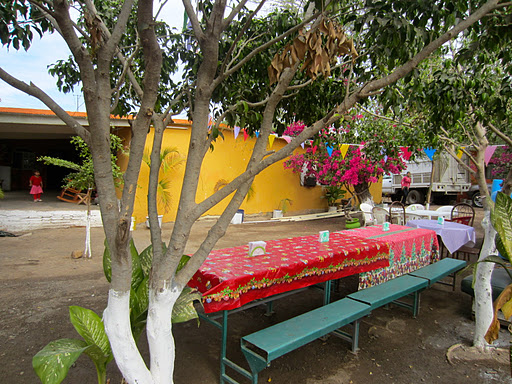
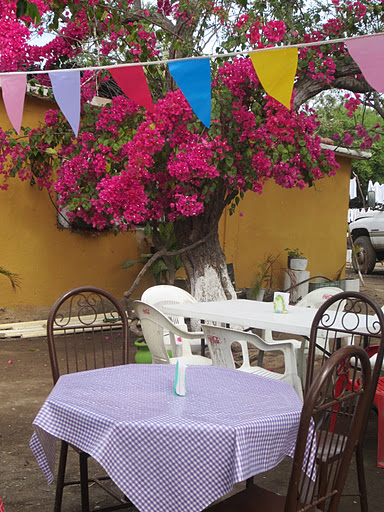
Our hosts were all ready to serve us lunch. I fell in love with the setting. It reminded me of picnicking in a vineyard in Italy, with the bright colors and flowers.
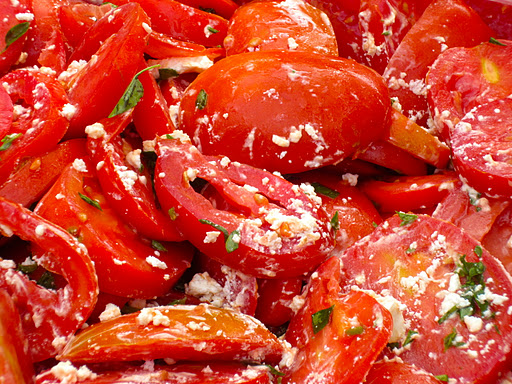
Carlos’ wife had taken some of the organic tomatoes, sliced them, and added goat cheese, fresh-picked basil, olive oil and a bit of low-sodium soy sauce. OMG! We were in HEAVEN!!!!! I think I ate about ten tomatoes they were so good!
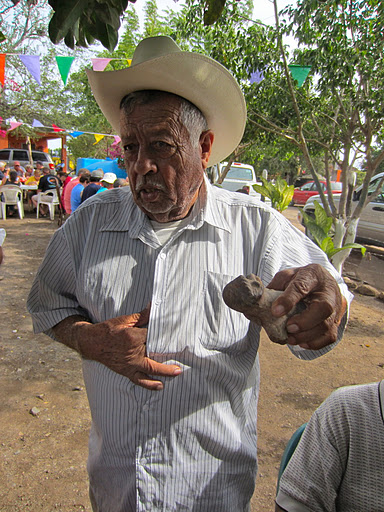
While we were munching, Maximiliano, the grandfather, started regaling us with stories of the pre-Hispanic artifacts he has found while tending his fields in Los Llanitos. The area, according to him, is home to the game of ulama; this town is where it originated, they say. Max brought out a couple of pottery figurines that he passed around to show us.
The figures had clear faces: eyes, nose and mouth, arms and legs. They seemed to be wearing shirts or tunics. They reminded me of the Chinese burial dolls, which I’ve also seen in Japan, as well as among some of the Pueblo Indians of the US Southwest.
Most fascinating to me, however, were what I first thought to be “angel wings” on the back of the dolls. Upon closer scrutiny, they seem to be the hands of other dolls. It would appear these dolls were part of a set or group of dolls, with one doll hugging the next.
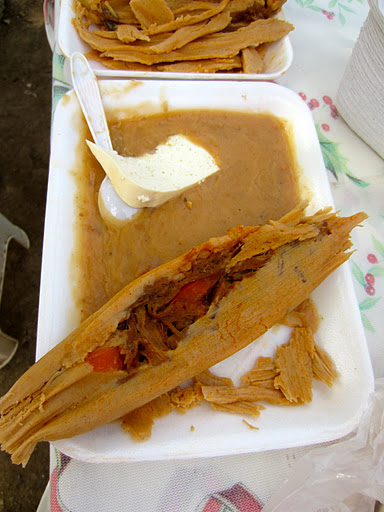
As if after our big breakfast and all the tomatoes we might still be hungry, our hosts in Los Llanitos brought out some of the best tamales I’ve ever had. Organic beef, tomato, chile, and squash, in a thin wrap of corn masa.
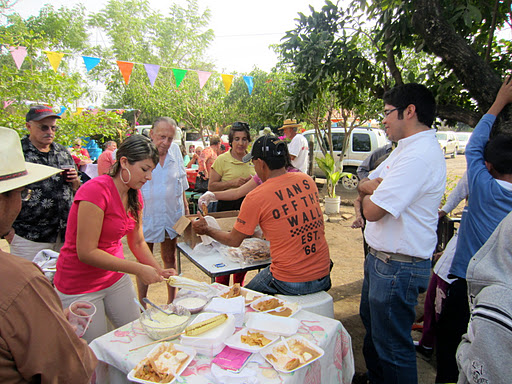
Followed by freshly harvested corn on the cob, which our pretty new friend proceeded to drench in fresh cream, cover with grated cheese, and serve up. Oh my!
But, no! That still wasn’t enough. There were homemade jamoncillos.
And my personal favorite, freshly baked empanadas de calabaza, pumpkin turnovers, made by one of the daughters in the family.
My new friend Consuelo lives in Mazatlán with her daughters. They are all three estilistas, beauticians who do manicures, makeup and hair styling. We hope to see them here again soon. She also has a son who was there for the winter holiday, Marcos. He is graduating soon as a biologist, from university in Ensenada, and will return to Los Llanitos to contribute to the local community.
The kids were really cute, but what really stood out for Greg and I were that the boys were sharpening knives for use in cockfighting or palenque. It seems they often hold cockfights in the backyard. I’ve seen men who love this, and I know families attend. I just didn’t realize that kids from such a young age raise chickens for fighting and get so excited about it.
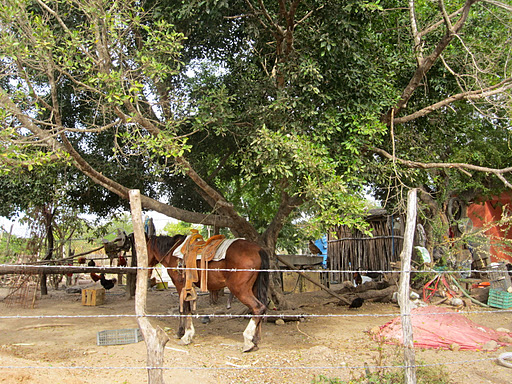
After lunch we walked or drove over to the fields, passing some corrals along the way.
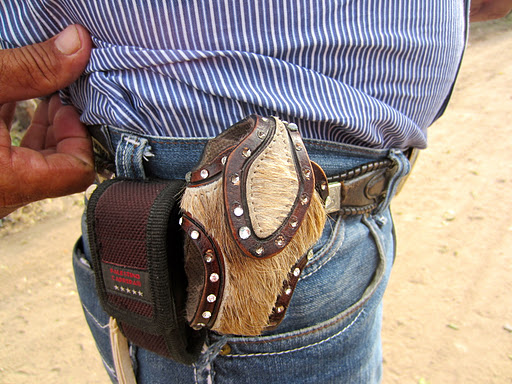
One of Consuelo’s brothers, Gustavo, had a deerskin cell phone holder on his belt.
Gustavo, Greg, and his brother and daughter really hit it off well. They insisted we come back to visit soon, and we have every intention of doing so. This is obviously a very hard-working, wholesome Mazatlán community that we would love to get to know better.
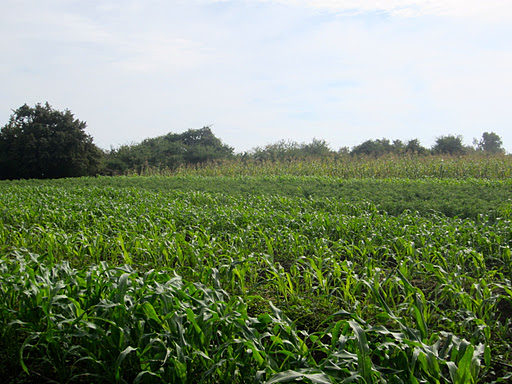
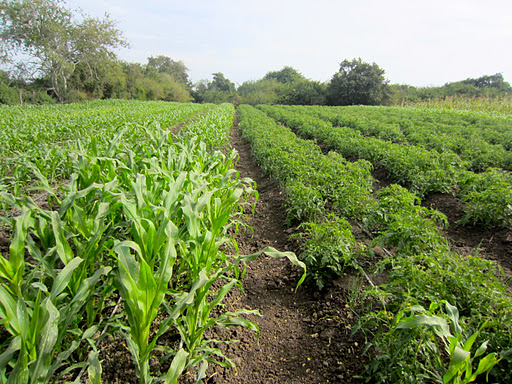
The fields on one side of the road are organic. Gustavo told us the produce is mostly sold to Mexico City or exported abroad. They had many different kinds of vegetables here, scallions and corn. Acres and acres of green.
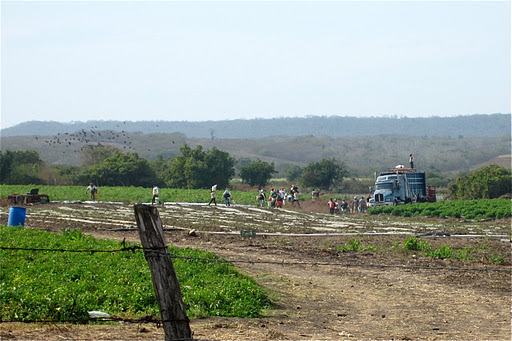
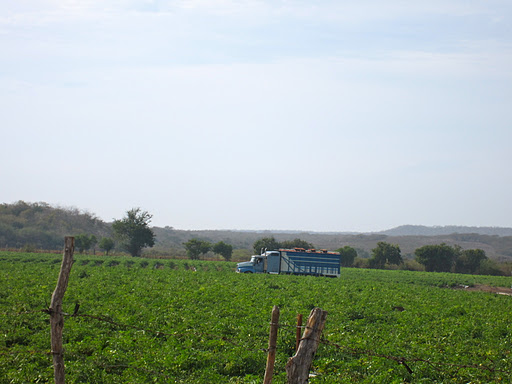
The fields on the other side of the road are “regular,” non-organic. These fields seemed to go on forever. We were there just as the field workers finished loading 16 TONS of tomatoes into a trailer truck, bound for DF.
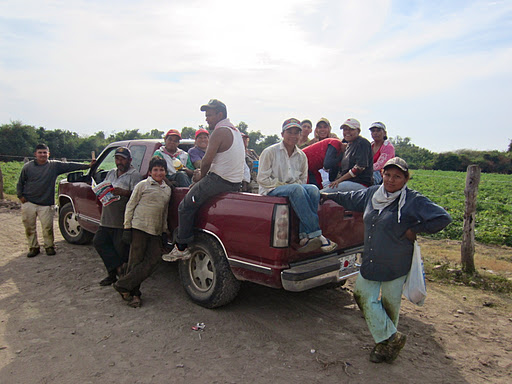
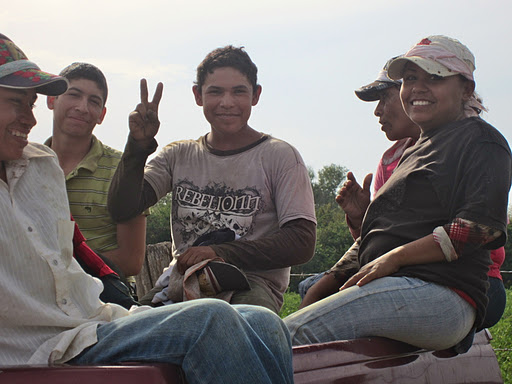
We had to leave earlier than the rest of the group, so we missed visiting the dairy and the “biodigestor” (compost system?). As we drove out, however, a group of field workers asked if I’d take their photo. Here it is, folks.
One young man in particular wishes to send a special hello to all the young ladies on Facebook 😉
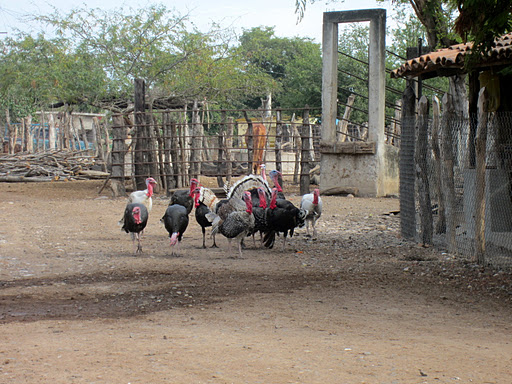
I’ll close with a beautiful shot that Greg took of some turkeys in the yard. It was a long and very wonderful day. Thank you, Martha, Gaby, and everyone else who helped make today happen. We are so happy to know you, and look forward to seeing you again soon and helping in any way we can to support you as you work to develop our area in environmentally respectful and sustainable ways.
Second stop on our tour today was at the organic community orchards and gardens of Comunidad Guillermo Prieto, a couple of kilometers north of La Chicayota on the highway. My oh my do they have beautiful produce! (If you missed it, link to blog post on our first stop, La Chicayota)
Lush, delicious, fresh; all they lack is a market. They sadly told us that much of their first-year bumper crop of scrumptious organic tomatoes went unsold! We of course immediately told them about the new Mazatlán Farmers’ Market/Mercado Orgánico de Mazatlán every Saturday morning in Plaza Zaragoza, Mazatlán. The cooperative’s leader, Sra. Sacramento, promised they would be here this Saturday to start the application process, so that their organic produce might also be sold there on Saturdays.
Sra. Sacramento… a beautiful name, don’t you think? That is her in the photo at left. When I told her she had a beautiful name, she said it’s what she’s been “saddled with” because when she was young her father moved north to tend fields in Sacramento, CA.
To Sacramento’s left, in the red shirt in the photo, is Carlos Carballo, an engineer, teacher of organic farming, holistic cattle raising, and ….
Hydroponics. These farms are located in an area of town that is sort of “off the grid.” The only source of water, other than private delivery by truck, is to have it piped in from Dimas, miles away. The water from Dimas is turned on once a day for two hours. To work around this shortage of water and be able to reuse some the precious water they do have, the community has turned to hydroponics.
Another difficulty facing the organic farms of Comunidad Guillermo Prieto is that they don’t have a steady market for their product. Traditional planting aggravates this market problem because crops ripen at the same time and need to be harvested quickly. Hydroponics, as we were told, allow the plants to root indoors in a greenhouse, protected from the sun, and provide the farmer a bit more leeway with when to put the plants in soil. In this way, the cooperative farmers can choose when to transplant a hydroponically rooted strawberry or lettuce plant, and extend the harvest!
Comunidad Guillermo Prieto uses two kinds of hydroponic systems. The first, as you see above and at left, is a tube system. The engineering uses readily available items (see the rebar holding the piping on the wood support).
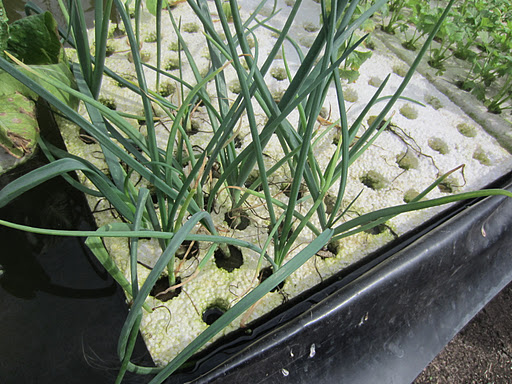
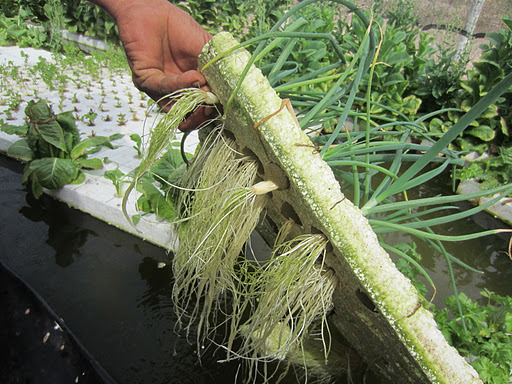
The second hydroponic system we saw here were floating gardens — plants rooting into the water through holes in styrofoam! It was really cool. Four times a day for 15 minutes each time, pumps are turned on to circulate and refresh the water.
We saw lots of kinds of lettuce, cilantro, and scallions growing in these floating gardens.
And here in the photo you can see how well the roots respond to the floating garden concept.
Because the community here doesn’t yet have sufficient greenhouse space or netting, they are unable to vine-ripen their organic tomatoes. If they allow the tomatoes to ripen on the vine, the birds eat their crop. Thus, they harvest them while still green, and allow the tomatoes to ripen inside the netted greenhouse, safely out of the way of the hungry birds.
We saw a lot of different crops here, including peppers, camote(sweet potato), cherry tomatoes, and citrus fruits.
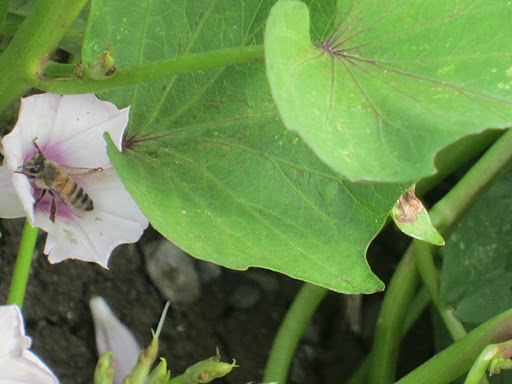
A bumblebee inside a camoteflower.
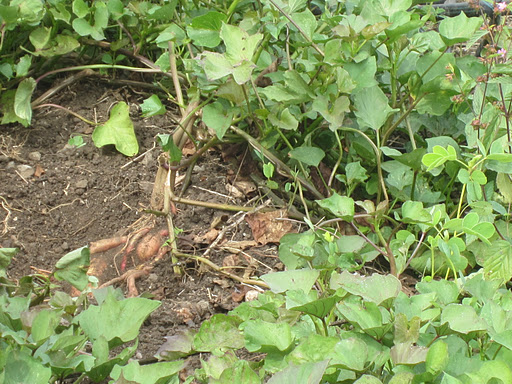
And some camote, peeking up through the soil.
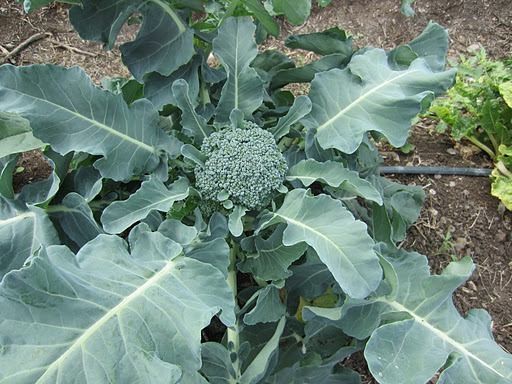
A nice healthy broccoli plant…
Many thanks to our hosts. We weren’t able to spend a lot of time here. I would have loved to have toured the orchards and some of the other fields. As we left I was gifted with a huge bunch of basil and three gorgeously sweet grapefruit. I will be back, to buy some plants and produce, and to visit the terrific people we met. Thank you all!
(Link to third and final blog post from today’s journey, Los Llanitos)
UPDATE:
I am really happy to report that yesterday, Jan. 28, Sacramento and her crew were at the Mercado Orgánico Mazatlán. Conanp had submitted all their paperwork, and will be buying them a tent to aid their display. Hooray! So very happy that this trip and this post had a positive outcome in that way. Sacramento was psyched because they quickly sold out of greens and were well on their way to selling out of other vegetables as well. So glad also that MOM/Mazatlán Farmers Market and Conanp are also now in touch.
Today we had the very good fortune to meet some awesome people doing wonderful work to promote economic development, environmental sustainability, and ecotourism in La Meseta de Cacaxtla preserve.
We accompanied Gaby from CONANP (Federal Department of Natural Protected Areas) and Martha Armenta from CONREHABIT (Conservación y Rehabilitación de Fauna Silvestre) on a tour of several villages in this protected area: La Chicayota, Comunidad de Guillermo Prieto, and Los Llanitos. CONANP invested 1.5 million pesos last year (2011), with more requested for this year (2012). 100% of this money goes towards projects in the 50,000 hectare La Meseta de Cacaxtla preserve.
While the Meseta de Cacaxtla was named an ecologically and archeologically protected area in 2000—it is home to 26 species of amphibians, 59 species of reptiles, 79 species of mammals, and 340 kinds of birds, as well as to numerous pre-historic sites including Las Labradas—that status has had little meaning. No efforts were made to stop the hunting and poaching of protected animals, nor the looting of archeological sites, and the local communities continued, as they had for generations, to be generally poor and lacking in resources and infrastructure. Five years ago, however, CONANP began investing in the Meseta: ecotourism projects in Barras de Piaxtla, La Chicayota, and El Pozole, and productivity projects in Guillermo Prieto, Coyotitán, Los Llanitos, Toyua, and Mármol.
This first post will be about our first stop, La Chicayota. We have driven through this small town many times on our way to take visitors to Las Labradas, and once I know we stopped there hoping for some refreshment. CONANP federal funding is supporting quite a few plans for La Chicayota because it is the gateway to Las Labradas Petroglyphs, a UNESCO World Heritage Site. To reach it, you exit at Km. 51 on the maxipista just north of Mazatlán.
The first order of business should definitely be road improvements, as it’s long been our complaint that entrance to this gorgeous area is quite the bouncy, dusty, pot-holed endeavor! While we didn’t hear about any CONANP plans in this regard, we are still hoping federal or state tourism authorities or others are budgeting for this much-needed improvement.
The town is named after this tree, la chicayota. My dictionary tells me it is the same name in English, but I am not familiar with it.
The main street in town shows you how (un)developed La Chicayota is. The residents keep the area very well-tended, with many flowering trees and other plantings.
The community consists of 12-20 families. With CONANP funding they have built a community kitchen. It is a beautiful building using local materials, building techniques (sort of woven limbs) and builders.
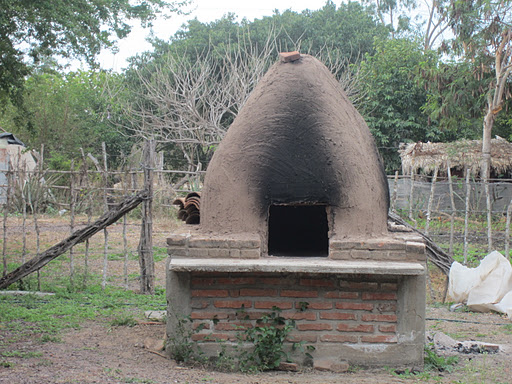
Outside the community kitchen is a large earthen oven for cooking breads.
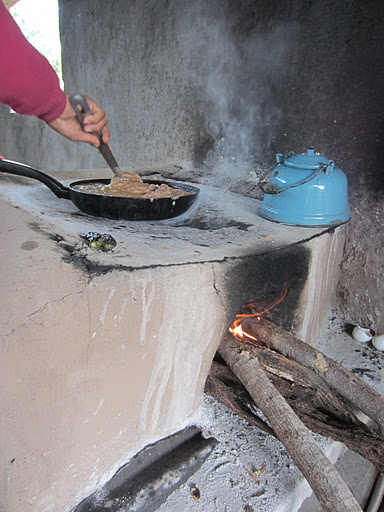
Inside the community kitchen is a wonderful wood-fired comal, great for cooking tortillas or almost anything else (cooking refried beans, below). You can tell from this cook’s smile how friendly people were and how welcome they made us feel. They are so eager to learn how to cook, give tours of their local area, and in other ways help national and international visitors to the area.
The indoor wood-fired comal smartly vents to the outdoors, and I was fascinated with how beautiful the smoke looked against the woven wood, the cactus, and the roof tiles.
Beside the indoor kitchen is a very large community meeting space or party place.
In addition to the community kitchen, there is a smaller “guest” kitchen, with another wood-fired stove and sets of dishes. Behind these two kitchens and the meeting space are public restrooms. Right now they flush by dumping a bucket of water into the basin, but there are plans to install a septic system or dry toilets.
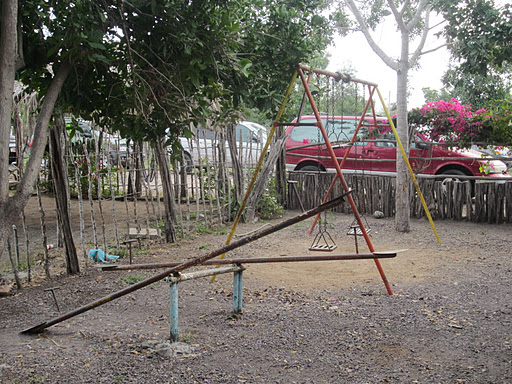
The community center area also has a nice playground for the kids: teeter totter, swings…
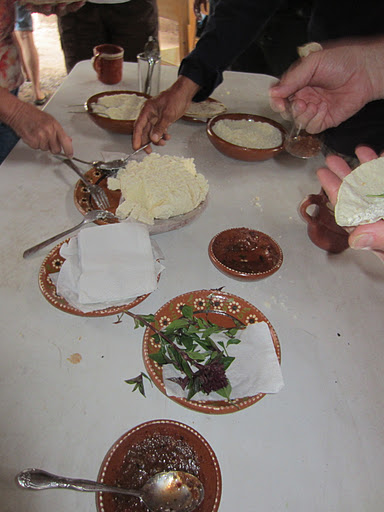
For breakfast this morning the ladies kindly served us freshly made tortillas de maiz with queso fresco (de vaca), fresh-picked basil, freshly made salsa and refried beans. They ROCKED! There is nothing like a tortilla cooked on a wood-fired comal with fresh cheese!
One of the terrific women I met here is named Nereida. She told me that the quesos or cheeses are made in a nearby town. Some are made from goat’s milk, other’s from cow’s milk, and that they are made in several different styles. She gave me her cell phone number and invited me to call her anytime, as she’d be happy to take us on a queso-making tour. I can’t wait!
Almost just as wonderful as the fresh tortillas con queso were the panes de mujer, served fresh from the oven and dripping with brown sugar glaze.
I noticed that these wonderful breads arrived from the house next door, so of course I wandered over there. In a spotlessly clean outdoor kitchen I met Silvia, mixing up some more bread dough.
She didn’t measure anything–just eyeballed and dumped all the ingredients into a bowl, mixed with warm water, and set to baking more wood-fired-oven-baked panes de mujer. OMG they were good!
Above is a video of Silvia removing the breads from her wood-fired oven or hornillo. At the end of the clip you will also see José, one of the project’s leaders.
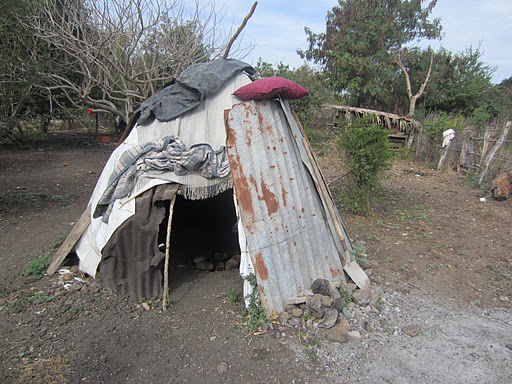
To be honest, what really brought me over to the neighbor’s house was noticing this: a temazcalor sweat lodge. Silvia told me all about how to fire it up and make it work. She said her grandchildren and her get in it every other night, and that it’s terrific for fighting colds and maintaining good health. She said after sitting in the temazcal for a while, you feel that every impurity has been cleansed from your soul. Then, she also gave me a cell number, and said to call her anytime I wanted to take a sweat. You bet I will!
This is a fish-eye view of the inside of the temazcal. You can see that Silvia and her family made it with recycled materials. No Home Depot purchases for them!
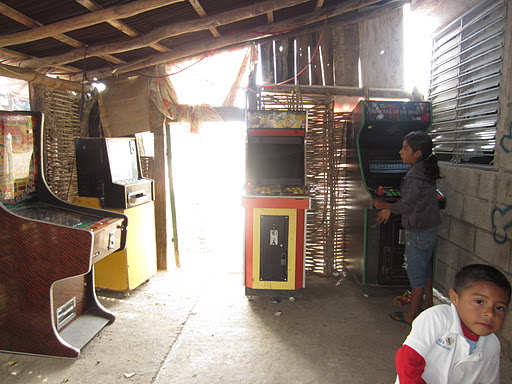
Next to Silvia’s kitchen and temazcal, on her front porch, is La Chicayota’s video arcade. The kids seem to love it.
In Chicayota you can eat, take a boat tour, go fishing, mountain biking, or horseback riding. The best way to visit, at this point in time and if you are not very comfortable with Spanish or rural Mexican travel, could be to get on one of CONANP’s tours.
Let me close this post with a video of Gaby telling us a bit of history about the Chicayota project. Martha is translating. Behind them, against the wall you can see José (far left) and Nereida (far right with glasses). To see the second post in this series, about our stop at Comunidad Guillermo Prieto’s community orchards, click here.
I ride my bike a lot in Mazatlan. It is a great town for bike riding, at least as far as I’m concerned. Some people are put off by the traffic (pedestrian and vehicular), but I think it adds to the excitement and challenge.
Most people do what I used to do and go up and down the malecon (or boardwalk) along the ocean. It is relatively flat, very scenic and overall very safe. However, it is not very challenging and if you are trying to get in some good cardio or burn a few extra calories, you either tow a bag of bricks behind you or seek a tougher ride.
I started seeking tougher rides nearly two years ago. I started going north to the far end of town, but that involved too much street time and too many crazy drivers. It was all flat other than the two bridges that are more of a workout due to the speeding traffic then the incline or distance. I also have experimented with riding downtown and do still enjoy it from time to time. It is best to go really early and realize that for a great workout, you will be going up and down the same small hills over and over.
Mazatlan has two big hills – both in the southern part of town, called Olas Altas. Mazatlan also has the second tallest natural lighthouse in the world. So, about six months ago, I decided to combine the challenge of an up and over a good sized hill with a climb to the top of the lighthouse for a good cardio workout.
If you do not know Mazatlan, you can’t imagine what a wonderful ride this is. So today I packed along my camera and took a few pictures in an attempt to show at least some of what I like about this ride. As for the hill, well, I admit it doesn’t look like much in these pictures, but it is a moderate challenge for me and of course is getting easier the more times I go. Try it and see.
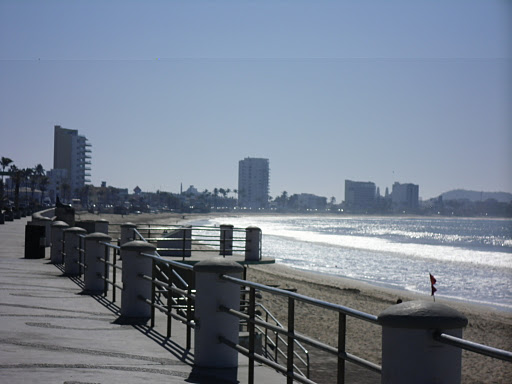
Here is the malecon looking south from in front of our house:
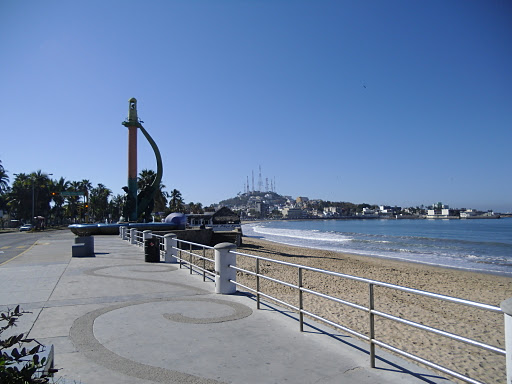
Here you can see the curve of the bay and how flat most of the malecon is:
The curve and flatness continue as we go past the Fisherman’s Monument:
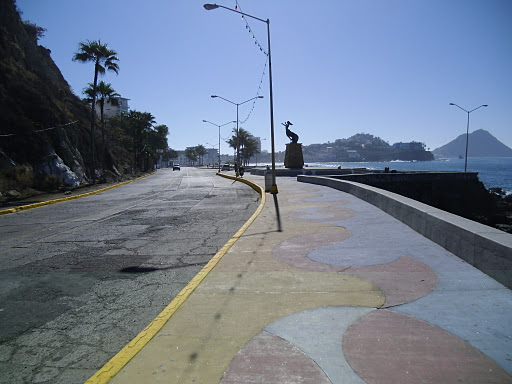
Once we get past the fishing boats, there is a small incline, but not much of a challenge:
Are you digging the view as much as I am? Can you see why so many people choose to just stay on the malecon? At this point we are directly across from where we live and have gone around the bay. Our building is circled:
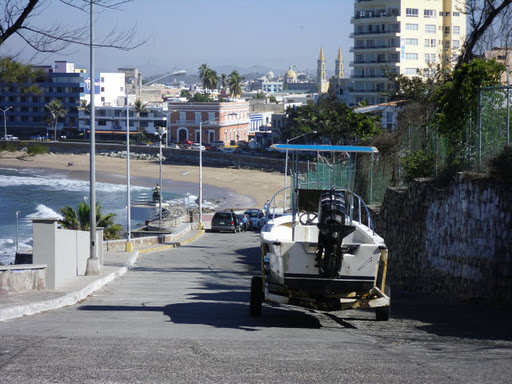
Now, there is another incline in the road to make for a little challenge:
After we round the corner and go past some vendors and the huge flagpole, we begin to see the hill to the right of the statue in the picture below and the lighthouse on the far right:
As we get a little closer, we can zoom in on the first part of the hill that we will need to climb. Today, Sunday, is the easiest day. During the week the school (blue and white building) at the elbow in the road is very busy. The turn is extremely tight and there are cars and kids everywhere. The hill is essentially three little hills in one. We will go straight up towards the school, turn left away from the ocean and then turn right and rise up above and behind the school, before eventually turning right and enjoying the downhill ride to the road to the lighthouse.
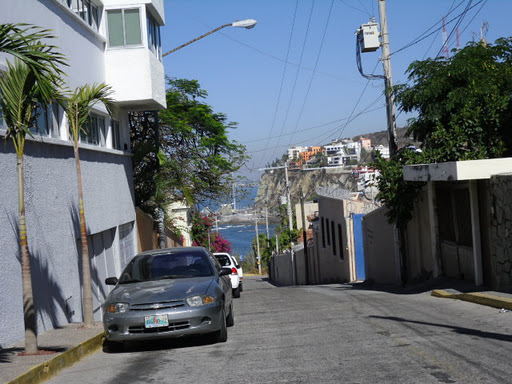
Here we are ascending the hill towards the school and a shot looking back from the school:
Next we turn left and parallel the school (hill 2):
From the next corner we pause to look behind us:
And in front of us (hill 3):
It’s at this time that my heart is usually working the hardest. With an allowed maximum heart rate of 170, I am happy to see that I have not overdone myself today:
If you look closely, you can see that we have only been at this for 28 minutes. It’s taking longer to type this than to ride it!
Looking back down hill 3:
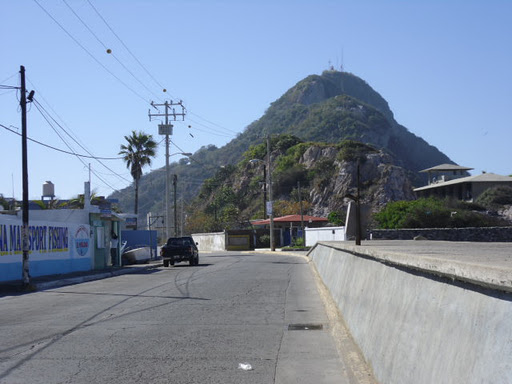
And ahead to the downhill ride the awaiting lighthouse:
The approaching lighthouse and a look back at the fun downhill ride we just had:
The road to the lighthouse – water on both sides. The lighthouse used to be an island, but a road was built over the rocks to accommodate traffic.
We have written about the lighthouse. You can read that entry here. Some people actually ride their bike up the switch back dirt path and then carry the bike up the stairs (or turn around). What I like to do is tie up my bike at the bottom. Fast walk up the path and 300+ steps, spend two minutes at the top, hurry down the stairs and then run down the path and jump back on my bike. It keeps my heart pounding and takes about 30 minutes depending on how many people I have to get around on the stairs. It is a great workout. My final picture is my bike tied up to a telephone pole waiting for me as I complete my trek down the hill. To get home, I go back the way I came. Total time is usually around 90 minutes, give or take as the wind and stopping to talk to friends often makes a difference.
A note about the picture. If you look to the right, you see three people sitting in the middle of the roundabout–one with a guitar. These three guys were sitting there when I got there and when I left just playing music and singing old Mexican ballads (quite well too). Just one of those little treats here in Mazatlan that helps me remember why we moved here.
If you ride a bike here, please be safe. It takes a little getting used to. Most of all be careful and have fun. Enjoy your ride!




































 ¡VidaMaz!

