Moving to Mexico (Mazatlán) with School Kids

We have had several inquiries recently from parents who want to move to Mazatlán with their children. More and more Mazatleco-born parents seem to want to return here with their US-born-or-raised children, as well as Canadians and US American parents. So, I am reposting the below. Of particular importance to SEP (Mexican Education Ministry) is the apostille, and it takes the most effort on your part BEFORE you leave the USA or Canada, so be sure to get it before heading out, everyone!

Dianne Hofner Saphiere's avatar¡VidaMaz!

The goal of this blog post is to explain some of the things we have learned while parenting a school-aged child in Mexico (or at least in Mazatlán, Sinaloa), and some of the contrasts with the US system of education. Much of the information below comes from the questions we are most frequently asked by those who are thinking about or planning to relocate.

Obviously the below is based on our experience as a family; many will have different opinions and experiences. It is worthwhile noting that people moving to Mexico City, Monterey or Guadalajara will have many more choices than we have here in the “provinces,” as they say in Spanish.

I hope some of this might help you as you think about relocating. I only wish this sort of information had been available to us when we moved!

Choosing a School
Make the decision around choice of school…

View original post 4,192 more words

Lucha Libre: Despedida de El Angel

10370350_10203687017113077_2614208064520861891_n

Last night was a huge milestone in the life of a dear friend of ours, and also a major event in the sports history of Mazatlán. El Angel, the first world champion in Lucha Libre from Mazatlán, retired from the ring after a 30 year career. Some of you may know Tony Acuña, who owns a stand in the Pino Suarez Market, and previously owned several shops in the Golden Zone as well. We felt very privileged—and had oh-so-much-fun—helping him celebrate!

We invited a bunch of friends to this historic event—about 50 bought tickets to join us. I had been to Lucha Libre once before, in the bull ring, and don’t remember enjoying it very much. But last night ROCKED! I’d made signs supporting Angel, bought a bunch of noise makers, we all wore black shirts, and many of us bought masks as well. OH MY GOSH! Was it fun!

Yes, lucha libre is like a dance—one fighter follows the other’s lead, and there are some basic moves fighters must master plus variations and frills added on. It is absolutely full of joy, whether the luchadores are back-flipping off the ropes or hitting each other over the head with chairs. These men are up there to entertain. The luchadores are skilled athletes, many of them gymnasts. They love the kids, they take time to play with and take pics with the audience. They were even game to pose with us middle-aged sexy women 😉

Last night El Angel was joined by the very famous Blue Panther and the Mascarita Sagrada, who flew into town for this event. The Kempo Dragon, a young local lad with abs of steel and contact lenses that made his eyes look very spooky, was another hit with our group. We saw dozens of luchadores fight last night. It was a wonderful, action-packed, 3 1/2 hour event.

Most of the lucha teams last night—there were six or seven fights total—were composed of four members each. There is a técnicos team—the good guys, and the rudos team—the nasty guys. Booing the nasty guys is sooooo much fun! They came over and grabbed some of the signs I’d made, right out of my friends’ hands, and ripped them to shreds. My girlfriends scolded them and enjoyed themselves to pieces yelling at and then posing with them.

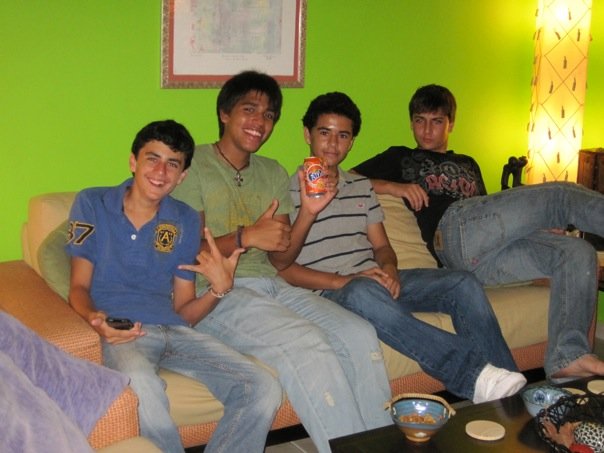
Our son had several young adult friends with him, and I haven’t seen them so happy since Carnavál.

If you are like me, and you haven’t really been to Lucha Libre, because you weren’t expecting to like it much, I’d recommend you reconsider. Going in a large group, revving everyone up for the event, and having some noisemakers, t-shirts, and signs to make sure the event is fully enjoyed, will really help.

Beer is sold in the Cancha German Evers, and usually you can get ceviche or salchichas or some other snacks as well. Masks are sold, as well as some other toys for the kids, and a guy walks around selling peanuts and chips. Highly recommended.

10306773_10204278646310736_8016062870084480031_n

La Cancha German Evers/German Evers Gymnasium is way up at the beginning of Zaragoza. It is across the street from the girl’s orphanage. Remember that Zaragoza is a one-way street. Both boxing and lucha libre are held here. Taxis and pulmonías wait out front to take people home after the events.

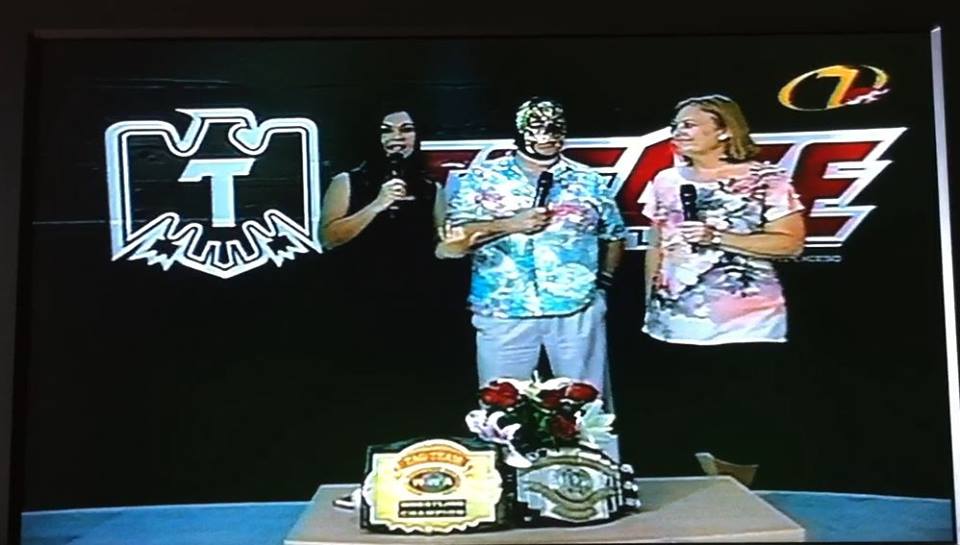
People ask me how they can know when there is a lucha libre or a boxing match. The sports section of the newspaper is the easiest bet. These events are also announced on radio and television sports programs (shot of me below on TV with El Angel), and on posters all over town. Keep your eyes and ears open!

10418402_10204265167493774_8876339337473679203_n

Tony, congratulations on an outstanding career! Thank you for doing so much to promote the sport in Mazatlán and throughout the Americas! We are proud to call you friend. And everyone who joined us, thank you for coming and for making this night so very special for Tony! PS, the mask-maker was VERY psyched to sell so much last night, and hopefully he’ll now be able to get his hip surgery done!


“Minority Boy” Nears High School Graduation

8127_1241984606865_6876975_n

My oh my oh my! Time most definitely does fly. This morning, as I was sitting in the Rigodanza Auditorium at ICO, looking out on the nearly 300-strong “Generación 59” graduating class, I just kept seeing them as youngsters! What a journey this has been.

Six years ago, after our son Danny graduated primary school, we moved here to Mazatlán, Sinaloa, México, where he would start junior high. He didn’t speak Spanish, though he’d worked with a tutor twice a week for a year. So many people told us how crazy we were.

  • “Why in the world would you leave a Blue Ribbon School of Excellence for a Mexican school?”
  • “How dare you neglect your kid in this way! It is irresponsible parenting to move with a child to such a dangerous place.”
  • “We are from here. If we had any way to educate our kids anywhere else, we would. I can’t believe you’ve purposefully brought your son to Mazatlán.”

Well, we did purposefully bring our kid here. We wanted him to grow up as a member of a minority, to know how that feels—to build empathy, and to develop skills for living as a minority—a skill any global nomad needs, a valuable life skill, and one he may very well be needing soon as a “white boy” in his birth country (USA). So we had a passion and commitment in our choice to move here. But, really, with so many people, locals and foreigners, scolding us with such abandon for the past six years, what parent wouldn’t second-guess herself?

The past six years have not always been easy. Watch what you wish for! As a minority, Danny was (inadvertently) excluded from so many important communications about school, social gatherings, and sports practices. It was hard not to feel left out. He is a good actor, and was given one of the starring roles in a school play—unfortunately it was that of the ugly American boss who treats immigrants poorly and is only out for money. Really? Give me a break!

76854_1718784006552_4051817_n

The first six months of our stay here were painful. As the person in our household with the best Spanish, it fell on me to tutor our son every night. Remember that in the eyes of a 13 year old boy, Moms know NOTHING. It was so frustrating, such a test of my patience, which is way too thin. Then, one night about six months into our lives here, he went to bed, and the next morning he understood Spanish. It was like a light switch flipped on. He didn’t understand everything, he didn’t speak or write perfectly, but I no longer needed to help him understand what his homework was.

The past few weeks this same young man, 18 now, has been interviewing local business and community leaders about our city’s future, what skills they feel our city needs, and how he might craft his studies and internships during university so that he can come back to Mazatlán and obtain a worthwhile position here. He loves this city as much as we do. He’s Mazatleco now; there is very often a culture gap between his immigrant parents and the Mexican, Blended Culture young man he’s become. Those interviewees are all telling him that his complete fluency in English and Spanish, his fluency with both cultures, is a huge asset that he must not lose when he goes to the US for school. He must find a way to retain and amplify it, ideally by adding Chinese language and culture. Wow.

1656079_10203356052326463_415408752_n

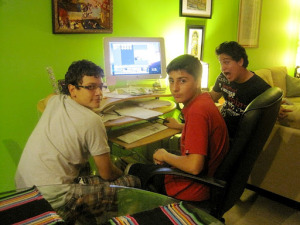
He’s definitely not the same little boy who celebrated his 13th birthday at our pool with his brand-new school friends here, and was shocked as all get out when they gleefully shoved his face into the cake! What a surprise that was for him, especially when they all laughed. But he is much more flexible than his mother, and he took it all in stride, laughing and vamping for the crowd with frosting covering his face.

230295_1066751786154_5237_n

To those naysayers, who told us our son would not get a good education here, I am very relieved to have your prognostications proven wrong. Danny received an award from a Mexican university, and has fielded quite a few recruiting calls from other schools in Mexico. He also received six scholarships, several over US$80k, to well-respected US universities. He’s chosen a terrific small liberal arts college with an international focus, located in an ethnically rich metro area. I believe his incredible scholarship success is due, in major part, to the fact that he’s grown up abroad, and that he is able to demonstrate his biculturality and cultural bridging abilities. And the SAT scores show that, indeed, he received a very strong education here at local Mazatlán schools, both in junior high at Andes and in high school at ICO. He sure had a high school curriculum that put mine to shame—law, ecology, philosophy, ethics. My most heartfelt THANK YOUs to all his teachers—elementary, secondary and high school. Bless you for your patience and talent!

10152011_10203325681839921_3652998631530014311_n

Today I had the huge privilege of speaking to Danny’s graduating class. I was part of a panel of six parents, given the opportunity to share with the kids what life has taught us. What an incredible gift for a gringa Mom to feel included in this way! To me it is a testament to the open-mindedness of the Xaverian education at ICO. Our panel included business owners and housewives, parents who graduated from name universities and those who attended technical school, locals as well as those from outside Mazatlán. I loved sitting up front, looking out and seeing the young men and women who have frequented our pool, our home, our beach, my son’s life. I felt distracted as I spoke, so hoping that those kids who are staying in town to study will stay in touch with us, despite the fact that Danny is leaving. Several of them feel like my own children, and I kept getting teary eyed.

For those of you who have followed our family on this journey, thank you for your companionship. I am very happy to report that, so far, the experiment has been a success. As Danny, who did not want to move to Mazatlán in 2008, said to us on our first anniversary here, “One year since the best decision we ever made!”

The next journey will be reentry: learning how to live happily, productively, and multiculturally, in the US of A. And, of course, learning how to do those same things in college!

Linked to the My Global Life Link-Up at SmallPlanetStudio.com

Don’t Fall Prey to Scams!

extorcion

Scams are everywhere. From Canada to Chile, Russia to Italy, and China to Australia, you can bet con artists are eager to play with our ignorance (or innocence) and part us from our money.

North of the border we read so much advice about how to prevent online fraud, identity theft, or telephone scams. We know the criminals especially target retirees. Then we move to Mexico. The scams here are different. It’s a different place, a different culture. We need to learn the ropes, educate ourselves on how to avoid falling prey to a con. We may not know the language, or we may struggle with it, as well as with the customs and “fitting in.” Such factors can cause us doubt, feelings of powerlessness and thus, make us more prone to getting duped.

Con artists know human nature; they play on our hopes, fears and beliefs. And what’s one of the biggest stereotypical beliefs about Mexico these days? How violent it is—the preponderance of kidnappings and extortions. Most stereotypes are grounded in truth, but they become so generalized, applied so broadly, and become so firmly fixed in our psyches, that they become false “truths,” boxes into which we habitually throw people, without using our minds or our other senses as filters. The smallest glimmer of the stereotype in the back of our minds provides a direct beeline to our fear response. And that is just what the criminal wants, whether we’re a local or an immigrant.

Do you know the most common scam here in Mexico? It is a phone scam, 80% of which take place in private homes. Someone, most likely from a jail, calls our home. They either say they are our long-lost cousin or compadre who needs help, or they tell us they have our spouse or children held hostage. This latter is enough to get most anyone upset and, when we’re upset, we too often fail to act rationally. Remember that such phone scams are probably no worse than a scam north of the border but, because they play to our fears for our family, it can put us off balance. Think things through now, so that you are prepared if this happens to you.

Here is a summary of the advice I’ve most often read in the local press, about how to respond to a criminal call:

  1. First, think! Do we know the person on the line personally? Is this the person’s voice? Be assertive. Ask questions. Use common sense and intuition; if something doesn’t seem right, it’s probably not. Especially if the person is asking us to leave where we are, go outside, go into a hotel or certain store—don’t do it!
  2. Second, hang up. That is the advice we most often read in the local newspapers. If someone calls us and we don’t know who they are, especially if they are asking us questions or threatening us in any way, hang up. More often than not they will call back. Don’t pick up. We may worry about not understanding the Spanish, about offending someone by hanging up. But, if it doesn’t feel right, we are wise to trust our instincts.
  3. Never, ever, give out any personal information! This is true north and south of the border. If someone tells you they have your spouse or your children, or they are your long-lost cousin, don’t give them a name! Don’t tell them where you live. Don’t give them any information. Play the scenario through in your head, several times, so that the response will come more naturally should such a scam call ever come in. It’s a call we’re not prepared for. It plays to our deepest fears, and our deepest stereotypes. Don’t let it claim you.
  4. If you find yourself unable to hang up, press those on the phone for information. Plan this ahead of time, so you can think clearly in a crisis. Ask them what your spouse is wearing, or on which side of his head your (bald) spouse parts his hair. Hopefully hearing a wrong answer will then give us the courage to hang up the phone.
  5. Once you hang up, contact your spouse, children or cousin to verify that they are ok. You will feel better. Remind yourself that the caller was likely contacting you from outside Mazatlán. The most common calls here in town come from prison—and prisons even as far away as Tijuana! Most often, they just want spending money or time on their phones. But we’ve had friends, local and expat, who’ve given away much more than that. The caller is most likely not watching you or your family members. They are talking about kidnapping because they know it will more likely scare the money out of you.
  6. Call the police. That number is 066. Federal crime prevention can be reached at 088. The tourist police number is 669-914-8444. The anti-kidnapping unit can be reached at 01-800-3221-5803. Or, you can email noalfraudtelefonico@hotmail.com

Stay smart and safe, everyone! Remember, Mexico is a beautiful place, and we choose to live here for awesomely wonderful reasons. Like anywhere, we need to stay aware. Perhaps if we do, we can start to break the cycle of violence that is the kernel of truth in the stereotypes about our adopted home.

This Weekend in Durango

Well, since the SATs (college entrance exam for many schools in the USA) are held in Mazatlán only in the springtime, we drove to Durango this weekend so Danny could take the test. The last two times we drove that route, it took 3 and 3 1/2 hours for us to get from Mazatlán to Durango. This time, on Friday, it took 5 1/2! Granted, it was raining and foggy, and there was a whole lot of truck traffic. But we counted only 18 tunnels and 12 bridges that we crossed. We would swear that more of the new highway was open the last times we went. Perhaps more has closed due to damage from the recent heavy rains?

Needless to say, we arrived on Friday evening much later than we would have preferred, since we had to get up at the crack of dawn to get Danny to the test. But we had a great weekend! Unbeknownst to us, Durango is celebrating its 450th birthday (since summer), and right now is the Festival Cultural Revueltas—music, literature, dancing, theater. The streets were packed and all were having a grand time. While we have seen a lot of folkloric dancing in our day, it was the first time we’d witnessed ballet folkloric danced to banda music!  (I post a short video below, if you’d care to see.)

We stayed in a beautiful hotel very near the American School, where the test was held—the Hotel Gobernador.  Click on any photo below to enlarge it or view a slideshow.

While Danny took the test, Greg and I spent a whopping 20 pesos to go round-trip on the teleférico, or gondola, one of four in Mexico. What a gorgeous day we had, and such incredible views! At the top of the route is the Santuario de Nuestra Señora de los Remedios, a beautiful, small, and very old church, dating back to the founding of the city itself (and worship at the site by native Mexicans even earlier). (Click on any photo below to view it larger or view a slideshow.)

At the top of the gondola, a group of folkloric dancers were performing. Many of them were the same dancers that we’d happen to see again that evening in the Plaza de Armas. (Click on any photo below to view it larger or view a slideshow.)

Once Danny was finished with the test, we ate lunch at an incredible restaurant, Esquilón (Hidalgo #411, tel 618-811-1632). The space was awesome, the food was very, very good, and they have loads of private party areas. We  highly recommend it. (Click on any photo below to view it larger or view a slideshow.)

As part of the festival there was a handicraft market going on. As always, I was interested in the native peoples. There was a lovely Huichol couple doing beadwork, and several Tepehuanos sewing barbasca de pino/pine needle basketry. While we weren’t able to make it this trip, there is an Artesanías Tepehuana (O’dam) at Tuxpan 227, cel. 618-151-9862 or 618-116-8849. We also learned that there is an Indigenous Art and Culture of Durango Cooperative at Isla Acerralvo 211, cel. 618-171-9661 that sounds well worth visiting. Danny was able to buy a nice birthday gift for his friend, made of animal skin, so he was also quite happy. (Click on any photo below to view it larger or view a slideshow.)

Our favorite part of Durango, always, has been the beautiful architecture. The climate there seems to be so much more forgiving than ours here in Mazatlán, and they light the buildings up so gorgeously at night! It is breathtaking.

Finally, let me share with you some various shots of children playing and other city scenes.

Once the highway and the Puente Baluarte are truly open, they are predicting that the trip to Durango will take 2 1/2 hours. Even at 4 hours, it is well worth a visit!