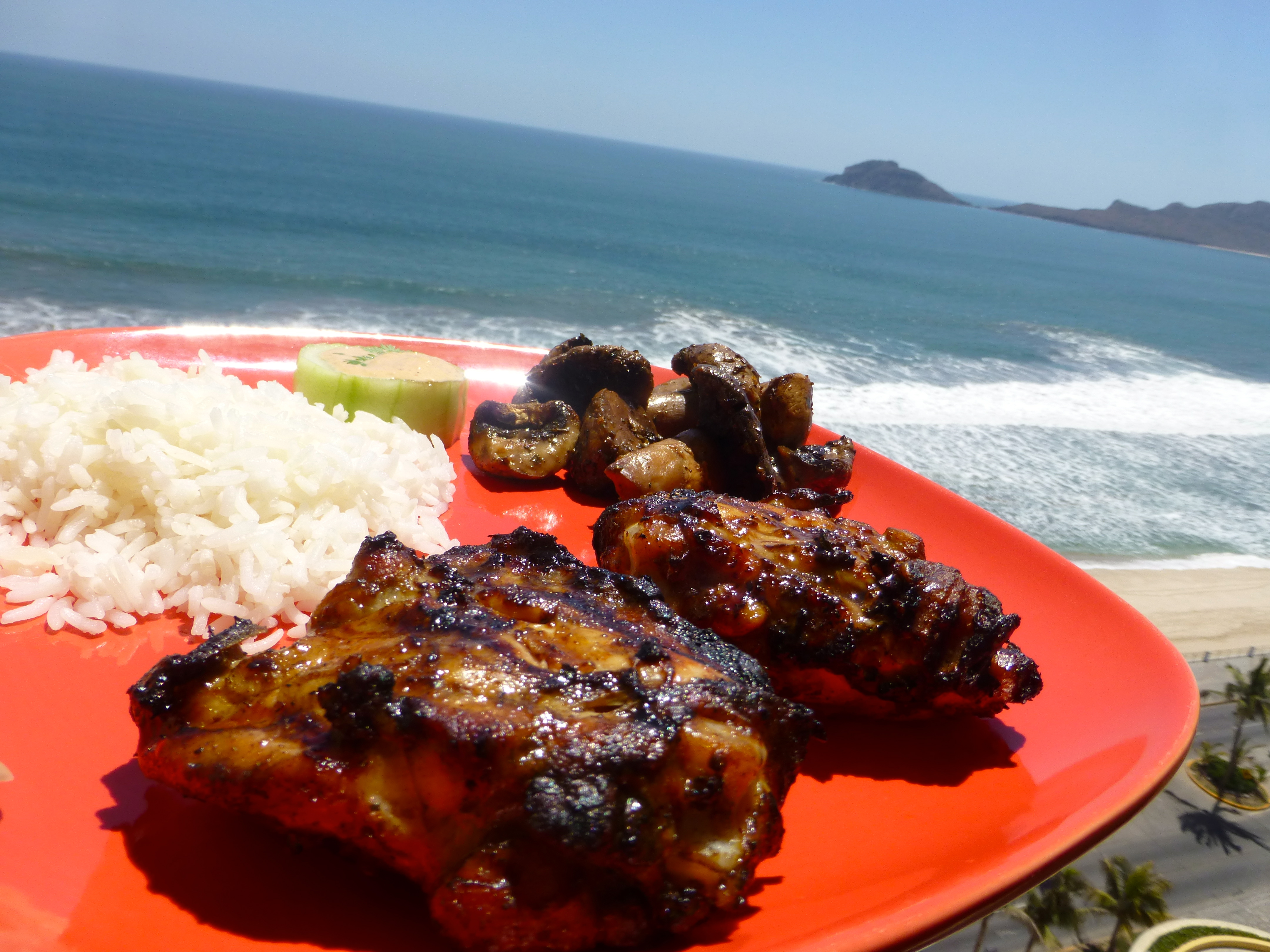
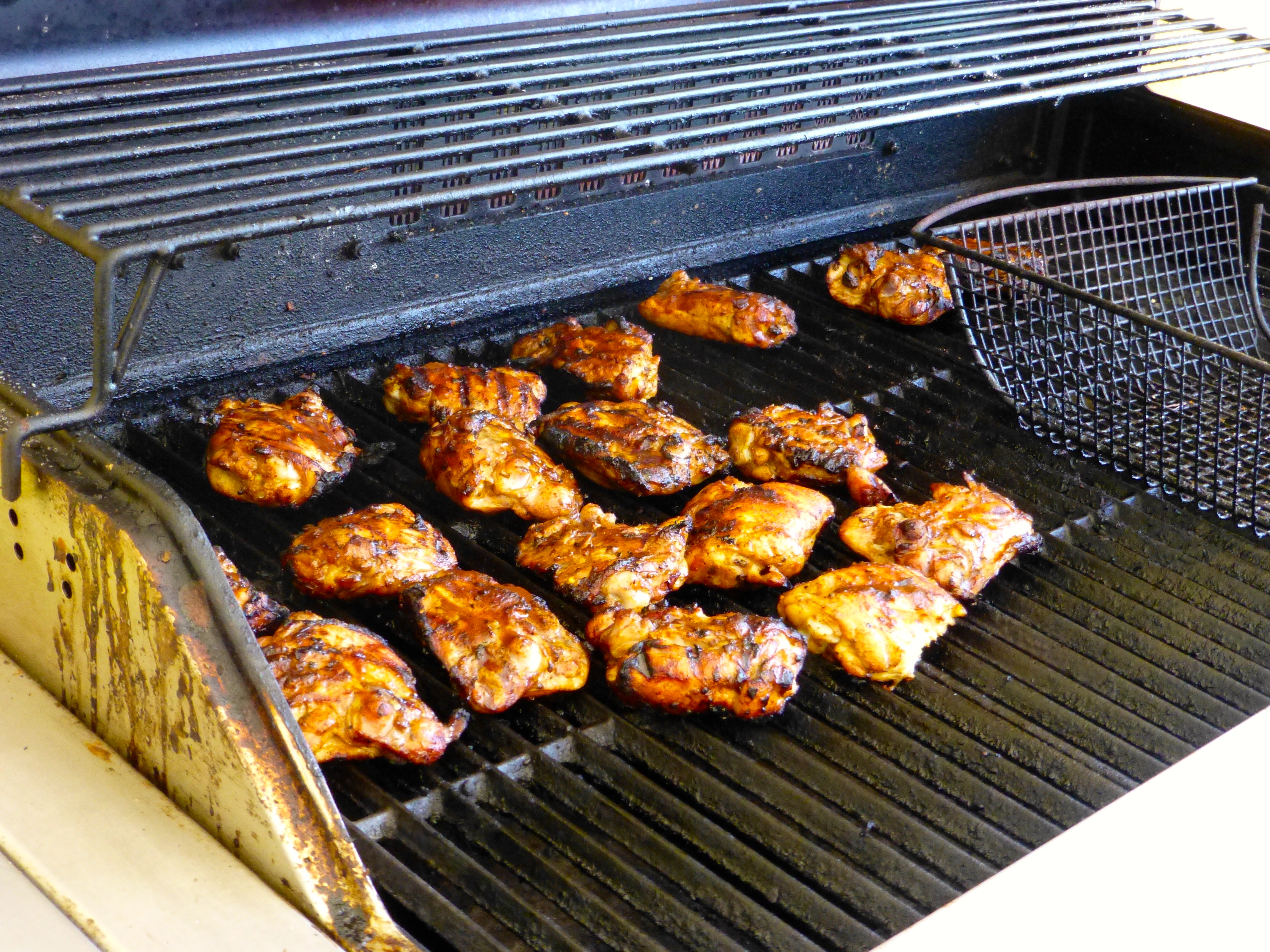
Greg barbecued chicken for us the other day. It was mightily good. Really good. There were grilled veggies to go with it, lots of mushrooms.
He made a lot of the chicken, as you can see below (we are three people). There were LOTS of leftovers. We put it in Tupperware in the refrigerator.
The next day, when Greg went to get a piece, it was all gone. The joven had struck! He had already finished it all for cena the night before.
This happens quite frequently. Danny’s a growing boy; he needs sustenance. Thankfully he’s healthy.
But, surely, a bit of self-defense or auto-protectivo was in order. So Greg got to thinking…. I had just cut up a PERFECT, sweet and juicy pineapple for us, and put that into Tupperware. Last week, I had done the same, and Danny “snacked” on it after school, finishing it all before we’d even tasted any (slight exaggeration). So, Greg hit upon an idea!
He printed a color photo of some asparagus—something that Danny says he hates. Greg taped the color photo to the top of the Tupperware, to disguise (and protect) the sweet juicy pineapple within.
While I thoroughly enjoyed every moment of his evil plan, and we both got a good laugh, it didn’t fool the joven for even one second. 😉
Here’s one news story that I absolutely love! This morning in Mexico City the Alianza por la Salud Alimentaria (Alliance for Nutritional Health) reenacted the arrest, for violation of human rights, of four “Captains of the Junk Food Cartel”! Bravo! It’s about time!
Arrested were the Coca Cola polar bear, the Cocoa Krispies’ elephant, Tony the Tiger, and Ronald McDonald. They are accused of violating the rights of Mexican children under two principal charges: manipulating and cheating children via the publicity and marketing of their products, and introducing food and beverages that contribute to the obesity epidemic of Mexico’s children. During the arrest, officials explained the specific criminal actions of which each of these captains is accused:
Tony “the Tiger” falsely tells children that eating Frosted Flakes will lead to success in sports, despite the fact that 40% of the weight of the product he peddles is sugar. He is held responsible for displacing oats and amaranth from the diet of Mexican children.
Melvin “the Elephant” is accused of distributing Cocoa Krispies, a substance containing 35% sugar and four artificial colors, three of which are associated with hyperactivity and attention deficit disorder in children. Yet, this is the most advertised product on television.
Ronald McDonald, alias “the Clown,” entered Mexico in 1985. He now operates out of 400 locations in Mexico. He uses toys, images of parties and healthy, happy play to induce children to ingest high volumes of fat, salt and sugar. He has previously been fined in Brazil for his nefarious activities.
“Coca” the polar bear, is accused of being one of the major causes of both the obesity and diabetes epidemics facing Mexico. Each 600 ml bottle of the Coca Cola that she deals contains more than 12 TABLESPOONs of sugar. Coca’s reach has penetrated every nook and corner of the country, far and wide, and has helped make Mexico the world’s largest consumer of soda. Despite Coca’s agreement with the World Health Organization not to publicize to children under 12, she has conducted numerous campaigns aimed at that very population.
Héctor Bonilla, one of the arresting officers, stated, “The unregulated presence of multinational corporations in the food sector is truly criminal. I welcome the attempt to counter the millions and millions of dollars in publicity of these organizations, with horizontal communication and the moral authority of those who are motivated by social conscience to collaborate, rather than by economic interests. New technologies are fertile territory for cunning and the unveiling of great lies to the public.”
Such a public demonstration seems to me a great way to raise awareness among kids. Congratulations to the arresting officers! Kids, let’s get outside, breathe some fresh air, and run around! Try some new, whole foods and you’ll be surprised just how good real food can make you feel!
Above is one of those photos recently circulating the internet, of a school science project that illustrates the quantity of processed white sugar in various commercially available bottled beverages.
Belisario Dominguez seems to have become the street of the wonderful, healthy bakeries, first with Molika (#1503) and now El Trigal (#1807).
Many of you are familiar with 20-something Daniel and his mother, the proprietors of El Trigal. Last Thursday the terrific smells wafting out from their simple, clean new bakery literally demanded that Greg and I enter during our wanderings.
We purchased a luscious chocolate brownie which we munched on a shaded bench in the Plazuela, as well as a pie that we took home for cena/late night dinner.
And what a pie it was! We’ve all sadly had pies that, after cutting, fall nearly flat. Not so with El Trigal’s!
Our pie was piled tall with fresh tomatoes bursting with flavor, chopped fresh basil and goat cheese. We purchased it warm from the oven and it filled our car with such a good aroma that I can’t believe the pie made it home in one piece. Reheated later on it tasted so so good!
El Trigal sells a wide variety of breads including garlic, onion, cheese, bacon, herb, carrot, cranberries, raisins and nuts. They also carry a broad selection of pies such as strawberry, blueberry, pineapple, guava, apple, cheese and pumpkin, and flanes (custards) flavored with peach, caramel, mocha, nuts and neopolitan.
If you have not yet tried out El Trigal, you’ll definitely want to stop in and have a taste! It’s on Belisario Dominguez downtown, near where 21 de Marzo crosses. They are a terrific addition to the food scene in Mazatlán, I wish them much good fortune!
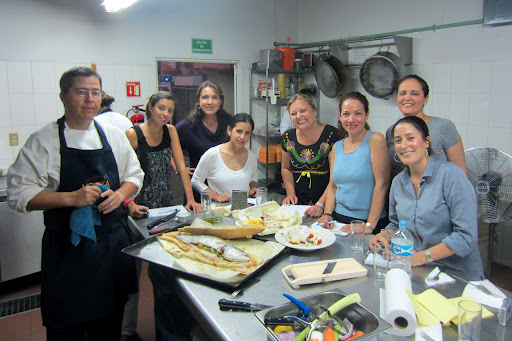
I’m privileged to have a terrific group of lady friends who like to cook, and we get together to learn and to teach one another once a month or so. In addition to our Thai cooking classes, we’ve made timballo (Italian “drum” with pasta and eggplant), tortas ahogadas, rajas, chicken mole, macarones, and lemon cake, among some other wonderful things.
Well, my friend Magda got the wonderful idea to book us a series of classes with Héctor at Molika, downtown on Belisario Dominguez near the Plazuela. While I’ve known Héctor for several years — he’s a GREAT bread baker (sourdough and ciabatta plus other good loaves) and I am in love with his grilled vegetables (which we also frequently make at home) — I discovered that he also truly shines as a teacher!
He is funny, charismatic, and I LOVE that he teaches METHODS rather than recipes! In one two-hour class on cooking fish, he demonstrated SIX different methods of preparing the fish we commonly have available here in Mazatlán. For me who learned to cook fish while living in Japan, I learned a lot. For example, he taught us to cut off the fins (see video above) before cooking the fish (you’ll know that most Asians LOVE the crispy fins and would never think of removing them before cooking), saying that the fins have too strong a flavor.
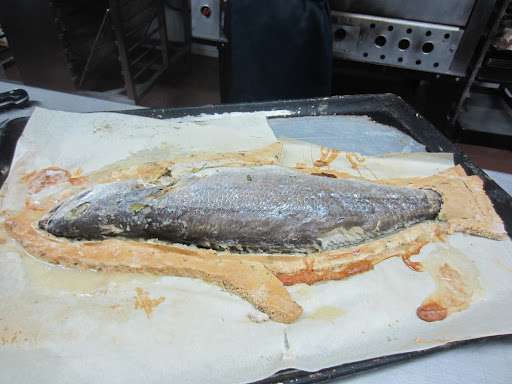
My favorite? Well, by now you know me. I love something different, and especially something impressive. And Héctor delivered: Pesce in crosta di sale, or fish in a “tomb” of salt. I’ve eaten many fish baked in salt crust before, but nothing quite like this!
Rather than just salt with aromatics, Héctor made a salt dough with the 2 salt : 1 flour, eggs, fresh herbs and a bit of water.
He kneaded it (see video above),
Rolled it out,
Pressed two pieces (top and bottom) to the form of the corvina, sealing the dough with beaten egg, decorated it a bit,
Trimmed it to shape (video above), and then baked it for 45 minutes.
The fish of course turned out incredibly moist, aromatic and flavorful. He said he prefers to use robalo rather than corvina, but I was plenty happy with this.
He suggested that we cut the rock-hard crust in the kitchen (you can see above that’s pretty challenging), then take the encrusted fish to the table, where we open it in front of our guests. That way the room fills with the wonderfully aromatic scents.
Finally, unlike Japan where everyone knows how to eat fish on the bone, Héctor suggested we remove the flesh from the fish in front of our guests, serving it up on plates. He removed and discarded the skin, saying that baked/steamed fish skin doesn’t taste good. I can hear the shocked gasps of my Asian friends now, but it was nice for me to learn a more European approach. I will definitely give this gorgeous dish a try. I must admit that I preferred the taste of several of the other dishes he prepared! This one was just a presentational stunner, like my timballo (thanks, Allison, for teaching me!).
We made pescado en papillote, fish steamed in paper. We stuffed the fish with aromatics: lemon peel, garlic and fresh herbs (basil, parsley, rosemary, thyme), then garnished with sliced fresh celery, onion and carrot. It was interesting to me, again with my Asian influence, that Héctor taught us to peel the celery, removing the fibers. Definitely a finer dining touch than I’m used to.
Above you can see Héctor opening the papillón.
A third dish we made in this two-hour class was the dish I swore every single Japanese restaurant serves: sole meuniere (lenguado). Many of the ladies were very happy to have Héctor teach them how to filet. Cleaning and preparing fish is fortunately one of the many skills I learned well in Japan. One of the key points he pointed out is to filet fish when it’s cold, fresh from the icebox. That way it’s much firmer and easier to handle.
Héctor studied and cooked in London before returning to his native Mazatlán, and he uses lots of olive oil and sea salt, as you’ve already seen (way more than I’m used to, though I will start putting a bit more olive oil on for taste at the end), and for this dish he used a whole lot of butter as well. Nobody said good cooking isn’t fattening! He did caution us to check the ingredients on the butter we buy, as ideally it should be made from milk, and not contain emulifiers and a bunch of chemicals. I do think that’s part of the baking challenge I’ve had since I moved here — gotta buy better butter.
And here we have the finished lenguado/sole, covered with sauce from the pan and garnished with a bit of parsley.
I had been craving salmon and asparagus, and just that morning bought both to make for lunch, so was fascinated to see Héctor make this as part of our repertoire for the day. He of course used clarified butter as it withstands higher heat, to get the nice crispiness on the salmon. Note: he removed the skin before cooking. I guess this is also either a European way or alta cocina, because personally I love the crispy skin. I was sooooo gratified to see him cook it the way I feel it should be. Héctor told us that salmon, tuna and swordfish should always be left rare in the center, and I heartily agree. People here in Mazatlán always seem to overcook fish.
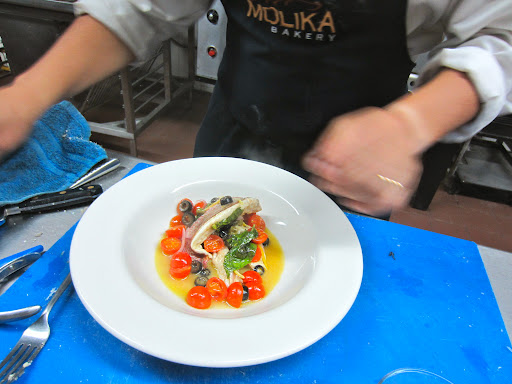
The fifth dish he made was swordfish. He cubed the fish, sauteed it with fresh herbs, cherry tomatoes, capers and olives. In addition to the lemon (yellow lemon) rind he added to most all these dishes, he also added a bit of lemon pulp. This concoction he poured over his famously to-die-for ciabatta, and oh my!!!! The bread somehow soaked up and enhanced the lemon flavor of the sauce, and it was soooooo delicious!
I’ve left my favorite dish for last. Fortunately, it was also probably the easiest to cook: pescado en la bolsa, fish in a bag. He used the same ingredients as most of the other dishes — fresh herbs, cherry tomatoes, olives, capers, sea salt, extra virgin olive oil. The wonderful part, besides the incredible taste?
He put all the ingredients in a ziploc bag and cooked it in near-boiling water on the stove! It took just a few minutes and there was nothing except the serving dish to clean up! My son is in Scouts, and they cook just like this on their campouts. Maybe not quite the gourmet ingredients as this, but still very tasty nonetheless.
Thank you, Magda, for setting this up for us! Thank you, Héctor, for a marvelous class! We are very much looking forward to our next one.
Anyone wanting to arrange a class for a group of friends, please give Molika a call: 669-981-1577. Héctor’s English and Spanish are flawless, and his kitchen skills are a gift to Mazatlán.
One of the best aspects about living here in Mazatlán is the fresh fish we are able to buy every morning. Okay, well, we don’t go on Mondays, because there’s not been a lot of fishing on Sunday, but any day Tuesday through Saturday, you can bet we are happy campers.
We take our daily walk down the malecón and, in Playa Norte just across from the pangas, is our favorite spot: Pescadería del Mar.By now these guys know us and they’ve helped us to learn a lot about fish and fishing here in town: what’s seasonal, how fish are stored (on ice, frozen, salted) from the time they’re caught till they’re brought in to shore, and how to cook what’s available locally.
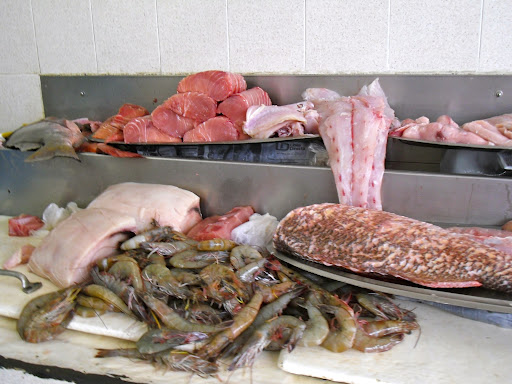
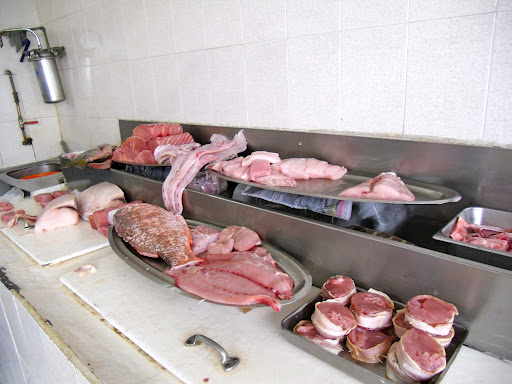
At 7 am when we’re there we usually have a terrific selection. Of course, depending on the season and the weather, we may have more or less fish to choose from. As you can see in this photo, though, there’s usually quite a variety.
The fishmongers will scale and clean any fish we choose, so I can cook it whole, or they’ll fillet (de-bone) and cut up anything we’d like, however we’d like it. They also get fresh shrimp, which I love, because they are deep water shrimp that have NOT been stored in salt, so they’re sweet rather than pungent. They get quite a bit of squid, also, which I love to saute with garlic and herbs. We can occasionally get fresh scallops, too. Our favorite is corvina, a nice firm fish that is sooooo savory! We can at least a couple of times a week get smoked marlin (usually still warm from the smoker and sooooooo aromatic!), and escabecheon Fridays.
It’s fun to watch either the fishermen fresh off their pangas across the street, or a dealer/go-between (usually on a scooter or motorcycle) come to deliver the fish to the fishmongers and make a deal. They have an outdoor scale to weigh what’s brought in, and an indoor scale to weigh what you purchase before it’s trimmed to order.
Having lived so many years in Japan, I am also very happy when they get sushi-quality tuna, though I do believe most of the fresh fish they have is sushi/sashimi quality. Chirashi has never been so delicious and affordable!
If you are a carnivore/omnivore, and do not take advantage of our local fresh fish, please do! You are missing some really flavorful and healthy, and easy and quick to cook, local delicacies!

















 ¡VidaMaz!