Conselva’s “Nuestro Patrimonio Natural” Dinner

IMG_2585

I sadly missed Mazatlán’s first Holi festival due to my travels, but fortunately returned just in time to attend the Conselva “Nuestro Patrimonio Natural” dinner on Tuesday night. Over 300 people enjoyed the event in Casa Garcia, at which chefs from Cocina!—the community outreach program of local Mazatleco chefs—collaborated on a fundraiser dinner for Conselva: Coasts and Communities. Mayor Felton and First Lady Sylvia, along with many municipal government and business leaders, attended. I was very happy to see that we also had a good expat representation—WTG for supporting environmental sustainability in our region!

Those cooking included Mariana Gomez Rubio from Pedro y Lola; Julián Portugal, from El Parador; Luis and Ignacio Osuna, from Grupo Panamá; Héctor Peniche, from Hector’s Bistro; Diego Becerra, from El Presidio; and Marino Maganda, from Pueblo Bonito. Proceeds from the event were earmarked to purchase highly efficient Patsari wood stoves/comales for families of the Monte Mojino ecological zone. “Patsari” means “the one who takes care of” in the Purhe’pecha language. In addition to conserving wood, the stoves preserve the quality of indoor air.

The Monte Mojino ecological reserve is located in the mountains of southern Sinaloa between Concordia and El Rosario. Its 200,000 hectares of dry tropical and pine forest contain 66% of the fauna found in the state of Sinaloa and 56% of the plant families found here, including 160 species that are endemic to Mexico. According to Conselva, the reserve has a biodiversity richer than that of Costa Rica. Conselva has worked hard to teach the 12,000 residents of the region conservation and eco-tourism, so they can thrive while protecting their natural environment.

The seven chefs welcomed all of us through the doors of the Compañía Minera bar and restaurant portion of Casa Garcia with a selection of terrific fish and seafood ceviches and drinks at the first food station of the evening. Wine and beer were included, but strangely non-alcoholic drinks had an up-charge.

Once inside the large outdoor patio we were entertained during the cocktail hour by a jungle-clad drum and dance troupe, while three dancers made up as jaguars pranced among us. It was delightful.

We were able to see a Patsari stove in action as throughout the evening two ladies from Monte Mojino used one to make tortillas.

Funds raised from the dinner go to buy wood stoves like this one for Monte Mojino residents.

Funds raised from the dinner go to buy wood stoves like this one for Monte Mojino residents.

Seating was throughout the central patio, both downstairs and upstairs. As usual the venue was gorgeous and the weather was perfect. For dinner we were able to enjoy three different food stations. The station downstairs served fish, soup and tamales made from regional products, while another upstairs served delicious meats from the Monte Mojino region. The fourth and final station was inside the cleared El Presidio restaurant, and consisted of about seven different desserts!

Click on any photo to enlarge, or to view a slideshow.

Puzzling to me about the event was that food was served on plastic dinnerware. While more ecologically sound than styrofoam, Greg and I found it very strange that a conservation organization would use plasticware, and particularly for an event that cost 1000 pesos per person. Hopefully the materials were recycled or recyclable. The other unfortunate reality was that seating was extremely awkward, with many people unsure where to sit or having to move after they’d already been seated. With an event of this size, a few hiccups are perhaps to be expected. All in all, the night was quite magical, and very savory!

At the conclusion of the evening everyone attending was given a gift bag of Monte Mojino honey to take home.

I’m very happy we have several organizations in Mazatlán that are dedicated to preserving our natural environment and to educating people about conservation and eco-tourism. It is my most sincere hope that southern Sinaloa can become a champion of environmentally friendly and sustainable tourism before it is too late. We’ve already lost so much. Southern Sinaloa is blessed with an incredibly vibrant biodiversity, and we will be wise to work together to create sustainable ways of making the most of its beauty and riches, for both ourselves and the generations to come.

¡First Annual GumboFest A Complete Success!

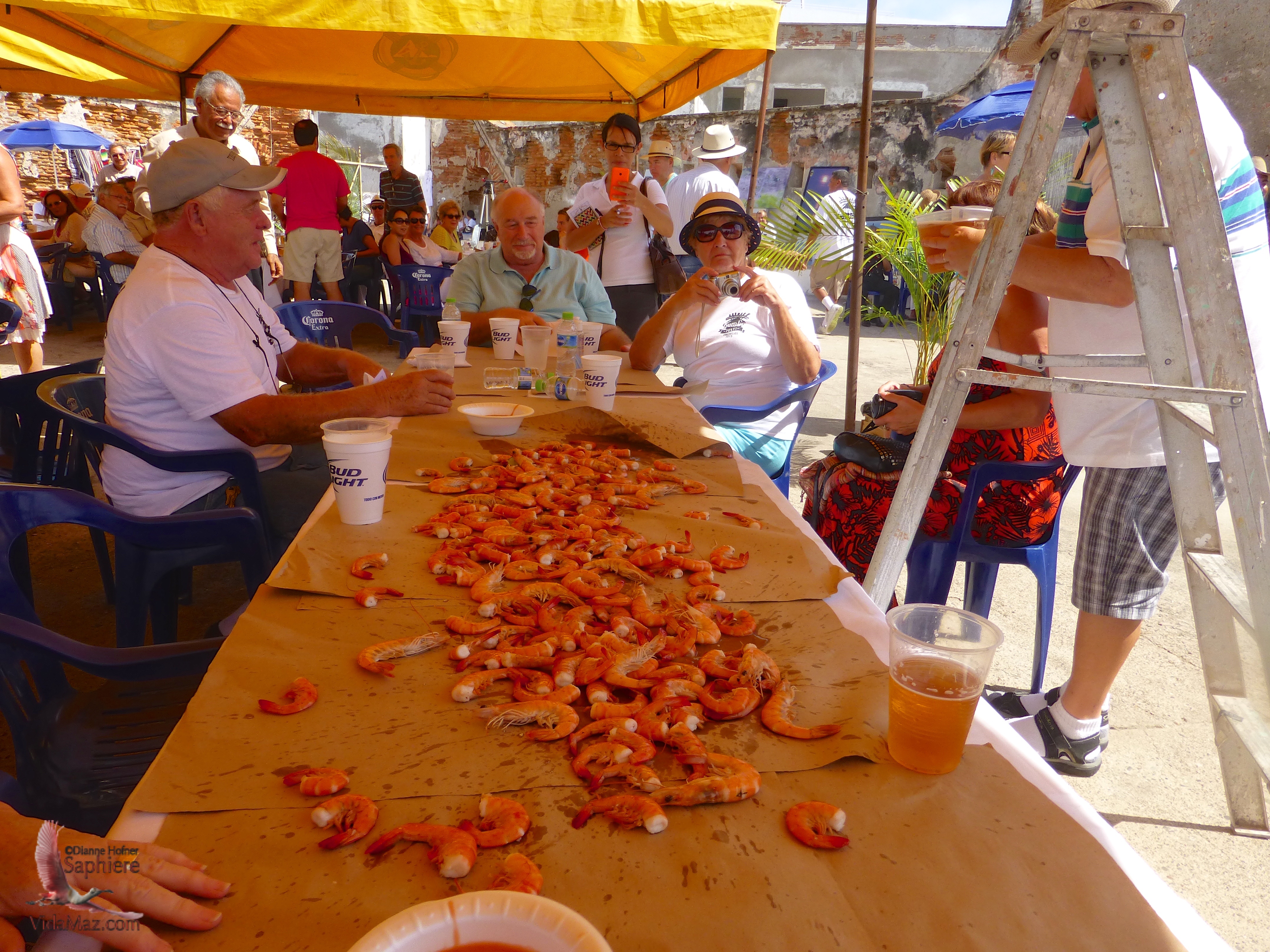
P1270023A most gorgeous, sunny yet not humid day; a historic setting; a view to die for; the joy of partying with some of the most entertaining people in Mazatlán; all the oysters, peel-n-eat shrimp, salad and gumbo (of course cake and ice cream, too!) anyone could possibly consume; plus beer and soft drinks—such was Mazatlán’s first annual GumboFest! The event was put on by Gustavo’s Kitchen and Amigos de Mazatlán, in an attempt to build community support for saving and restoring the Casa del Marino and Fuerte 31 de Marzo, and to teach us all a bit about local history. Click on any photo to view it larger or see a slideshow.

One of my favorite parts of the afternoon was that each table was covered with brown butcher paper, and the peel-n-eat-shrimp were theatrically dumped on each table from a bucket at the top of a ladder. Great touch and very fun! (Please try to ignore that fun-loving woman screaming at the end of the video below…) It looked to me that about 200 people attended, and Judith, Gustavo and Gustavo Senior tell me that the event was such a success that they plan to hold it again next year. How often do you get good gumbo in Mexico??!! Call us lucky!

A trio played live music, including both Latin and jazz, the children from the Salvation Army Home performed folkloric dancing, and Antonio Lerma and Nicolás Vidales told us, in English, the history of the battle with the French that took place here, dispelling some myths in the process. Gustavo Sr’s wife, Silvia Lorda, and the inimitable Rubye Hinton both graced us with their singing.

AngelTouchFilms published a wonderful short (30 second) video about GumboFest, with terrific New Orleans jazz, me eating an oyster, and loads of other smiling happy people. Enjoy it, below!

Congratulations to everyone involved! Can’t wait for next year!

Private Estate Bottling Tour in Tequila

P1250141

My favorite Reserva de la Familia’s collector box


My favorite tour in the quaint pueblo of Tequila, Jalisco, is of Herraduras. The hacienda is beautiful, and the people are very welcoming and down-to-earth. I’ve generally avoided Cuervo, because I see it as such a machine. We have friends who love it, however, and they recently took us with them on a private bottling tour there. I HIGHLY recommend it!

Firstly and most importantly, every person on the tour gets a bottle of La Reserva de la Familia. This is INCREDIBLY smooth and easy-drinking tequila, leaving no hangover, and comes in an annual collector’s box designed by the artist-winner of their annual contest. We paid LESS THAN THE PRICE BELOW for a six-hour day that included a tour of the fields, the hacienda and gardens, a tasting, snacks, and our private bottling!

P1250136

First let me show you what our day included, and then I’ll give you the scoop about what I learned about how to get the best deal.

We started by getting into a van to drive out to the fields. Below are some photos of the demonstration we had there, where Ismael, one of Cuervo’s long-time jimadores, demonstrated to us how they uproot and trim a blue agave. Most of the hacienda tours will include something like this.

Click on any photo to enlarge it or to view a slideshow.

Next, we went back to the hacienda (not as old as Herradura, and we definitely felt it was more for show than to get work done in), and had a tour and explanation of the distilling process. In a group of about 30 people (it was a puente weekend), we saw the ovens, the tanks, the barrels. We sampled the leftover agave after it’s finished baking—it was good! Nice and sweet, sort of like sucking sugarcane. We also did a tasting of various tequilas out of the barrels. Again, most tours at most haciendas include something like this, and to me, Cuervo is not the prettiest hacienda.

From here we broke off from the group tour and went down into the cellar, where we would have a private tasting of Reserva de la Familia. Now we became about ten or twelve people. Again, it was a puente weekend; I believe that on a regular weekend we would have been fewer people.

The cellar was gorgeous—hard to take photos in, as it was so dark. We were allowed to drink pretty much all the Reserva de la Familia we could handle in the 30 or 40 minutes we were down there. Of course, we were already buzzed by the time we arrived in the cellar!

My favorite part was that we were instructed on how to use a copper ladle (benencia or ladrón) to dip into the barrel and fill a brandy glass. This part was a whole lot of fun, and unlike any other tour we’ve taken.

So, by now we’ve been “sampling” tequilas for about three hours, and this last cellar visit gave us the chance to sample the best of the best. Now we got to (try and stay vertical long enough to) climb up the stairs and go to a tasting. A TASTING? Seriously?! Oh my!

This took place in a gorgeous room all set up special. We were joined by a few additional people, so we were maybe four family groups in all. Our terrific guide for the day, Rosy, taught us a bit about how to smell and taste three different tequilas (the brandy snifter in the photo below is my leftover Reserva de la Familia from the cellar!), using a plate of tastes and smells (coffee beans, cinnamon, lime, etc.) to help us.

Next we thankfully got a bit of a break, and even some fresh air! We walked out through the gardens, after which we sat down to eat a few of the snacks that were included in our tour. Our break took place in a gorgeous little courtyard, and we had a beautifully sunny day. To my memory (which by now is quite fuzzy), they tasted great. We enjoyed chatting and laughing with the kids who came by selling fresh-made bread and rolls.

Finally we got to the BEST PART. We went back down into the cellar and got to bottle our very own private Reserva de la Familia bottles! We filled a clean bottle from the barrel. We corked it, wrapped it with tape so that it would be easy to open, then dipped the cork and tape into wax. You can tell by the photos below that my wax dipping didn’t come out as “clean” as it should have, but I sort of liked the artistic result.

Once the bottles were corked, we had to glue on the labels. Somehow our guide felt the need to straighten each of the labels I put on; can’t imagine why that would be. Our estate bottle numbers were officially registered into a log book, and we were able to hand-letter a personal message on each of our bottles. LOVED IT!

Finally, our bottles were wrapped in tissue paper and placed into the collector box, which is a different design every year.

Once our six-hour, wonderful day finished, we were able to walk around the hacienda further, have another round of something to eat, and shop in the gift shop. Since we had four identical boxes, plus a fifth matching box at home, I asked Rosy if she wouldn’t trade me out for a different box. I’d spotted a cool Japanese woodblock print-looking rabbit box earlier. Sure enough, Rosy did me that favor, and now we have two different kinds of collector’s boxes.


We stayed at a clean, bright hotel conveniently located right on the plaza, steps from the church, called El Jardín. You can see the affordable rates in the photo below. We were happy to spend the night in Tequila; we hadn’t done that on previous visits. As much tequila as we’d “tasted,” we were glad to have the hotel! The plaza at night was hopping, and we ended up with souvenir clay cups or jarras, which our bartender kindly filled with fresh fruit juice and tequila (because of course by then we were thirsty again).

The next morning we walked around a bit more, and enjoyed breakfast with Rosy, our guide from the previous day. As usual, I enjoyed people watching—kids playing music, men and dogs snoozing…

Okay, so here’s my advice if you want to do this tour. First, go online and get your Mundo Cuervo membership card. This gives you all sorts of different benefits. Next, “like” Cuervo’s Facebook page. There they share a bunch of special offers, contests and discounts. We were able to have our membership card upgraded to one of the top levels, which allowed the two of us to get our six-hour day including everything above for just 2900 pesos! Of course, we also had champion negotiator, our friend Paco, do the bargaining for us. Even at normal cost of 1600 pesos, however, the bottling on its own is a good deal, but the total price we paid blew me away for everything we did.

Tequila is a fun trip no matter what. Private bottlings require scheduling ahead of time, so if you want to do that, be sure to call ahead.


Loads of Pics of Carnavál Parades 2015

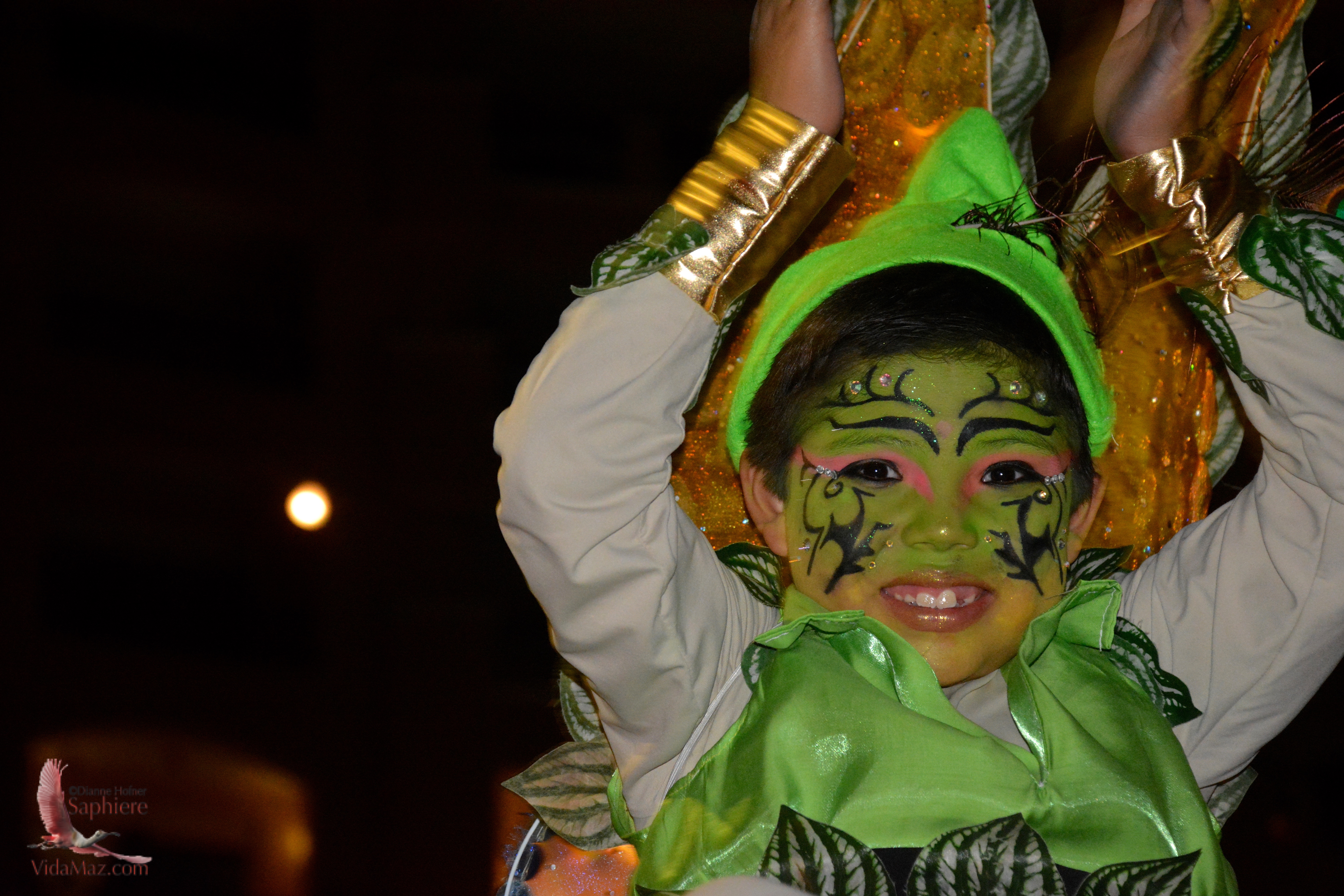
DSC_0711 - Version 2We absolutely LOVE the Carnavál parades every year. There is nothing better than a bunch of Mazatlecos in good humor, with their dancing shoes on and ready to party! Everyone from toddlers to grandparents get in on the fun. Mazatlán’s first Carnavál was 117 years ago (1898), and 2015’s parades had 31 floats. Dance troupes from studios and schools all over town participate in our parades. I love all the youthful exuberance and excitement as these kids, who’ve rehearsed for months and raised money for costumes, get their big day in the limelight. It is a city tradition, involving at some point in time nearly every family in town, it seems. I enjoy watching them in the parades, and also as they put on their makeup, chat, eat and warm up prior to the parades. I especially love the young couples in love. Here are just a few of my favorite Carnavál faces of 2015’s parades. Click on any photo to see it larger or view a slideshow (highly recommended).

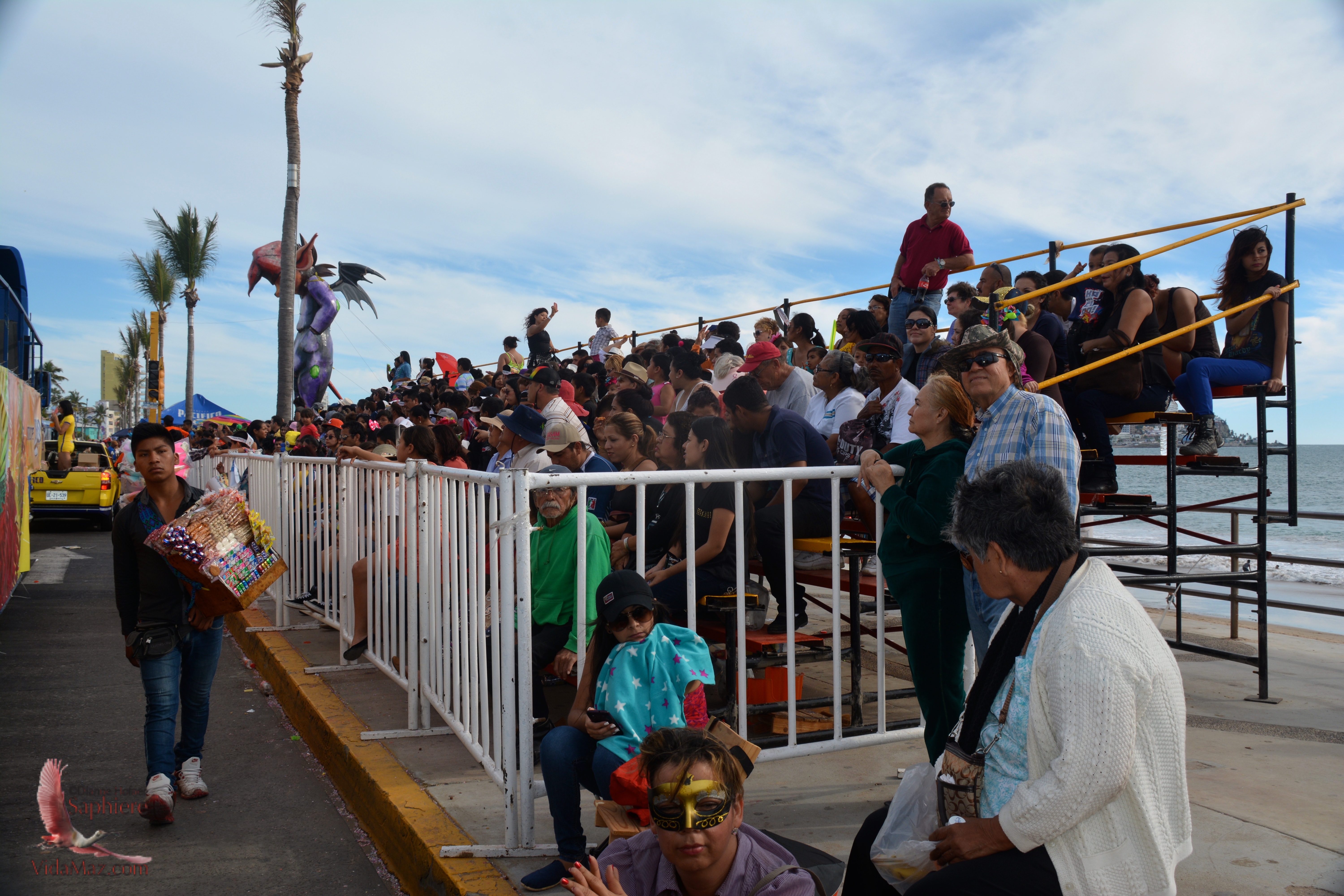
The parade on Sunday had 300,000 spectators, not to mention those on Tuesday! The city supplied free bleachers with 15,000 seats this year, making Carnavál fun accessible to more people.

DSC_0246

Most of the people in our condo building prefer to watch the parade from the pool deck. From there they can take photos of whole floats, with the bay and the sunset in the background. We prefer our annual street-side party, where we can cheer on the dancers and join with them when they invite us to do so. It’s great fun! Click on any photo to see it larger or view a slideshow.

This year the pre-parade came round and we all caught beads, hats, t-shirts and other gadgets. The main parade, however, was well over an hour late. It started fairly on time; we saw the fireworks. But then it stopped. We waited. We drank and danced. We talked with our neighbors and friends. We enjoyed the clowns and vendors passing by, and the families and kids playing in the street. And we wondered what had happened to the parade.

It seems a generator failed on one of the floats, and it took quite a while to get it functioning. Also, a huge group of people were blocking the parade route, and the police had to restore order to the scene. Finally, about 8:00 pm, the first parade reached us.

The theme this year, “Dreams of Momo,” the god of merriment, was interpreted as one of fantasy and mystery, including a variety of entries such as Ali Baba and the 40 Thieves, dragons, fairies, Indian goddesses, unicorns, a Medusa-like octopus, China, Japan, Egypt, and Native American chieftains.

As you know, Maestro Rigo Lewis, who designed our royal floats for over 50 years, passed away last year. This year of course was a transition year. I’m afraid it was a rather disappointing one. The royal floats were not nearly as regal, intricate, realistic or impressive as we have grown used to—no one gasped or said “wow” like they usually do. We have been told by some of the designers that CULTURA was afraid of losing Rigo’s legacy, so they wouldn’t let them create freely, but rather had them attempt to honor his baroque style. On the other hand, we’ve heard and read that CULTURA is eager to forge a more modern, minimalist style of floats.

All I can say is, I hope the outcome is better next year. The regular floats were uneven; some were really quite cool, and some looked like they were put together by high schoolers. For the first time ever, some of the commercial pre-parade floats were better than those in the main parade! We saw plain, undecorated iron rods and scaffolding; generators right in the middle of floats, blocking the view of key elements; floats that were very obviously made for third-story rather than street viewing, which ruins the whole tradition in Mazatlán of a street party and caters to the privileged; floats such as that of Momo that were so plain as to be embarrassing; people showing through sheer fabric on the floats when we weren’t supposed to see them; lights that were too direct and overbearing; and floats that had so many elements to them that there was no viewing angle from which you could see the main points clearly. All in all, the floats were not up to the standard that CULTURA has set for us. But, it is a transition year, and we can hope that 2016 will be better than ever.

There were quite a few LED floats, which we saw the first time a few years ago in the children’s parade on Monday night. This year, there was no children’s parade, nor were there fireworks on the malecón on Monday night. We really missed this, as did tens of thousands of Mazatlecos and tourists. The Espinoza Paz concert in Olas Altas was great, but not a replacement for a family-friendly, easily accessible and free-of-charge activity like the parade and fireworks.

Want to know one of the best parts of the pre-parade on the second day? A bunch of girls in one of the comparsas spotted Espinoza Paz dining in a sushi shop just down the street from us. Check out the hysteria that ensued:

In the end, it was a TERRIFIC couple of parades, with everyone feeling joyful and happy. Beautiful community-building was had by all. Complaining that some of the floats weren’t up to the incredibly high standards set in previous years doesn’t diminish the unbelievable wonder of the event. Thank you, Mazatlán, CULTURA, dancers, and everyone involved!

Whale Watching in Mazatlán


1.DSC_0310 - Version 2

One of many happy humpback couples we saw on our excursion last week

I love how you all join in the excitement about our whale-watching trips with Onca Explorations. On our first trip in 2009 we had unbelievable good fortune; we had so many pods of whales come right up to the boat—breathing beside us and playing with us—that we lost count of how many whales we saw! The video on the link above will give you an idea. Remember, the camera is not zoomed on those shots! We felt like we could almost reach out and touch the whales, they came up so close to us.

Each year we have been blessed to see whales, though each time out has been a bit different. The humpbacks (ballenas jorobadas) that frequent our waters are the most acrobatic of the baleen whales; in fact, that’s how they got their name—the humped back motion they make when they breach out of the water. In addition to breaching, humpbacks spy-hop, lob-tail, tail-slap, and fin-slap. In our various outings we have seen humpbacks jump on top of each other and hit each other with their pectoral fins, which the males do to establish dominance and secure a mate. This time out, however, we saw a bunch of couples romancing—swimming around slowly and gently, courting and most probably mating with one another. Here, in warmer waters, is where the humpbacks mate and have their babies.

Onca’s owner, marine biologist Oscar Guzón, had to teach a class so did not go out with us this time. Saúl Herrera was our guide, and he told us that no one has ever recorded seeing humpbacks mate. Apparently it’s not uncommon to see huge gray whale penises in areas such as Baja, where they frequent. Saúl lowered a microphone so that we could hear the male humpbacks singing. They produce their haunting songs by pushing air through their nasal cavities.

Below is a short clip of one of the happy couples, swimming about romantically, with the Baja Ferry and the smaller Onca I (we were on the Onca II) in the background. First you’ll see their spouts, then the dorsal (back) fins come up, and, finally, the whale on the right dives sharply enough that the fluke comes briefly out of the water. Ah, love. You can see how coordinated their water ballet is.

The gestation period for humpback whales is 11-12 months, so calves this year were conceived in our waters last year 😉 Mature humpbacks reach 40-50 feet in length and weigh about 80,000 pounds (females are bigger than males). Their tail flukes—up to 18 feet across—are like human fingerprints: individual identifiers. No two flukes are alike.

Humpbacks live up to 50 years and are sexually mature at 6-10 years. Below you can see some of the great variety of flukes, as well as some of the spouts, that we saw during this trip. As you can see, there was a whole lot of love going on out there! Click on any photo to enlarge it or view a slideshow.

Oscar is a marine biologist, and he, Saúl and the crew of Onca have now spent nine years cataloguing and tracking the whales that frequent our waters. Their research has made huge contributions to what scientists now understand about humpback behavior at the southern tip of the Sea of Cortéz. Below is a clip of Saúl telling us a bit about cetaceans in our waters, including that they have recorded sightings of 17 species of cetaceans here in Mazatlán.

In addition to whales, this year we saw two species of dolphins (bottle nose and spotted) and, the stars of the trip, the mantas. Be sure to click on the link if you haven’t seen those photos!

Another great advantage of this whale-watching excursion with Onca is the great view of Mazatlán from the water.