Mazatlán vs. Cartagena

images-1

Cartagena de las Indias, Bolívar, Colombia
images

Mazatlán, Sinaloa, México

You know that Mazatlán bills itself as a “colonial city on the beach.” It was never a colonial city in the historical meaning of that term—major European settlement came with the gold rush in the 1800s—but it does have gorgeous architecture and an interesting history, so we’ll give Tourism some leeway.

The other major Latin American “colonial city on the beach” that I know of is Cartagena. I’ve long wondered how it compares to my beloved Mazatlán. A few years ago, when I first traveled to Bogotá for work, I’d hoped to make it to the Caribbean city. Well, it’s taken me till now, but Greg and I made it. So, here’s the down-low on the comparison.

There are so many similarities between these two cities it’s eerie. The people are warm and friendly. Hot water with a steady flow is very difficult to find. There is a malecón/oceanside promenade, lots of great seafood, fishing boats, strolling vendors of every sort, panzones/big bellies, beautiful women, litter, beautiful historic architecture and beaches in both places. Whether in the Pacific coast port or the Caribbean port, you’d better watch where you walk: sidewalks, when they exist, are broken, have sink holes, pot holes and uncovered man holes. Both cities have skyscrapers that house condominiums owned by wealthy foreigners who only live in them some weeks of the year. Both are open-air cities: restaurants, bars, cafes. Both have nearby islands, mangoes, pineapple, coconut.
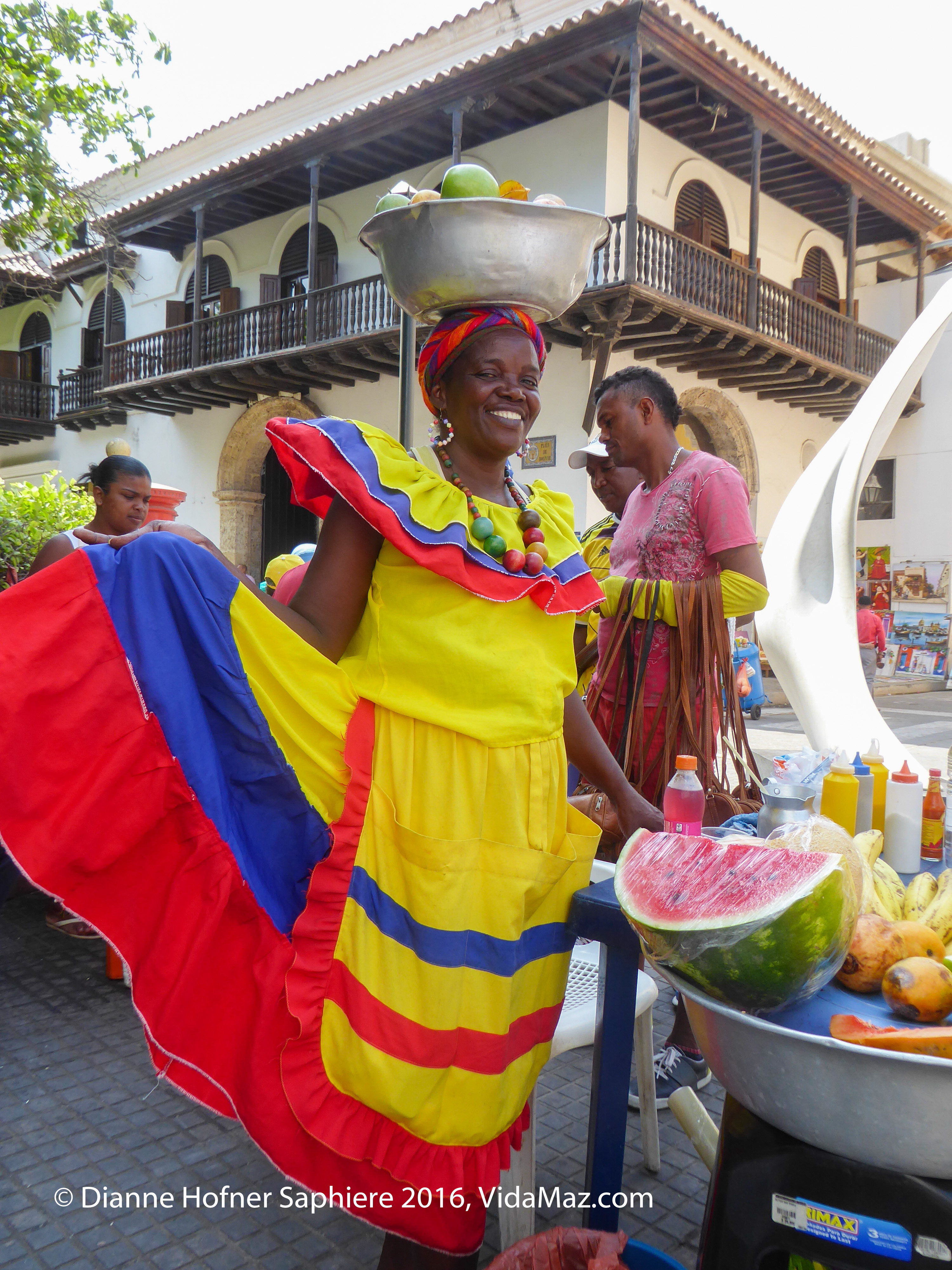
Una palenquera, María, a fruit seller from Palenque, Colombia

Una palenquera, María, a fruit seller from Palenque, Colombia

What are the differences? Cartagena has a decidedly more European (narrow winding streets, the al fresco dining in the plazas, architecture) and Caribbean (Afro-Colombians, colorful dress, music, plantains) feel. The WIND that we’ve experienced here is absolutely unbelievable, and makes dining or drinking seaside an irritating endeavor, in our opinion. Supposedly the wind will stop once the rains come, but we’re told it’s been windy like this since January—that’s four months! Mazatlán has more beggars and vagrants in the tourist zone. Cartagena generally includes a 10% tip on all food and beverage served; by law, consumers can add or reduce on that base. The food is generally not spicy in Cartagena, and we didn’t find any hangouts that were primarily for foreigners; the city seems more integrated. In Cartagena we were told that “gringo” means any foreigner. Mazatlán is noisier, thanks to the pulmonías, ahorigas and wandering street musicians.

And, drum roll please… Mazatlán is overall cleaner than Cartagena! Hard to believe? We are so eager to educate Mazatlecos and visitors to our port about putting litter in its place, about getting people to use permanent water bottles rather than plastic, and to never again serve something on styrofoam. Our son spent five years of his life repeatedly cleaning out Estero del Infiernillo, getting so discouraged at how one week later the locals again had it filled with their garbage. But, honestly, Greg and I have seen more litter here in Cartagena in the past four days than I thought was humanly possible. Having said that, the walled city itself is cleaner and tidier than our Centro Histórico.

We’ve worked up a table to show you our ratings. Obviously this is completely subjective, and it’s not fair, either. We’ve lived in Mazatlán for eight years and have traveled there for 35; we’ve just spent four days in Cartagena. So, we welcome input from those more experienced with the Colombian city.
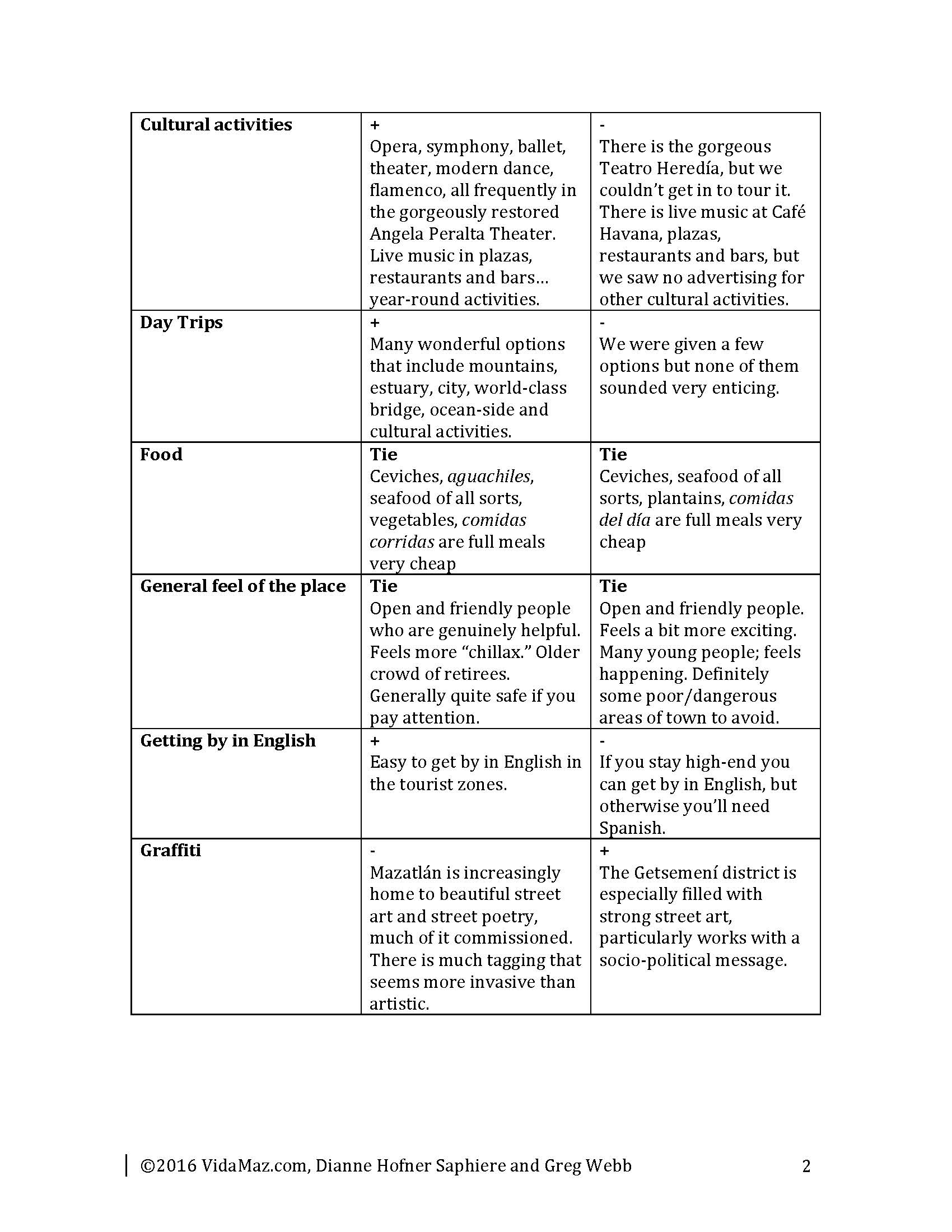
 

Mazatlán vs Cartagena table_Page_1Mazatlán vs Cartagena table_Page_2Mazatlán vs Cartagena table_Page_3.jpg

Mazatlán vs Cartagena table_Page_4Mazatlán vs Cartagena table_Page_5Mazatlán vs Cartagena table_Page_6

Colombianos, you have a gorgeous city in Cartagena, it’s true. And, I urge you to come visit us in Mazatlán! I think you will be surprised! And, municipal governments of Mazatlán and Cartagena, I would urge you to initiate a special task force, so that you can learn from one another! Your situations are incredibly similar, and your strengths and weaknesses are complimentary—lots to learn from one another!
 

We Burned Our Dancing Shoes!

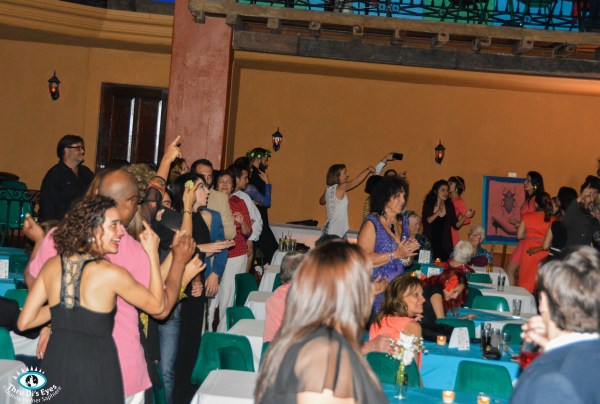
DSC_0318… last Wednesday night at the Hotel Playa with the 24 new graduates of the Escuela Profesional de Danza. What a wonderful evening! It was a benefit to help send the kids to Florence, Italy, in July for a dance festival and ten days of workshops—they’ve been offered free tuition/scholarships and home stays. Click on any photo to enlarge it or view a slideshow:

I was most looking forward to dancing to my favorite local band, La Falsa Orquesta Cubana, and indeed, we danced to salsa, bolero, cumbia and conga till well after midnight. The highlight of the evening, however, were the three performances by the new graduates.

It is unbelievable how talented these young adults are! Representing ten different states of Mexico, they are, indeed, a national pride. I didn’t attend the Delfos fundraiser last weekend, but I’ve heard from 7-8 people how disappointing the choreography was. Not Wednesday night! This choreography rocked! There were three student-choreographed performances:

  1. Bripola, a two-person dance about the vibrations that occur when the strings of a small guitar are plucked and strummed.
  2. Diagram of the Trajectory of Laurence, another dance by two dancers, representing the steps forward, backwards, up, down and sideways through space.
  3. Passaro, a group dance representing the intense energy of flying birds.

Many of the graduates’ families came from out of state to support them, and donated items for the silent auction and door prizes. The dinner was also amazingly good.

THANK YOU to all of you who read this blog and bought your tickets and got a table together! Seeing the energy, excitement and talent in these young people gave everyone who attended such encouragement.

If you would like to support their effort to raise money for the airfare, you can deposit your donation to Bancomer #0193238377, in the name of El Espacio del Verbo. You can also donate from US$5 upwards via Internet on Fondeadora.

If any of the students would like high-resolution images of these photos without the watermark for your personal use, just let me know.

I do sincerely hope the event raised a lot of money for your journey. Best of luck! Show them just how talented Mazatlán and México are!


No Child Labor a Good Thing?

©1.DSC_0402

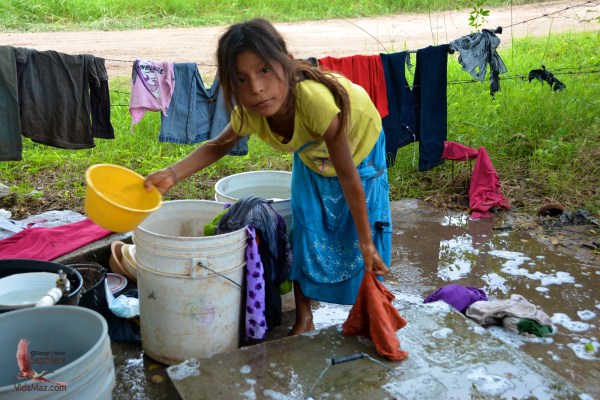
Doing the wash while her parents are in the fields

The plight of migrant agricultural workers sadly continues, decades after César Chavez’ death.

In one month this year, five children died just in the migrant camps of Teacapán: one fell into a ravine, another was bit by a scorpion, a third choked, a fourth drowned in an uncovered tinaco… On our trip to visit the migrant workers in Teacapán recently, we met a family that had lost a two year old just a few months ago. Such is what happens when adults need to work in the fields to feed their families, and children are left home to take care of younger siblings and neighbor kids. Click on any photo in this post to enlarge it or view a slideshow.

Most of us can agree that child labor isn’t a good thing. Many of us perhaps campaigned or voted to outlaw child labor. Grocery stores up north won’t buy produce harvested by children, so the local growers are vigilant to ensure that children don’t participate in agricultural activities. But, with the absence of effective support systems, and given the horribly inequitable economy in which we live, outlawing child labor has meant that children are dying, and are not being educated, in record numbers.

The thousands of migrant workers in Sinaloa come from places like Oaxaca, Chiapas, Guerrero—poorer states of the republic. Most of the workers are native Mexicans: Miztecos, Zapotecos… Many of them don’t speak Spanish, as it’s a foreign language to them. Most of them don’t have birth certificates or official documentation, as they were born at home and it’s not their custom to register with the government. Given the lack of language and birth certificates, most migrants are unable to enroll their children in school.

Sound like a hard life? Add to it the fact that the migrant workers are treated like outsiders in most any community in which they work. In Teacapán, for example, I was told the migrants pay 2000 to 3000 pesos a month for rent—of a ROOM, with no running water, no furniture, and most definitely no toilet or kitchen. It was heartbreaking to see.

During my trip to visit the migrant workers, there were still huge puddles of standing water on the roads, in the yards and fields. I was told that Hurricane Patricia dumped 25 inches of rain on Teacapán in 15 hours; the puddles were the months-later remnants of the flooding.

The migrant workers are disciminated against. Many of the townspeople tell their children to stay away from the migrants; they call them filthy and stupid. I suppose if I didn’t have access to water or a toilet at home, I’d be dirty, too. Last Christmas a church in Mazatlán brought toys to the migrant workers’ kids, and some of the townspeople made such a stink because their kids didn’t get toys, that the church was afraid to go back this year. The mistreatment of migrants is by no means limited to Teacapán; that is just where I happened to go visit them.

The migrant workers told me they stay here in Sinaloa for about six months, then travel to Baja or Zacatecas to continue their labors, rotating their residence to follow the agricultural cycle. One worker told me he is paid two pesos for a bucket of chiles; how is that for exploitation! Can you imagine how long it must take to pick a bucket of chiles? Women work all day in the fields, then return home in the evening to cook and care for the kids.

I went to visit the migrant worker families on a trip organized by Sue Parker of Vecinos con Cariño. Each of the ten or so of us on the trip that day paid 400 pesos, money which is used to buy food, disposable diapers, baby formula, and basic medical supplies (cough syrup, cold medicine, aspirin, first aid supplies), after paying the expenses of the van and driver.

In Teacapán we visited the home of Helen and Jerry Lohman. They have a gorgeous place, right on the ocean. Their yard is the biggest stretch of green grass I’ve seen in Mexico outside a golf course. The Lohmans and their driver, Ulises Gil Altamirano (a retired engineer), do all they can to help the migrant workers. Helen has learned the hard way that the migrants do not like to wear shoes (they wear huaraches or go barefoot), nor do the women wear slacks. She has personally sewn 22 pairs of jeans, 57 dresses, and 72 receiving blankets that she’s given out to the migrant families just in the past couple of months. She has five volunteers who now help her. Ulises works as ambulance driver, interpreter, and lawyer for many of the migrant families.

On this trip we also met Brenda Irvin, who lives in Teacapán with her husband. Despite having her arm in a sling, Brenda goes out three days a week every week to hand out nutritive biscuits and milk to the migrant children. Oh how they look forward to her visits! She has divided the town into four zones, and each of the days she goes out, she visits a different zone, in rotation.

Brenda, the Lohmans and Ulises worked hundreds of hours to get registration information for 500 members of the migrant worker community. They got a judge to agree to issue them birth certificates, so the kids could go to school, and the parents could get access to health insurance. But, after all that effort, the documentation remains in limbo; the judge has not come through on his word.

Brenda told me that a few years ago she happened to gain an audience with Governor Malova. She showed him photos of the conditions in which the migrant workers live. He agreed to get the state DIF (Family Development Services) involved. Now Sinaloa DIF sends milk, the nutritive cookies, and some other basic items to Teacapán regularly, and Brenda delivers them to the workers’ families.

I am posting a lot of photos, because the photos tell you more than I can with my words.

If you are interested in taking this trip with Vecinos con Cariño (VCC), contact Sue Parker via email. She tells me she will do a couple of trips in January, 2016.

VCC will welcome your donations; 100% of what you donate will go to help the migrant worker families. The money goes a long way; a donation of US$300 helps them clothe all the kids, for example. They will also take donations of gently used clothing, basic medical supplies, disposable diapers, and non-perishable food items.

Santa Visits the Isla

©35.DSC_0557

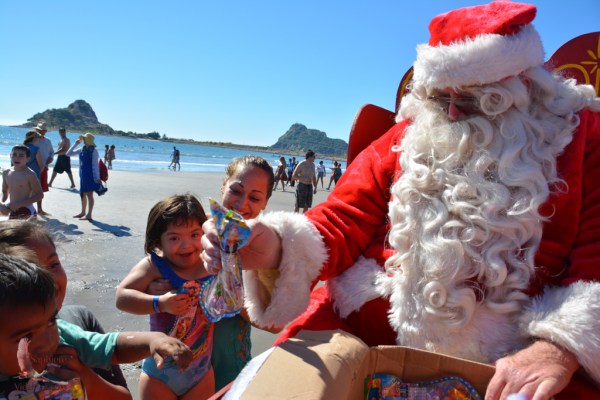
Don Wood, the Santa of Isla de la Piedra

I’ve been touched by the cool tradition of the “Gringo Santa” who hands out candy to the children on Stone Island. I find it encouraging when someone does their best to spread good cheer to others, and especially so when that someone is an immigrant in an adopted home.

So when our friend Dallas and his wife Rocio invited us to join the parade this year, to meet Santa and his helpers and enjoy the fun, we were ready to go! Danny and Rohit joined us, as did our friend Genaro and his kids.

Don Wood has been playing Santa on the Isla for about nine years now. He has a wonderful team of helpers who support the effort. The crew purchases 8000 pesos worth of candy-stuffed stockings, and then they pull a sleigh with a three-wheeler to be sure kids—old and young alike—get one. Click on a photo to enlarge it or view a slideshow.

We spent about two and a half hours handing out candy today, winding along the streets and alleys of the village and, at the end, right down the beach as well. The kids were so excited! Albañiles stopped working, and grandparents came running as well, so candy is obviously not just exciting for the little ones.

Santa has some very well-dressed and happy helpers, and the recipients of the candy stockings were all quite thrilled as well. Since Dallas drove the three-wheeler that pulled Santa, and Rocio played Mrs. Claus, Greg drove the rest of us in Dallas’ truck. Oh did we have fun!

After all the hard work, we enjoyed a terrific lunch together with our new friends at a palapa on the beach. We are very grateful to have been included. It was a great warm-up for handing out chickens tomorrow morning!

Below are just a few more pics I took today.


Happy holidays, everyone! And, Dallas, Rocio, Don, Nancy and crew—thank you and God bless you for what you do each Christmas!

La Reserva Chara Pinta

An easy day trip, as it’s 90 minutes from Mazatlán, I highly recommend that you spend a couple of nights in the very comfortable yet simple cabins/cabañas at the Tufted Jay Preserve on the other side of Concordia. There you can hike, listen to bird song, breathe fresh mountain air, and just generally relax. It’s a great place to go when it’s hot here in Mazatlán, as it’s high in the Sierras.

Most people go to Chara Pinta for the birdwatching. I love birds, but I sure don’t know their names, nor do I have the lens to capture them in the wild. Some day! If nay of you have an 800 mm Nikon lens sitting around that you’d like to sell me cheap, let me know 😉 Below are a few of the warblers and beauties I was able to catch with my 200 mm lens. Click on any photo to enlarge it or view a slideshow.

We saw some tufted jays or charas pintas, the birds for which the reserve is famous, but I’m afraid I was unable to capture them with my camera to share with you. Sorry! They are gorgeous!

We hiked pretty much all day on Saturday when we arrived, and then all Sunday morning as well. I honestly saw the most birds, however, when we stood still. On Sunday I sat in a chair and took most of the photos you see above. Three women talking and giggling (I went with two local friends) while they walk seems not to be the most conducive way to birdwatch!

The views up at the Tufted Jay Preserve are spectacular! There are mountains and valleys, cliffs, a rock outcropping called “The Pyramid,” a clear view to Presa Picachos/Picachos Dam, and views of Mazatlán by day and by night.

Needless to say, sunset and sunrise are gorgeous times of day and not to be missed, nor are the stars! Whoever thinks that stars are white has to rethink things if you visit la Reserva Chara Pinta. The blue, red and white stars blanketed the entire sky; it was amazing! Oh my how we enjoyed our visit! Be sure to enlarge these by clicking on them if you love starry skies!

I have been wanting to go to the Chara Pinta Reserve for a couple of years. My girlfriend Jeanett very much wanted to go, so off we went. We were told we were the first all-female group the ejido has hosted!

We hired Don Santos Vasquez as our guide; he is the President of the Reserve and a member of the local ejido that stewards the land. He took us on hikes up to the mirador/lookout, down in the canyons, and up to the Pyramid. He is a gentle and wise man who really knows this area, its flora and fauna. Santos does not speak English; he charges 100 pesos/hour for his guide services.

The cabins have solar panels so there is light and hot water for showers. There is gas for the stoves, so you can cook. You’ll need to take your own food and a cooler; if you are a group of ten or more you can request a cook who will serve you and your guests in the dining hall. Cabins are of wood, they are gorgeous, beds are comfortable, bathrooms are tiled, and there are barbecue and fire pits outside. The Reserve is a recipe for a wonderful couple of days reconnecting with nature. The caretaker of the property is Javier, another kind and gentle soul, who you can see in some of the photos below. He generously and ably made and tended our fire for us.

There are cabins for two people and cabins for ten people, as well as several sizes in between; all are well constructed and comfortable. Some have fireplaces. Some cabins are grouped together, others are off to themselves for added privacy. The place felt extremely safe, and our hosts were most hospitable.

The hiking trails are fairly easy and vary between jeep and foot trails; some are pretty steep. The vegetation we saw was incredible; such a variety, and all so very robust. We ate blackberries, we found wild cotton, we marveled at peeling bark and every type of fern, we saw dozens of types of pine trees, and thoroughly enjoyed ourselves breathing the fresh mountain air.

I’ll post more pictures of the wonderful stuff we saw below, but for those of you interested in going, let me give you the information.

HOW TO RESERVE AND GET THERE, WHAT TO BRING

To reserve a cabin, call 044 66 9134 0166. You can also have book Don Santos’ guide services via that number. Reserva Chara Pinta is just this side of the small town of El Palmito. Take the toll road towards Durango, and exit at pretty much the only exit there is—towards El Salto. You’ll go about 15-20 minutes on the old highway, and then just before you reach El Palmito, you’ll see a sign for the Reserve on your left. The final 10 minutes are on a dirt road up a steep climb. I recommend a 4WD or at least an SUV. If you prefer, there are also cabañas in town; they are definitely not as picturesque, but they do have easier access.

We were told that the best time to go is in June, when the guacamayas/macaws can be viewed, and in July, when the tufted jays are nesting. All year round is good, however, as we were told it doesn’t snow at Chara Pinta, nor does it get that cold (we used light jackets).

Bring a towel, soap and toiletries, water, and any food you want to cook or eat as well as a cooler. Bring a flashlight if you want to walk outside at night, and charcoal if you want to barbecue; they have plenty of wood for a fire. We also brought extra blankets, but you don’t need them; the reserve supplies sheets, pillows, blankets and toilet paper. Also don’t forget the sunscreen.

Okay, so on to the rest of the flora. I used to live in Colorado, so I know and love bromeliads, otherwise called air plants. Chara Pinta is absolutely filled with them!

And where there are air plants, there is usually moss. In Chara Pinta there is loads of it:

We marveled at the gorgeous flowers as well. Wild mountain flowers are always so colorful and often so very dainty:

Perhaps my favorite aspect of the flora in the Sierras are the textures: bark, dried plants, leaves, pine cones of all varieties, peeled bark, curly ferns, pine needles three feet deep and joyously comfortable to lay on…

Finally, I really enjoyed the leaves of all colors and types. There were fresh green leaves, leaves with the trail remnants of some insect, leaves in silver and gold, and leaves in red and brown.

We absolutely loved our trip and will be going back in June or July. I highly recommend you make the trip if you haven’t already!