No Child Labor a Good Thing?

©1.DSC_0402

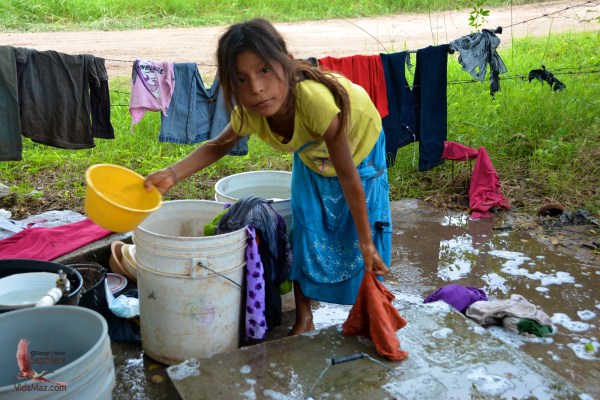
Doing the wash while her parents are in the fields

The plight of migrant agricultural workers sadly continues, decades after César Chavez’ death.

In one month this year, five children died just in the migrant camps of Teacapán: one fell into a ravine, another was bit by a scorpion, a third choked, a fourth drowned in an uncovered tinaco… On our trip to visit the migrant workers in Teacapán recently, we met a family that had lost a two year old just a few months ago. Such is what happens when adults need to work in the fields to feed their families, and children are left home to take care of younger siblings and neighbor kids. Click on any photo in this post to enlarge it or view a slideshow.

Most of us can agree that child labor isn’t a good thing. Many of us perhaps campaigned or voted to outlaw child labor. Grocery stores up north won’t buy produce harvested by children, so the local growers are vigilant to ensure that children don’t participate in agricultural activities. But, with the absence of effective support systems, and given the horribly inequitable economy in which we live, outlawing child labor has meant that children are dying, and are not being educated, in record numbers.

The thousands of migrant workers in Sinaloa come from places like Oaxaca, Chiapas, Guerrero—poorer states of the republic. Most of the workers are native Mexicans: Miztecos, Zapotecos… Many of them don’t speak Spanish, as it’s a foreign language to them. Most of them don’t have birth certificates or official documentation, as they were born at home and it’s not their custom to register with the government. Given the lack of language and birth certificates, most migrants are unable to enroll their children in school.

Sound like a hard life? Add to it the fact that the migrant workers are treated like outsiders in most any community in which they work. In Teacapán, for example, I was told the migrants pay 2000 to 3000 pesos a month for rent—of a ROOM, with no running water, no furniture, and most definitely no toilet or kitchen. It was heartbreaking to see.

During my trip to visit the migrant workers, there were still huge puddles of standing water on the roads, in the yards and fields. I was told that Hurricane Patricia dumped 25 inches of rain on Teacapán in 15 hours; the puddles were the months-later remnants of the flooding.

The migrant workers are disciminated against. Many of the townspeople tell their children to stay away from the migrants; they call them filthy and stupid. I suppose if I didn’t have access to water or a toilet at home, I’d be dirty, too. Last Christmas a church in Mazatlán brought toys to the migrant workers’ kids, and some of the townspeople made such a stink because their kids didn’t get toys, that the church was afraid to go back this year. The mistreatment of migrants is by no means limited to Teacapán; that is just where I happened to go visit them.

The migrant workers told me they stay here in Sinaloa for about six months, then travel to Baja or Zacatecas to continue their labors, rotating their residence to follow the agricultural cycle. One worker told me he is paid two pesos for a bucket of chiles; how is that for exploitation! Can you imagine how long it must take to pick a bucket of chiles? Women work all day in the fields, then return home in the evening to cook and care for the kids.

I went to visit the migrant worker families on a trip organized by Sue Parker of Vecinos con Cariño. Each of the ten or so of us on the trip that day paid 400 pesos, money which is used to buy food, disposable diapers, baby formula, and basic medical supplies (cough syrup, cold medicine, aspirin, first aid supplies), after paying the expenses of the van and driver.

In Teacapán we visited the home of Helen and Jerry Lohman. They have a gorgeous place, right on the ocean. Their yard is the biggest stretch of green grass I’ve seen in Mexico outside a golf course. The Lohmans and their driver, Ulises Gil Altamirano (a retired engineer), do all they can to help the migrant workers. Helen has learned the hard way that the migrants do not like to wear shoes (they wear huaraches or go barefoot), nor do the women wear slacks. She has personally sewn 22 pairs of jeans, 57 dresses, and 72 receiving blankets that she’s given out to the migrant families just in the past couple of months. She has five volunteers who now help her. Ulises works as ambulance driver, interpreter, and lawyer for many of the migrant families.

On this trip we also met Brenda Irvin, who lives in Teacapán with her husband. Despite having her arm in a sling, Brenda goes out three days a week every week to hand out nutritive biscuits and milk to the migrant children. Oh how they look forward to her visits! She has divided the town into four zones, and each of the days she goes out, she visits a different zone, in rotation.

Brenda, the Lohmans and Ulises worked hundreds of hours to get registration information for 500 members of the migrant worker community. They got a judge to agree to issue them birth certificates, so the kids could go to school, and the parents could get access to health insurance. But, after all that effort, the documentation remains in limbo; the judge has not come through on his word.

Brenda told me that a few years ago she happened to gain an audience with Governor Malova. She showed him photos of the conditions in which the migrant workers live. He agreed to get the state DIF (Family Development Services) involved. Now Sinaloa DIF sends milk, the nutritive cookies, and some other basic items to Teacapán regularly, and Brenda delivers them to the workers’ families.

I am posting a lot of photos, because the photos tell you more than I can with my words.

If you are interested in taking this trip with Vecinos con Cariño (VCC), contact Sue Parker via email. She tells me she will do a couple of trips in January, 2016.

VCC will welcome your donations; 100% of what you donate will go to help the migrant worker families. The money goes a long way; a donation of US$300 helps them clothe all the kids, for example. They will also take donations of gently used clothing, basic medical supplies, disposable diapers, and non-perishable food items.

A Very Happy Christmas for All

THANK YOU THANK YOU THANK YOU all for your help, participation, prayers, support and enthusiasm! We gave out 2512 whole chickens and 1800 despensas. That means that 2000 of the most marginalized families in our community are able to eat for two weeks because of you. Woot woot!

I am especially proud this year of my son, Danny. He began helping with the Chicken Breakfast when he was six or seven years old, when we came down here as tourists. This year I watched him jump in and take charge, helping organize volunteers for a more effective handout. He loaded chickens and despensas, and smiled all the while.

I am also very proud of our nieces, the Hernandez girls: Arely, Vanessa, Yolanda and our ahijada, Mara. Every year they’ve participated they do it a bit more actively. First they gathered some clothes, then they waited tables at the breakfast, then they got friends to donate items for the auction and bazaar. This year, in addition to all that, they also collected nearly 200 brand new toys to hand out to the kids! Brava, chicas!

I want to thank that terrific church in Canada (Calgary?) that collected clothing. We got 1/3 of it, thanks to Sue Parker and Vecinos con Cariño. It was a lot, and people LOVED it.

Wondering what to collect for next year? The most popular items this year were:

  1. TOWELS! OMG! People nearly stampeded for the 20 or 30 towels our family donated. Next year we’ve got to find a hotel or two that is buying new pool towels and wants to give their old ones to us!
  2. Mosquito coils. We happened to have an extra few packs, and people were ecstatic. Definitely a good item to add to the list.
  3. Chanclas/sandals and shoes. Everyone loved them. But, please, give us gently used items. This year we had to throw out three large trash bags full of items that were way beyond any useful life, which breaks our hearts. This is an attempt to bring joy to people.

Every year the handout of the chickens is different than the year before. We improve our systems, we learn. This year we were all packed and ready to go on the 23rd. Then, at 7 pm on the 23rd, someone turned in their ticket money from the breakfast, and someone else made a donation. So, Yolanda and Jorge went shopping, arriving home at 10 pm! Then, when we all arrived on the morning of the 24th, we had more packing to do before we loaded the trucks. It was quite the surprise, but all the volunteers gamely joined in and we had an extra 500 despensas packed in no time. Then, to make up for lost time, we had TWO lines of people simultaneously loading the despensa trucks, PLUS another group loading chickens.

We were able to do our prayer circle by about 8:30 and get out on our nine routes to the squatter communities or invasiones.

Blessed New Year, everyone! Thank you and bless you all!

Santa Visits the Isla

©35.DSC_0557

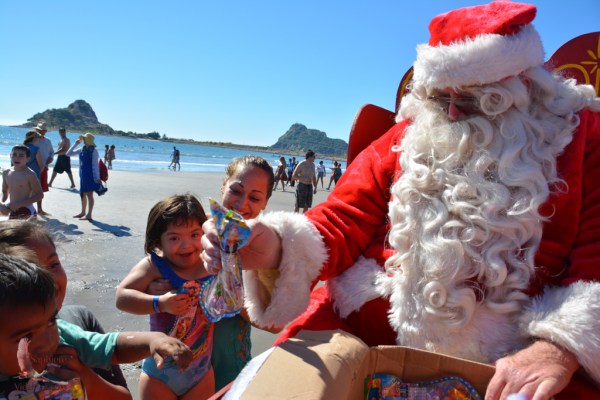
Don Wood, the Santa of Isla de la Piedra

I’ve been touched by the cool tradition of the “Gringo Santa” who hands out candy to the children on Stone Island. I find it encouraging when someone does their best to spread good cheer to others, and especially so when that someone is an immigrant in an adopted home.

So when our friend Dallas and his wife Rocio invited us to join the parade this year, to meet Santa and his helpers and enjoy the fun, we were ready to go! Danny and Rohit joined us, as did our friend Genaro and his kids.

Don Wood has been playing Santa on the Isla for about nine years now. He has a wonderful team of helpers who support the effort. The crew purchases 8000 pesos worth of candy-stuffed stockings, and then they pull a sleigh with a three-wheeler to be sure kids—old and young alike—get one. Click on a photo to enlarge it or view a slideshow.

We spent about two and a half hours handing out candy today, winding along the streets and alleys of the village and, at the end, right down the beach as well. The kids were so excited! Albañiles stopped working, and grandparents came running as well, so candy is obviously not just exciting for the little ones.

Santa has some very well-dressed and happy helpers, and the recipients of the candy stockings were all quite thrilled as well. Since Dallas drove the three-wheeler that pulled Santa, and Rocio played Mrs. Claus, Greg drove the rest of us in Dallas’ truck. Oh did we have fun!

After all the hard work, we enjoyed a terrific lunch together with our new friends at a palapa on the beach. We are very grateful to have been included. It was a great warm-up for handing out chickens tomorrow morning!

Below are just a few more pics I took today.


Happy holidays, everyone! And, Dallas, Rocio, Don, Nancy and crew—thank you and God bless you for what you do each Christmas!

Handing Out Tickets for Chickens

DSC_0113©

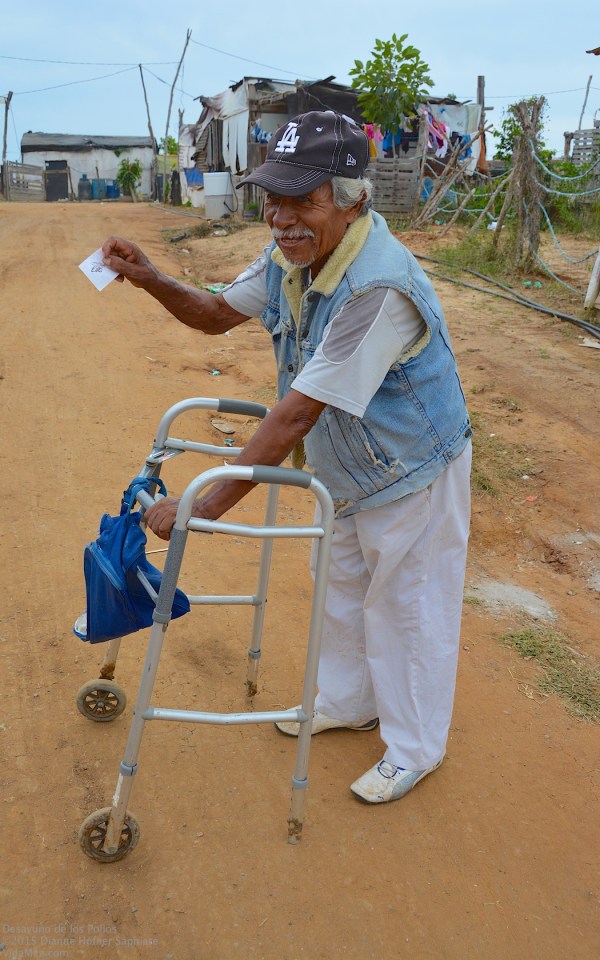
So happy to have his ticket for a chicken and despensas! He offered to make us mole.

Thanks to your help we are able to feed 2800 families for a couple of weeks at Christmas time. This has been going on for over a quarter of a century, and is called “The Chicken Breakfast” or Desayuno de los Pollos. On the morning of Christmas Eve (December 24th) we hand out a whole chicken plus despensas (rice, beans, sugar, oil, etc.) to families living in often dire conditions. This is an event coordinated by the Medina family, and it is very multicultural and bilingual. Join us and get to know some very cool people!

There are so very many ways you can help. How about buying some Christmas-themed fabric on sale after the holidays, and either making things for the bazaar next year with it, or giving it to us, and we’ll find women who will transform that fabric into goodies? How about collecting or donating things for the silent auction? Know someone who deals in chickens or despensas? Help us get a deal to better feed the needy! You can attend the fundraiser breakfast next year. Put us on your 2016 calendar!

For this year, gather together some new toys or stockings filled with candy, kitchenware, or gently used clothing. Bring a truck if you have access to one. Meet us early on the morning of the 24th at Quince Letras (directions here at http://www.DesayunodelosPollos.com).

In the meantime, enjoy some of the photos from today. Click on any photo to see it larger or view a slideshow.

This event has made my Christmas for a long time, and it is a pleasure to be able to continue being involved. I wish you the happiest of holidays, and all the best in the new year!

Need Help Packing and Muchísimas Gracias

IMG_8379

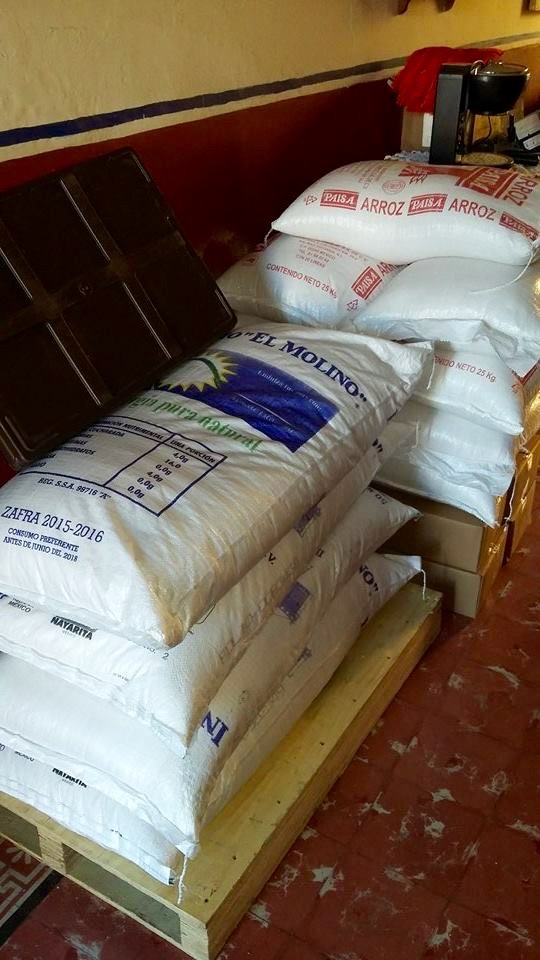
The rice, sugar and beans are in! These are just part of the food we’ll be handing out to those in need in our community on Christmas. We could sure use your help packing foodstuffs into smaller bags, so we’re ready for the 24th. If you are able to help, please call Jorge (he speaks English very well) at 6691-10-07-44. And invite your friends! This is a great way to do some good for an hour or two while catching up with friends in conversation!

As Christmas gets closer, we will need help sorting clothes as well. Thank you for pitching in!

If you need directions on how to get to Quince Letras to help with packing or to load trucks and join a convoy on Christmas Eve morning, visit: http://www.DesayunoDeLosPollos.com

Thanks to your help, Desayuno de los Pollos set yet another record this year. In the silent auction we collected 27,000 pesos, which will enable us to buy whole chickens and despensas for those 2800 or so families we feed each Christmas. I don’t yet have the overall numbers, but families in the invasiones will be happy! Below I will list those sponsors that I know of; if you helped and wish to be added to the list, please let me know.

I have a nice story to tell. Jeanett Sanz, interior designer, made a donation to the auction and came to the breakfast. The winner of her auction item is now wanting to contract her to update her home. Please put the Chicken Breakfast on your calendar for next year! Your goodwill can help build your business!

GRACIAS MIL to those who donated items for the breakfast:

  • Athina Spa
  • Barracruda’s
  • Candis Dear (hand-crocheted scarf)
  • Casa 46
  • Casa Canobbio
  • Casa Etnika
  • El Cid
  • Enrique Perraza Chavarin (tours)
  • Essence Spa
  • Fish Market
  • Gwen (baby quilts)
  • Il Mosto
  • La Rosa de las Barras
  • Jeanette Leraand (50-50 raffle)
  • Look Vintage and Modern Gallery
  • Marina Mazatlán Golf
  • Medina Wrought Iron
  • Pastelería DPatty
  • Paulina Carrillo (watercolor)
  • Pedro y Lola’s
  • Restaurante La Famosa
  • Restaurante La Palapa
  • Restaurante La Terraza
  • Salsa y Salsa (these amazing women donated US$1000!!!! Bless your souls!
  • Sanz Gallery Diseño Interior
  • Sonrisas
  • Sue and Dave Parker (Tikio paintings)
  • Tippy Toes Salón
  • Los Venados baseball team