Tortugas Marinas/Sea Turtles

One of the many fortunate aspects about living on the beach in Mazatlán is that often, whether we’re walking the beach or the malecón, or sitting on the beach eating lunch or dinner, a marine turtle may suddenly crawl up to shore to lay her eggs. It is always cause for joy. It is such a gorgeous miracle to witness, and one we can easily take for granted.

The season starts in September each year, and yesterday I saw my third sea turtle so far this year. The turtle is usually fairly strong as she crawls up onto the beach. She is obviously made for the water, and struggles in the sand, but she crawls up to well above the high-tide line. She settles on a nesting spot, and then begins to dig a hole in the sand.
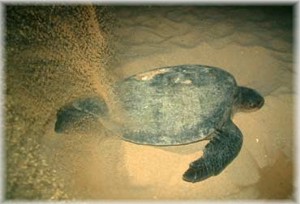


The turtle then buries her backside in the sand, above the hole, and lays her eggs. They lay a LOT of eggs at once. After she lays her eggs, the turtle usually rests for a few moments, but she is also usually very eager to get herself back into the ocean, where she is more mobile and less at risk of harm. It is so very heart wrenching to watch the mother sea turtle make her way back over the sand and into the ocean. She has no energy left, she is so very tired, and she just struggles something awful. Most people who watch tend to start cheering her on from a distance. It’s a nice community-building event.

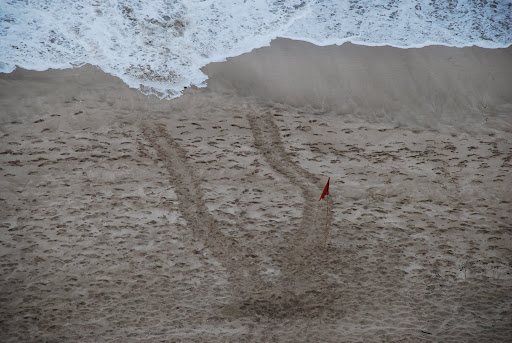
Here is a photo taken from our terrace of a turtle’s tracks, in and out, to lay her eggs. You can see the spot in the sand where she laid her eggs. This photo was taken after the Aquarium official had already removed the eggs for safe-keeping.
Sea turtle eggs unfortunately fetch a high price on the black market. I think people eat them as an aphrodisiac. Some people also kill the endangered turtles; “caguama” is a beloved, though black market, dish for many Mazatlecos, sadly. People use turtle hide to make things, and they use the oils in skin lotions and creams. Years ago I remember seeing a lot of turtle lotions and items for sale in the beach areas of Mexico. Fortunately these days we see a lot less.

I am no naturalist, but in doing some research on the internet, it seems we have three primary species that nest here on the east coast of the Sea of Cortés, Green Sea Turtles, Hawksbills, and Kemp’s Ridley Sea Turtles: http://www.greenpacks.org/2008/08/25/sea-turtles-endangered-marine-life

The sea turtles are endangered:
http://www.panda.org/what_we_do/endangered_species/marine_turtles/
There are signs everywhere on the beach that if you see a turtle, please call the police or the aquarium immediately, as they will come to keep the people away (so that the turtle can lay her eggs in peace), and they will make sure no one steals the eggs.

Despite the best efforts of most people, who keep a respectful distance away, there seem to be plenty of idiots who try to “help” the turtle by getting in her face and crowding her. Just what any birthing mother wants, right? Watch this YouTube for an example of some people’s heartbreaking behavior:
http://www.youtube.com/watch?v=WXka-FQJvsQ&feature=related

The turtle eggs are taken to one of three local spots that I know of for hatching, the Mazatlan Aquarium (click on Mazatlan on the map): http://www.grupotortuguero.org/imap.php?l=1

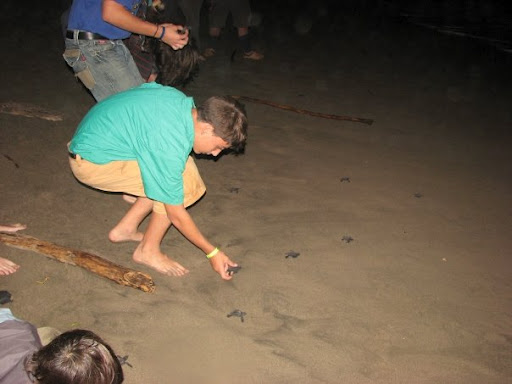
Down south to Estrella del Mar (a golf resort that has a sea turtle hatching facility), and up north in Marmol. They regularly hold baby sea turtle “release” events, where the babies are released into the ocean. Danny’s been fortunate enough to release baby turtles several times, including with the Scouts. Each year his troop hikes north on the beach for 6-7 hours or so, releases baby turtles, then camps overnight and celebrates with a huge bonfire on the beach. Below are some photos:

And there is a YouTube video of a baby turtle’s quest for the open waters:
http://www.youtube.com/watch?v=xthy69jHKOQ

Las Temporadas de Mazatlán/Seasons of the Year, Updated


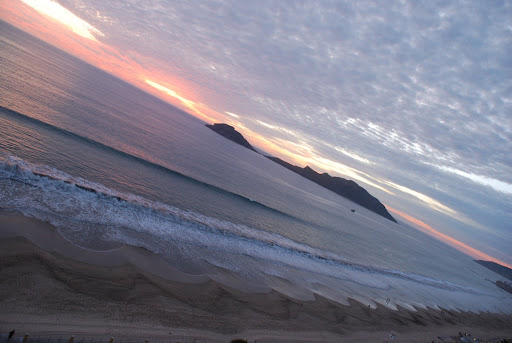
  • Season of the Curved Tides (January-February): The ocean waves come in with scalloped edges, leaving the sand on the beach with ripples. It’s beautiful! (See the photo above for an idea.)

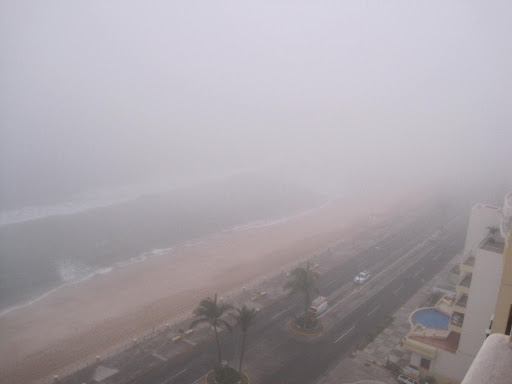
  • La Temporada de la Neblina, Fog Season (February or anytime as late as May): Starting around Carnavál and continuing for a few weeks, the cold ocean air meets the warm land and….our building disappears, as does Ice Box Hill and many other landmarks, for a good portion of the morning.


IMG_2985

  • Season of the Crying Screens, in May-June, after the heat of summer begins and before the rains start. We get condensation of salty ocean air on our window screens.
  • La Temporada de los Candidatas, the season of the PARADES!!! (May): Two kinds of candidates: political and royal. The royals are the fun ones—girls (and sometimes boys) from all over the metro area, who want to be queen or king of their school. They walk the malecón, the plazuela, and the Golden Zone collecting donations, usually accompanied by their court if they’re teenagers, and by their families if they’re primary school kids. When the little girls wear nice dresses, boy then am I a supporter of their cause! Parades of course accompany the campaigns of both kinds of candidates. Parades include multiple live bands (not marching but riding), cool cars, loads of balloons, horn honking, and sometimes fireworks. The political campaigns include the standard posters, bumper stickers, t-shirts, etc., and their parades, unfortunately, include the loudspeaker campaign speeches.

  • Season of the Panzas–or Panzones! (July-October): If you are walking the malecon, walking to the market, or basically just standing outside, beware of the bare bellies! Men of all shapes and sizes seem to quite enjoy the air conditioning they achieve by rolling up their shirts and exposing their mid-sections. Unfortunately, six pack abs are few and far between! This is also the season to carry a wash cloth or small towel–sweat rag season. A handkerchief will NOT be sufficient. 🙂
  • Septi-Hambre, Hungry September: The month when those who serve the tourist trade complain because there are neither national nor international tourists around.
  • La Temporada de Venezia, The Season of Venice (August and September): This is when you need a gondola to get your son to school, or to go grocery shopping. MUST wear waterproof shoes and shorts, as streets are flooded at least 1/2 meter deep and more in places.
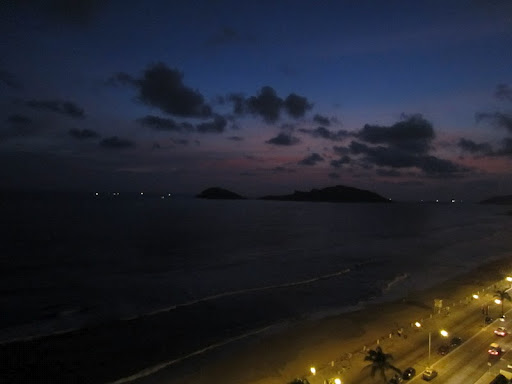
  • Necklace on the Bay Season (September or October through April or so): Open season on shrimp! US$4/kilo and even cheaper, higher for the really giant ones. You can get shrimp any time of year, but the legal shrimping season is now, so you can get fresh not frozen shrimp now. Mmmm. Our fleet is the biggest in Latin America. Opening day of the “veda” is one of my favorites. The shrimp boats all leave port, and in the darkness of night you see the lighted boats forming a beautiful necklace around the bay. Very difficult to capture on film, but incredibly beautiful and, from our experience, it only happens once a year. Don’t miss it! Opening day of the season….

This is the sixth update to this post. I’ll keep updating this post as I learn more.

Crane Convention

As I was driving Danny to school this morning, it seemed every crane, heron, wood stork, ibis (scarlet and white) and roseate spoonbill on the Pacific coast wanted in on the party. Was it a birthday? Quinceañera? Maybe a wedding? Or a discussion of how big birds should respond to the flu pandemic? No doubt it was the fact that something edible had just spawned in the water there, but it was beautiful!

In the estuary north of Insurgentes, behind Howard Johnson’s and Cherry, south of Mega. Right in the middle of town!

Link to the photos themselves or a larger slideshow.

Sinaloa Geckos

An online acquaintance of mine, Ken Layne, lives in the mountain pueblo of El Quelite. He’s a terrific writer, and I loved this story about our Sinaloan geckos. I hope you’ll enjoy it.


THE LIZARDS ARE ON STATION ©2006, Ken Layne

Hawaii has its geckos that hang around people’s homes, schools, and businesses to keep the bug population under control. These little green lizards have been memorialized on thousands of tee shirts, baseball caps, handbags, and countless other tourist items. They even star in TV commercials for an insurance company. Sinaloa, too, has its own unique family of lizards that challenges the Hawaiian geckos as household fixtures.

Most folks in Mazatlan do refer to these little lizards as geckos, and they probably are members of the gecko family. I think there are couple dozen varieties of geckos worldwide. These Sinaloa gecko-lizards are unique, though, in appearance and lifestyle.

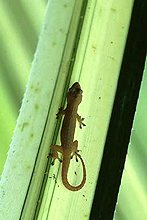
These little lizards are integral parts of every building in El Quelite, patrolling the ceilings and upper walls for insects. Unlike the Hawaiian geckos, which are bright green and can grow to a good size, the Sinaloa lizards are quite small — average length, about 3 inches — even when fully grown, and are almost translucent. Small size doesn’t hinder them in their insect-exterminatin g job, however. I’m sure that they are a major factor in keeping the Sinaloa spider population as low as it is.

In our house, the lizards hide by day behind the paintings on the walls and in small cracks and holes at the rafters. Conchita makes it a point never to take the pictures off the walls for cleaning. Rather, she dusts them in place. If you disturb the lizards, they might get upset and leave home — not good.

The lizards start to come out of hiding around 4:00 in the afternoon. They appear gradually. One may sprint out from behind a picture and run to the top of the wall. There, it will sit absolutely motionless for what seems an eternity. I think they even stop breathing and go into a catatonic trance. I know that any lizard can out-wait me. I’ll give up staring at one and go away before the lizard decides to move.

After the first lizard emerges, others gradually appear and start chirping. Yes, chirping! These little lizards talk to each other by chirping. Lizard chirp has a lot of volume and expressiveness. Lizard chirp is in the vocal range of a mocking bird or a magpie.

The first chirp is usually notice that the lizard has appeared for duty:

“Chirp! Lizard number 4 on station.”

How something that small can made such a noise is amazing.

These lizards are quite territorial. Each has its own area to patrol; if one lizard wanders into another’s turf, a war of words breaks out. A mighty dialogue of chirping ensues for several seconds until one lizard gives ground and retreats.

Occasionally, when tempers flare high, the lizards will square off like two Sumo wrestlers staring each other down. Then one lizard will launch a Kamikaze attack on the other. Darting across the wall or ceiling, the attacking lizard tries to strike a blow on the other’s flank. The rule seems to be that if the attacker achieves a strike, the other must leave the field of battle. If the attacker misses, it must continue on, out of the disputed territory. They don’t try to harm each other; they simply count coup to settle their disputes.

As I said, the lizards are territorial. Lizards on the south wall, never venture to the north wall, just 30 feet away. Ceiling lizards keep to the ceilings, while wall lizards patrol the walls. The latter never venture below windowsill level. I’ve yet to encounter a floor lizard.

One wise and enterprising lizard staked out the territory around the kitchen light. The kitchen light is a bare bulb in a receptacle mounted on one of the kitchen ceiling beams — decidedly not a decorator item but perfect for a lizard. The lizard in charge of this area will sit on the beam for hours, motionless for 10 to 20 minutes at a time. Here he enjoys the warmth of the 60-watt bulb and snatches any flying insects that venture too close to the light. Lizards are very smart.

Throughout the evening, the lizards come and go. They patrol their territory but periodically dart back to the safety of the pictures on the wall. We take a lizard census each evening. The highest count that we have gotten so far for the number of lizards present at one time is 8.

At bedtime, our lights go out. We can lie there in the darkness, falling asleep to the chirps of the lizards on patrol. At sunrise, we awake and the lizards are all gone — back to their hiding places until the afternoon when they once again appear on station.

Swine Flu


Influenza porcina, swine flu, has been found to be a combo of pig, bird and human flu viruses. Despite a huge economic hit, Mexico has closed schools, theaters, concerts, even restaurants and wedding halls. They’ve urged people to stay home despite this being a 5-day holiday weekend.

As it’s a new strain of flu, it’s of course a serious situation and demands caution. I’ve learned a couple of things.

  • Most people hear “pandemic” and think “death.” Pandemic seems to have the definition of a disease that hits a certain number of countries. That disease does not necessarily have to be fatal.
  • The WHO (OMS) and the US CDC (Center for Disease Control) do not necessarily agree on how to respond to a potential pandemic, or a new strain of virus.

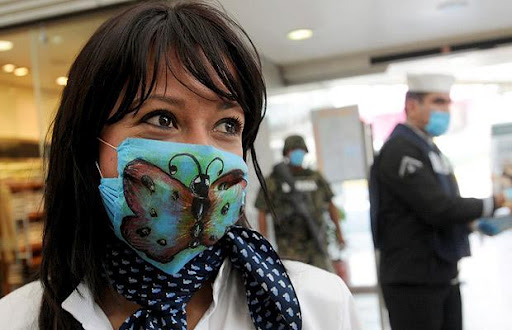
One of the things we love here in Mexico is the great humor of the majority of the people. There are quite a few songs about the swine flu. My favorite is the Cumbia de la influenza.  Many people, particularly those in the hard-hit Distrito Federal, and those who interact with the public, are wearing “tapabocas” or “cubrebocas,” face masks to prevent the spread of the germs. Check out some of the ways locals have found to alleviate the fear.


Hopefully the scare will be short-lived and all the precautions taken proven unnecessary. Hopefully school will start again on Wednesday, as originally planned, or I’m afraid our kids will be studying well into summer and not get much of a break. And, hopefully, all of you are washing your hands frequently, drinking plenty of clean water, getting your rest, and staying healthy.