Another Beautiful Mazatlan Sunday Bike Ride

I ride my bike a lot in Mazatlan. It is a great town for bike riding, at least as far as I’m concerned. Some people are put off by the traffic (pedestrian and vehicular), but I think it adds to the excitement and challenge.

Most people do what I used to do and go up and down the malecon (or boardwalk) along the ocean. It is relatively flat, very scenic and overall very safe. However, it is not very challenging and if you are trying to get in some good cardio or burn a few extra calories, you either tow a bag of bricks behind you or seek a tougher ride.

I started seeking tougher rides nearly two years ago. I started going north to the far end of town, but that involved too much street time and too many crazy drivers. It was all flat other than the two bridges that are more of a workout due to the speeding traffic then the incline or distance. I also have experimented with riding downtown and do still enjoy it from time to time. It is best to go really early and realize that for a great workout, you will be going up and down the same small  hills over and over.

Mazatlan has two big hills – both in the southern part of town, called Olas Altas. Mazatlan also has the second tallest natural lighthouse in the world. So, about six months ago, I decided to combine the challenge of an up and over a good sized hill with a climb to the top of the lighthouse for a good cardio workout.

If you do not know Mazatlan, you can’t imagine what a wonderful ride this is. So today I packed along my camera and took a few pictures in an attempt to show at least some of what I like about this ride. As for the hill, well, I admit it doesn’t look like much in these pictures, but it is a moderate challenge for me and of course is getting easier the more times I go. Try it and see.

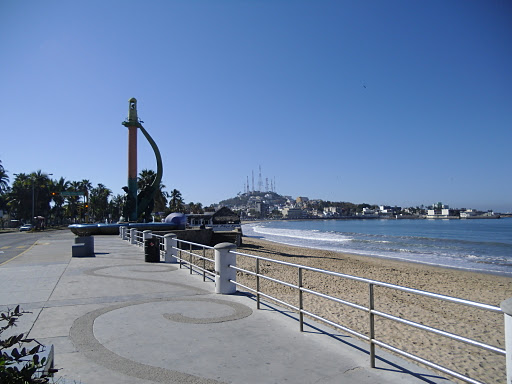
Here is the malecon looking south from in front of our house:

Here you can see the curve of the bay and how flat most of the malecon is:
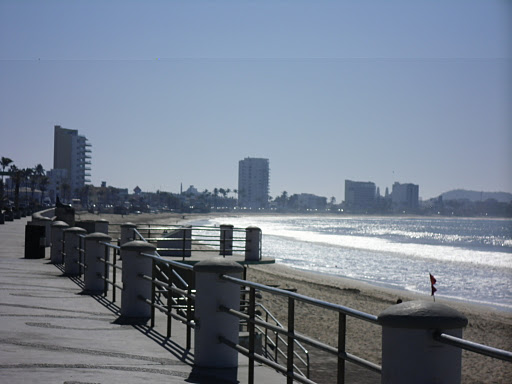
 

The curve and flatness continue as we go past the Fisherman’s Monument:
Once we get past the fishing boats, there is a small incline, but not much of a challenge:

Are you digging the view as much as I am? Can you see why so many people choose to just stay on the malecon? At this point we are directly across from where we live and have gone around the bay. Our building is circled:

Now, there is another incline in the road to make for a little challenge:

After we round the corner and go past some vendors and the huge flagpole, we begin to see the hill to the right of the statue in the picture below and the lighthouse on the far right:
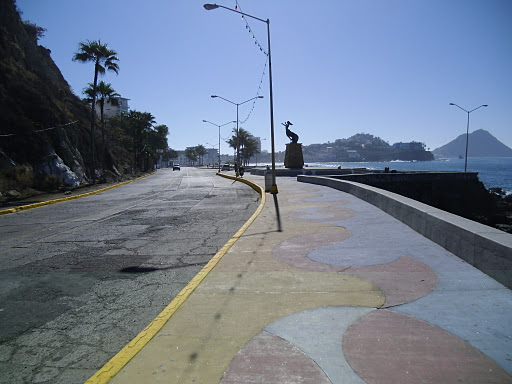
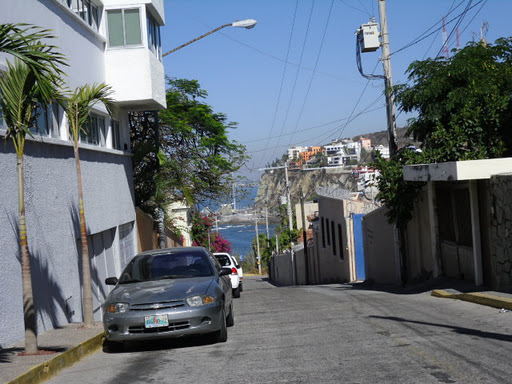
As we get a little closer, we can zoom in on the first part of the hill that we will need to climb. Today, Sunday, is the easiest day. During the week the school (blue and white building) at the elbow in the road is very busy. The turn is extremely tight and there are cars and kids everywhere. The hill is essentially three little hills in one. We will go straight up towards the school, turn left away from the ocean and then turn right and rise up above and behind the school, before eventually turning right and enjoying the downhill ride to the road to the lighthouse.

Here we are ascending the hill towards the school and a shot looking back from the school:

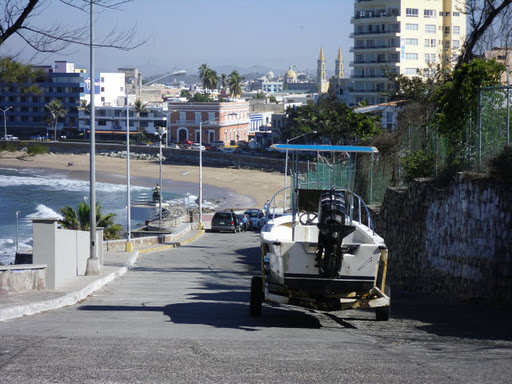
Next we turn left and parallel the school (hill 2):

From the next corner we pause to look behind us:

And in front of us (hill 3):

It’s at this time that my heart is usually working the hardest. With an allowed maximum heart rate of 170, I am happy to see that I have not overdone myself today:

If you look closely, you can see that we have only been at this for 28 minutes. It’s taking longer to type this than to ride it!

Looking back down hill 3:

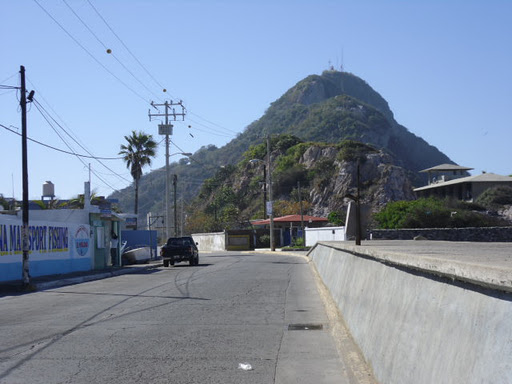
And ahead to the downhill ride the awaiting lighthouse:

The approaching lighthouse and a look back at the fun downhill ride we just had:

The road to the lighthouse – water on both sides. The lighthouse used to be an island, but a road was built over the rocks to accommodate traffic.
We have written about the lighthouse. You can read that entry here. Some people actually ride their bike up the switch back dirt path and then carry the bike up the stairs (or turn around). What I like to do is tie up my bike at the bottom. Fast walk up the path and 300+ steps, spend two minutes at the top, hurry down the stairs and then run down the path and jump back on my bike. It keeps my heart pounding and takes about 30 minutes depending on how many people I have to get around on the stairs. It is a great workout. My final picture is my bike tied up to a telephone pole waiting for me as I complete my trek down the hill. To get home, I go back the way I came. Total time is usually around 90 minutes, give or take as the wind and stopping to talk to friends often makes a difference.

A note about the picture. If you look to the right, you see three people sitting in the middle of the roundabout–one with a guitar. These three guys were sitting there when I got there and when I left just playing music and singing old Mexican ballads (quite well too). Just one of those little treats here in Mazatlan that helps me remember why we moved here.

If you ride a bike here, please be safe. It takes a little getting used to. Most of all be careful and have fun. Enjoy your ride!

Coffee Shops/Coffee Culture in Mazatlán


My previous experience with coffee in Mexico was Mexico City. I lived there during the summers from the time I was 13 till I was 19. Chilangos, in my experience, loved their coffee. My friends and I drank lots of expresso and cappuccino, over hours and hours of talking and laughing and generally enjoying being together. Most every restaurant we went to served delicious coffee drinks. Coffee grows in Mexico, it’s part of the traditional culture of the country, so I looked forward to this luxury when I moved to Mazatlán.

Thus, it was quite a shock to me when I discovered that most restaurants here in town, indeed, do not have an expresso machine! I’d order my beloved cappuccinos in a restaurant here in Mazatlán, and almost never would I get one. They only served that dreaded cafe americano, or worse yet, instant “Nescafé”! I’m not sure if the overall coffee culture has changed throughout Mexico, if it’s just DF that had that culture, or if it’s just Mazatlán that never really adopted a coffee culture. But here, I have to go to a coffee shop to get a good cup of cappuccino. With a few exceptions.

Every Friday we climb the lighthouse. Though my husband hates coffee, he generously and most kindly agrees to sit with me in the Looney Bean Olas Altas afterwards, prior to starting our work day. This last Friday something struck me. The place was really crowded, and it was puro gringo. This time of year all the snow birds are here, and El Centro in particular transforms itself. If I lived down there I’d be used to it, but it was a bit startling to me. So I started thinking. When I go out with my (local) girlfriends for coffee, it’s either late morning/noontime, or it’s in the evening around 8:00 or later. Then the coffee shops are filled with Nationals.

I like to drink coffee in the morning. Give me my caffeine; get my engine started! When Greg sits with me at a coffee shop in the morning, he says it’s like a methadone clinic: people are all anxious for their “fix”!!!! We wake up at 5:30 am Monday through Friday in order to get our son out the door to the school bus. Yes, I have an expresso machine; I can make my own cappuccinos. But I’d love to be able to go out and have a cup of good coffee early in the morning. Thus, my dismay when I moved here to discover that most coffee shops do not open till 10:00, a few at 9:00, many at 11:00 or later. Fortunately for me we have this wonderful gringo-owned, early-opening coffee shop in town!

Other differences: the length of time the patrons stay in the coffee shop; the comfort of the chairs; table side service or self-service; do the patrons eat or not, and how much (a pastry vs. a more substantial menu); sell “goods” (t-shirts, caps, bags of coffee) other than food or drink, or not.


Cultural Differences that my USA/Japanese Self has Experienced in Mazatlán

What are some of the major cultural differences I’ve experienced over the four years I’ve lived in Mazatlán? Surely, as an interculturalist, I should have some insight.

Too often, of course, our professions don’t serve us well in our personal lives; we don’t practice what we preach: the handyman’s home goes untended, the cobbler’s kids don’t have shoes. I trust that’s not blatantly true for me.
First, some qualifiers:

  • The below are gross generalizations. Everything is situational: for every truth the opposite is also true, in a different context or manner.
  • Observations often if not usually tell us more about the observer than about the observed. My perspective is as a USA-born person of a certain age, with a decade-plus of life experience in Japan. That is my bias or starting point.
  • I love differences, and the process of trying to figure out how to navigate new situations. Thus, my thoughts below are not intended to insult (every culture has different styles and habits, as does every person), but rather to explore and try to understand. I am still very much learning and would welcome your insights/teachings. Thanks.

No worries/I belong here: Come into a class or meeting late, even when it has two minutes remaining, and sit down, conveniently, in the end chair, expecting everyone who is already seated to shift their seats (rather than waiting for the class to finish and the next to begin). Push through, nearly pushing someone out of the way, even if the person pushing is a host or retail store employee and the person being pushed is a customer. It’s not rude or inconsiderate; it seems to be a mentality of “we all belong here.”

What’s really cool, in the situations described above, is that people also have a “live and let live” attitude, they lack the “get offended” gene: they move out of the way, they don’t mind a bit of a push; they expect it and allow that the other person has the right to do whatever s/he is doing. As with anything, there are limits….

Another example would be friends who invite themselves over to your house; they miss you. You prepare for their arrival, cooking up a storm, and then they never show. They don’t call, they don’t apologize. It’s the classic “plan ahead/control/honor obligations” mentality vs. a “be spontaneous/life happens” cultural divide, along with a “follow the rules/be polite” (wait to go until invited) vs. “relationship-first/take action” (I want to see her so let’s do it) gap. Plus the fact that my local friends here don’t expect me to fuss or “host” them the way I like to. Or maybe your friends do call, at the last minute, to explain they can’t come. Maybe you see them a few days later, and you ask them what happened. Huh? When? Oh, yeah; something came up. No offense is given, no offense is taken.

Even though in the situations above Mexicans may seem to lack consideration, in other contexts they absolutely demonstrate consideration: Many people remember amazing detail about your life, and the next time they see you they ask, if you had injured your knee even slightly, “How’s your knee?” Or they kindly remember that in passing you had mentioned your son was going camping, and they ask, “How was your son’s campout?” I know that I myself often forget such details. In this regard the communication style seems so considerate, so detail-specific, and reminds me of Japan. And there is definitely an expectation that I remember the same details: where they plan to go on Christmas break, who they will visit, etc. On that score I too often come up short.

Culture of caution: This is not a culture of trust, but rather, in gross generalization, distrust. People seem to expect you, as a buyer, to make sure the item is in good condition before receiving it, to make sure someone has done a good job if they are working for you. There seems to be little assumption of someone having done well. Even when it’s a very good friend who has done something for you, there is an expectation that you will inspect whatever it is and make sure it is done exactly to your liking. Sooo different from my Japanese-self mentality that this one has taken a whole lot of learning.

Negotiation/complaining: This was also a huge learning for me very early on in living here, because we were buying so many things (furniture, appliances, curtains) and contracting so many services (installs of ceiling fans, painting). I had to learn to voice concern or complaint, to negotiate price and timing. My US and Japanese styles absolutely did not work. I needed to be more assertive than I was used to, while also more social/convivial. There was a fine line: hold the negotiation and discussion of complaint tight, pointed, but with a big smile, a quick laugh, an obvious respect for the other person in wording. Much more firm, repetitive and persistent than I was used to. It felt rude to me, especially because I had heard Mexicans were indirect. This aspect of communication felt very direct, overly pushy, but with a nice veneer of a smile, polite language, and relationship-building phrases interspersed throughout. And lots of repetition and rewording.

Lack of thank yous: People in Asia or Europe often say the US is an “I love you” or “cheerleader” culture, with (often-empty) verbal professions of love, apology, thanks, encouragement. So I am obviously biased. But one of the surprises here for me was I’d give a gift, and the person would seem to like it, but would not express appreciation. Maybe admiration for the gift, or acknowledgement in some way. But I would be expecting thanks. The same for invitations to parties, paying for a meal, etc. The words “thank you” are not nearly so common here in my experience, and I wonder if they don’t add distance, a formality between people at the friend level? That sincere feelings don’t require a formulaic response. There is a similar lack of apologies here. Though that is one of my complaints in the USA as well. When a service person makes a mistake, or a vendor doesn’t meet a commitment, they so rarely take responsibility or apologize for the inconvenience. Again, probably my Japanese-influenced expectation. Whether in the US or in Mexico, my propensity to apologize tends to be seen as lacking in self esteem, when very often it is the exact opposite.

Bright side or enjoyment in the face of hardship: This is perhaps the characteristic that I most love and admire in my Mexican friends. They can be so graceful under pressure. We have friends whose house was built by someone they’ve known their whole lives, incorrectly. The roof leaks. The friend always, sort of, helps them fix it, but it’s never really fixed. They’ve now lived with a leaky house for four years. But they never yell, they never express the heightened emotion or frustration I would expect. When the roof starts leaking again they call the builder and start the process of fixing the leak, over and over again. The patience and tolerance is amazing.

This last fall we had horrible flooding in Mazatlán. Over 51 areas of town were inundated with dirty water, killing two children and destroying many homes and lots of furnishings. People worked all week to clean out the water, mud, and muck, and to dry their things. I saw tears, but I also saw lots of laughter. One family of friends, in the midst of their panic while the flood waters rushed into their home, ran out into the street, hugged one another and smiled for their daughter’s camera, yelling “Happy anniversary!” Definitely an admirable way to respond to something you have little control over. I want to learn more of this dignity and empowerment in the face of adversity!

One of the biggest challenges for me adjusting to life here has been that I CRAVE more cultural informants. I was spoiled: living in Japan for so many years, I was blessed with cultural informants and guides; Japanese loved to teach gaijin about Japanese culture. Even when I lived in Spain, I found loads of people who were more than happy to educate me on a daily basis. That has not at all been my experience here in Mexico. My local Mazatleco informants usually disagree with one another about the most simple things, and they are usually very reticent to “teach,” possibly because they just don’t “see,” that they have a culture, though they are very proud of it nonetheless. This place is not so self-reflexive as the one I spent so many years in in Asia. So, I have the “opportunity” to blunder through things and learn by doing a lot more. 🙂

I welcome your thoughts and insights! Enjoy the day!