Baby Sea Turtles

dsc_0012You know the sea turtles come to Mazatlán’s beaches to lay their eggs. It’s one of the joys of living here, observing these beautiful creatures coming to shore, then losing their last ounce of energy to return to the sea.

Sadly yet fortunately, most of the turtle eggs are rescued by the aquarium staff or the other turtle sanctuaries in town. Once they hatch, they are released into the wild, in hopes they’ll procreate and come back to our shores once again. It is estimated that only one in 1000 hatchlings will reach adulthood. Click on any photo to enlarge it or view a slideshow.

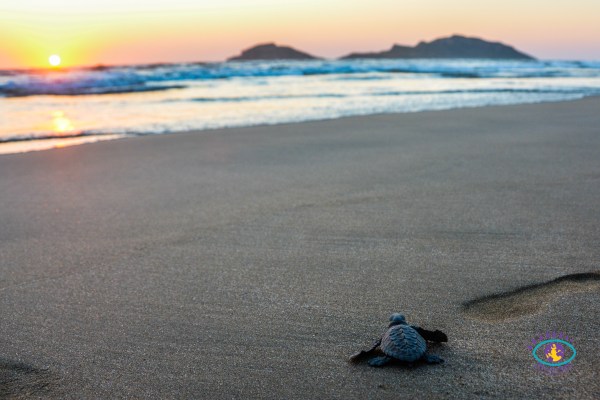
During the Gran Maratón del Pacífico each year is a huge public release of baby sea turtles. It was not my first choice for photographing, since there are so many smaller, more private releases that might give better photo ops, or so I thought. But, my friend wanted to go, so I joined in. It was, indeed, a huge mess of people. And, it was so joyous to watch the faces of the kids as they released the baby turtles.

The mother turtles are often about a meter long. The babies look so very similar to their mothers, and it’s hard to tell the size in the photos, but they are maybe three inches long. The sunset colors in the sky sure improved the photogeneity of the event.

If you haven’t joined one of the turtle releases, you owe it to yourself to do so. And it is a definite must for the grandkids or family who visit during the holidays!

Peer Pressure

15267703_10210798921186234_466070210640050474_n.jpgWhen you move to a new place, what makes it become home? I had the good fortune of moving to Mazatlán with my two main men, and having compadres who live here that we’ve known for decades. Plus, I’d been in love with our port city for decades myself, as had Greg, so calling it home was pretty easy.

However, the key when you make a new place home is creating community, and that takes friends. Like-minded friends, differently-opinioned friends, intelligent and fun-loving friends, friends who enjoy some of the same pastimes as you. And, I believe, the older we get, the more selective about those friends we get.

Thus, I am very grateful on this Thanksgiving Day weekend for the good friends in our lives. And, I am enormously grateful as well for the “peer pressure” of living on the malecón. I’ve written before how the malecón is the world’s largest gymnasium. In the nine years we’ve lived here, Kilometro Zero, the Bosque de la Ciudad, and the malecón, have been converted into one great race, marathon and triathlon event after another. Greg and I can’t help but be susceptible to the contagion.

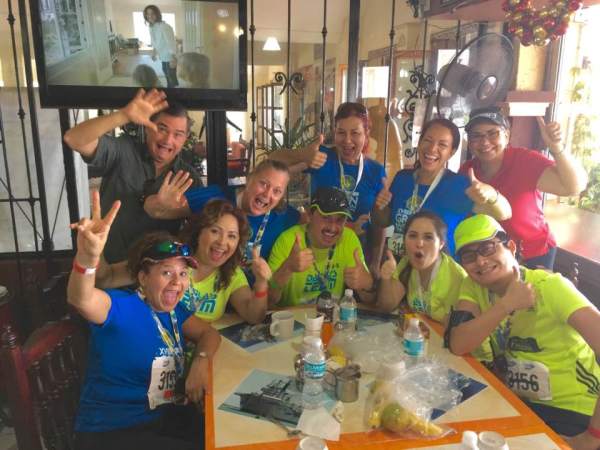
Tomorrow morning Greg will run the 21km in the Gran Maratón del Pacífico. I am so proud of him, recovering from his broken leg and nerve damage from two years ago. This year, as last year, I ran the 5km. The big news for me this year was two-fold: FIVE of my local girlfriends did the 5km with me! Better yet, they  brought their families! Second, despite the fact that I have a horrible head cold, and didn’t sleep well at all last night due to my coughing, I made a personal pace record this morning.

I’m slow, there is no doubt. But, hey, it’s my personal best for the 5km, despite the head cold and lack of sleep, and I’m happy about that! It was tempting at 6:30 this morning not to get up. It was tempting on the way back around the Bosque to quit, to say it wasn’t meant to be, as I couldn’t breathe. It was tempting at the 3km mark to join the 3km people. My lungs hurt, my nose was running, I kept coughing… But, I didn’t quit. I persevered. Me, who hasn’t run since being state champion in the 100 and 500 yard dash in junior high school, has started running again at 55. Woot woot. I still prefer swimming and zumba, but it’s nice to be able to run. At least a 5k.

We move to a new place in the hopes of creating a healthy and fulfilling life. I am grateful for the peer pressure I feel in this city of athletes, grateful that Mazatlán has become just such a city, and that we live in the middle of the athletic zone. I am grateful that Greg has led the way, running for so long and enjoying it so much that he eventually motivated me to start. My cousin Mary helped with that motivation, too. And, I am very grateful that I have a group of middle aged “Bellas Mazatlecas” girlfriends whose smiles light up rooms and who are healthy and motivated enough to join me in the “marathon”!

15202782_10210798212288512_5766215204083962544_n

God bless friends who love life!

Good luck tomorrow, Don Goyo! You’ll do great! Viva Mazatlán! Una meta más cumplida mis Bellas!

Silent Auction Sat, Dec. 10th

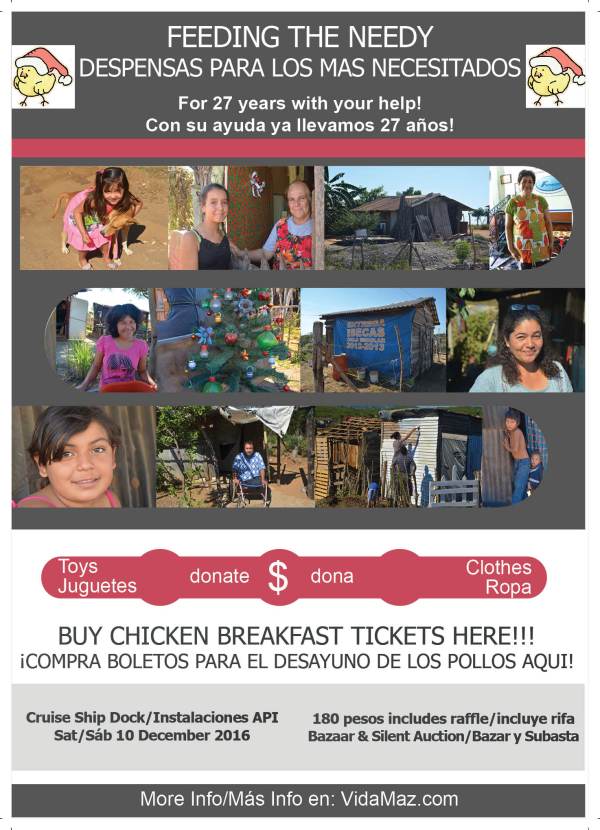
pollosposter2016Are you excited for the Desayuno de los Pollos? Do you have your tickets? Proceeds from the breakfast every year go to feed the needy at Christmas, and the past few years, with your help, we’ve fed and clothed nearly 3000 families. 2016 is our 27th year. The breakfast is on Saturday, December 10th, from 8:30 at the API cruise ship dock.

The full breakfast includes a raffle of major prizes—always including a few artesanally drafted wrought iron tables—a raffle of dozens of smaller prizes, a holiday bazaar of handcrafted items, and a terrific silent auction.

The silent auction tends to have loads of good items to buy, helping you and helping our cause: meals, stays at hotels, pieces of art, gift certificates, decorator items for the home… Click here to see some of the items we have had in past years.

This year we will have several wrought iron pieces, thanks to master craftsman Jorge Medina from Quince Letras. We also give many thanks to fiber artist May Woodford, who made an incredibly gorgeous white designer throw for us. Click on any photo below to enlarge it or view a slideshow.

Please help us help others by donating your time or talent, or an item or two in your home that are lovely yet no longer to your liking. Perhaps you have a favorite restaurant or store that you could ask to donate an item for the silent auction? You can download a gift certificate form here, then just let me know and I’ll pick it up.

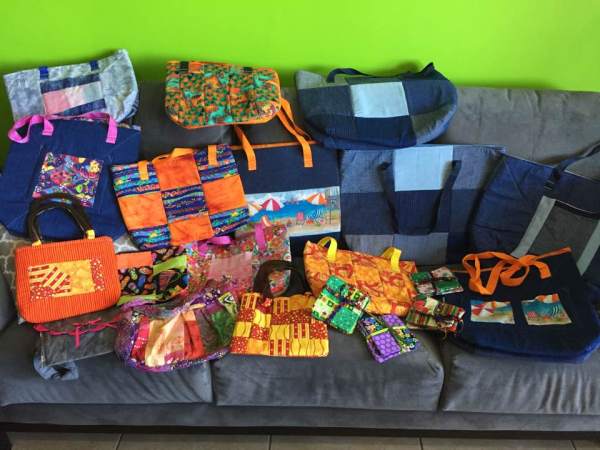
The bazaar is also going to rock this year. Many thanks to Karen Devine, who hand sewed a bunch of gorgeous bags that will be for sale in the bazaar. You can see some of her colorful work below. Thank you, Karen!

Karen Devine bags.jpg

May Woodford also made eleven afghans that she has asked us to hand out on December 24th to help those in need stay warm this winter. Yes, when you live in a cardboard box, the wind whipping through makes even the tropics feel freezing.

img_5240

Thanks for joining us and helping out! Invite your local and international neighbors and friends! If you can’t attend on the 10th, please donate or participate in some other way. Thank you!

A Saint in My Family

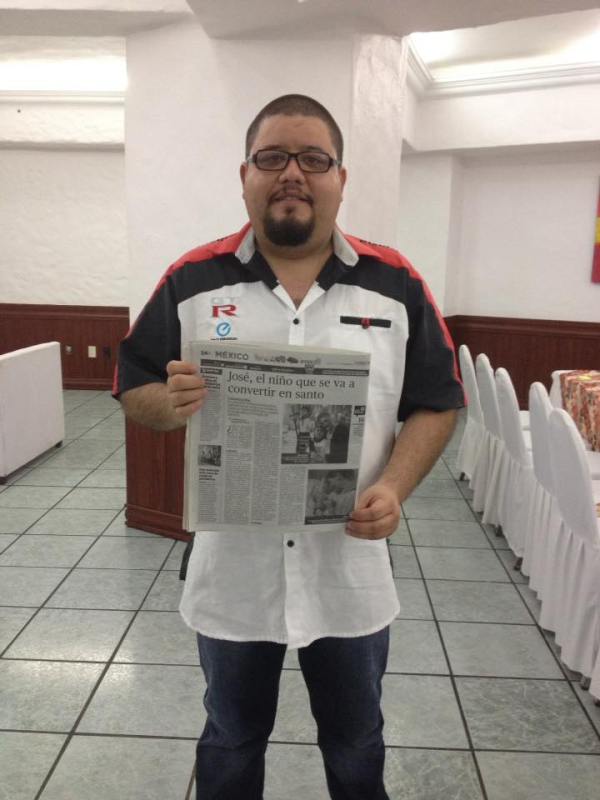
I recently heard about the Mazatlecan connection to a saint who was canonized just a few weeks ago, on October 16, 2016. I spoke to the saint’s great-nephew, Samuel Parra Sánchez, and he kindly agreed to write an article for us about Saint Joselito. I am happy to share his story with you.

11220849_320179115016506_4224063944948504846_n

Saint Joselito, left, and baby Ximena with her mother, Paulina, on the right

I do not know how many Canadians or US Americans celebrate a day dedicated to a religious saint who answers people’s prayers with miracles. It’s difficult to believe if you are not a follower of Jesus Christ, maybe because faith means everything to us. I am referring to the people who practice Roman Catholicism.

The story I am going to tell you is difficult to believe because the main character is already dead. On October 16 of 2016, Pope Francis canonized as a saint a 14-year-old boy who gave his life in protest against a bunch of murderers who, at the beginning of the 20th Century, tried to banish Mexican priests. That boy was named José Luis Sánchez del Río—Joselito—and he was my great, great, grand-uncle.

According to PEW Research:

  • 81% of Mexicans self-identify as Catholic, 9% as Protestant, and only 7% as unaffiliated with a religion.
  • While 71% of US American citizens identify with the Christian religion, only 21% are Catholic. 23% are unaffiliated with any religious belief, and 6% are non-Christian (Jewish, Muslim, Buddhist, Hindu, etc).
  • 39% of Canadians, in contrast, identify as Catholic, 24% as unaffiliated, and 11% with other religions.

Thus, I am not sure how am I going to convince you that there´s a saint in my family. Let’s start from the beginning  of the validated miracle.

The story opens with a baby girl, Ximena Magallón Guadalupe Galvéz, born on September 8, 2008 in the United States—so technically she´s American. After she was born, Ximena’s parents took her to the city of Sahuayo, located in the state of Michoacan, the same state where the Blessed Joselito had been born. When she was 15 days old Ximena fell into a fever that turned into meningitis and tuberculosis. She suffered seizures and a cerebral stroke. Paulina Gálvez Avila, Ximena’s mother, shared her baby’s story, saying that “humanly, Ximena had no hope of life.”

Her parents took Ximena to the pediatrician and he tried his best to help her, but she did not improve. They took X-rays to rule out pneumonia. Ximena was admitted to the Hospital of Santa María Sahuayo.

Doctors discovered she had fluid in her lungs, tests showed she had tuberculosis, and the smile on her face was lost after she fell into a vegetative state. Doctors induced a coma after they determined that 90 percent of Ximena’s brain was dead. They were going to disconnect her from life support.

“We went to Mass every day to ask God and Joselito to intercede for my baby, to perform a miracle. Before disconnecting her, I asked them to let me be with Ximena and hug her. After that they disconnected the machines. At that point, I put Ximena in the hands of God and the intercession of Joselito. Suddenly, my baby opened her eyes and smiled at me,” her mother said.

Ximena looked at the doctors and began to laugh with them. They could not explain what had happened, because they had done everything medically possible and it hadn’t helped. That is when they saw it was a miracle.

Medical personnel gave the baby a CT scan and an EEG, and 80% of her brain was somehow recovered. The next day her brain was completely healthy. Hospital staff advised that the baby would not be able to suckle. However, when her mother gave her the bottle she drank eleven ounces of formula. The doctors were amazed. They believed that if Ximena survived she probably would not walk, talk, see, or hear, because of the aftermath of the stroke she suffered.

Against all medical predictions, Ximena fully recovered and is perfectly fine, thanks to God and to the intercession of Joselito. Click on any photo below to enlarge it or view a slideshow.

José Luis Sánchez del Río was tortured and killed at age 14 during the 1924 – 1928 religious persecution of Mexican President Plutarco Elias Calles. José Luis had enlisted in the ranks of the Cristeros, under General Prudencio Mendoza.

He was captured by the federal army and his martyrdom took place on Friday 10 February 1928. They cut the soles of Joselito’s feet, and he was led barefoot to his grave. As he walked, José Luis prayed and shouted, “Viva Cristo Rey y la Santísima Virgen de Guadalupe!”—“Long live Christ the King and the Blessed Virgin of Guadalupe!”

At his tomb Joselito was hung on a tree and stabbed. One of the executioners asked him what message he would like to give his parents. The boy replied, “Que Viva Cristo Rey and that we’ll meet in heaven.” Hearing this response, the man shot him in the head and killed him.

Well, this is the story about a saint in my family. You can choose to believe it or not, you can say I am a dreamer, or a guy who likes witchcraft or mumbo jumbo. But do not waste time thinking about who has the best logic. Tell me, how great is your faith?

14479823_320828438284907_7183814868769127870_n

Contact Samuel via his websiteFacebook page, or YouTube channel.

Book Club, Pata Salada Style

14639875_10210580158437302_5183939219515694889_n.jpg

Worldwide, Australians purchase more books per capita than any other nationality, and Indians spend the most time reading—an average 10 hours and 42 minutes per week per person. Interestingly, it would seem that Canadians, Mexicans and US Americans don’t vary significantly in how much we read. Canada wins with 5:48 hours/week/person, next USA with 5:42, and finally Mexico with 5:30. They say 33% of US Americans never read a book after high school, 56% read at least 10 books a year, and 14% read 10-20 books/year.

The members of the book club I belong to here in Mazatlán definitely beat those averages. Some of my friends easily read four or five books every month.

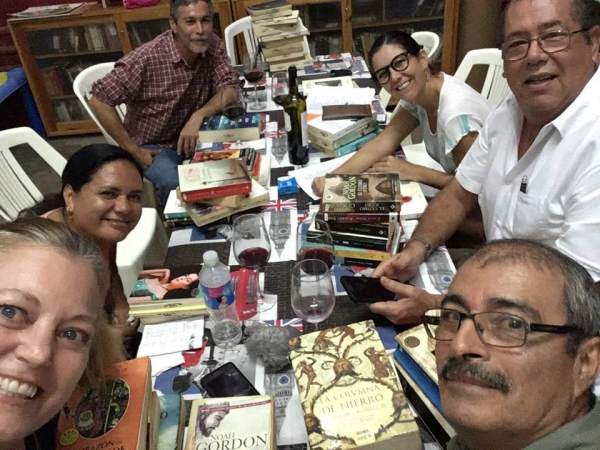
Are any of you members of book clubs here in Mazatlán? If so, what would you say are the key similarities and differences between a Pata Salada/Mazatlecan book club and a club north of the border? If you are not, check out the selfie of my club, above, for some clues.

The Story
A year or so ago a friend of mine invited me to join his group. It’s a Spanish language book club. Honestly, I was flattered that he’d invited me, but I worried he’d over-estimated my Spanish language ability. I wasn’t sure I could read books in Spanish, at least not if I were going to enjoy them. I’d read Spanish language books back in college, but, hey, that was quite a few decades ago! And, it was required reading.

Of course, I didn’t let my concern stop me. I agreed to give the club a go.

Next I second-guessed my decision because I’m already so busy—full-time job, photography passion, two blogs, trying to stay physically active— and I don’t really read that many novels. I tend to read non-fiction. My new book club reads fiction. Maybe not officially, but that’s what they read. I joined anyway, figuring all I could do was my best and see how it would work out.

Then, my friend told me I’d need to attend the first meeting to have everyone meet me and “approve” my joining! Wowzer! This was like interviewing for a job. Maybe some north-of-the-border book clubs do that; it makes sense that they would want everyone to get along well with one another.

My first meeting was great, but it was also intimidating. I really liked the club members. They were funny, lively, intellectually curious, and socially engaged. I was psyched. This would be a great way to get to know some interesting new friends! One of the women, however, scared the heck out of me that first meeting. She was very tall, outspoken, dressed up and made up, and she said, in front of everyone, “Diana, if you don’t completely read one book in Spanish every month, we will not keep you in the club. You have to read minimum one book a month.” Jeepers! Looking around the room, the books were thick! Nothing like pressure! I told myself she was joking, but no one laughed.

After that, I had my third wave of doubt: would I be able to effectively summarize what I’d read to my new friends in Spanish? Could I be engaging and interesting, able to explain what I’d enjoyed or hadn’t in a book?

I promised myself early on not to use a dictionary. If I find vocabulary that I don’t understand, consulting a dictionary would make my reading feel like homework. Obviously it would help me learn. But I know myself; I knew it would slow me down and ruin the joy of a good novel.

Well, I’m happy to report that so far, one year on, I have pleasantly surprised myself. I understand the novels just fine, and I’ve really enjoyed some great Spanish-language fiction this past year. I may not summarize the books I’ve read with one-tenth of the poetic flair my fellow members do—somehow native Spanish language communication style is so much more colorful and metaphorical than my gringa Spanish language style—but my friends humor me. They listen to me with interest and ably build on my ideas.

I am very happy I joined the club. We have a delightful group of people, from different professions, experiences and walks of life. Yes, I even enjoy that tall, outspoken, well-dressed lady who intimidated me in the first meeting—she rocks.

I’ve learned that I only want to read books written in Spanish, rather than translations. Somehow to me it just feels better, and I feel like I’m learning real Spanish, and getting an insight into the mindset of a native speaker. And, I’m especially interested in books that teach me something about Mexico or Latin culture (obviously my way of getting my non-fiction fix while enjoying a good novel).

The Differences and Similarities
So, what are some of the differences that I’ve noticed between this book club and others I’ve been a member of in the USA? In the photo at the top of this post, did you notice all the books? All the different books? Most obviously and importantly to me, we do not read the same book each month and then discuss it. That is what we’ve done in every other book club that I’ve ever been a member of.

Here, we all read different books and take turns talking about them; then we trade books, depending on who wants to read what. At first I found it so very weird. I missed the in-depth conversation that, for me, a “normal” book club provides. I still do. What is cool, however, is how this process allows each of us to read exactly what we want to—complete freedom! It exposes us to loads of new authors, and keeps our costs for buying books down, as well.

How does it keep costs down? Each month we pay a nominal amount to the club kitty. Periodically we take turns going to the book store and choosing new books that club members might enjoy. We then vote on which if any of the books to purchase and add to the club library. So, each month, we’ve got a whole library of books to choose from. We can check out as many as we wish to read, and periodically that library expands, as well. That’s especially wonderful because the price of Spanish language books tends to be much higher than similar books in English.

Look at the photo again. See those glasses and bottles? A second major difference is the amount of alcohol that we consume, at least in our book club here. I have been in book clubs up north where perhaps we each had a glass of wine or two during the evening, but here, in our club at least, we all bring a bottle of wine every meeting! And it’s good wine, not the cheap stuff. Sort of makes up for any cost savings on books, lol. Most times there is leftover wine for the following meeting, but sometimes… 😉

The other truly “Mazatleco” part of book club, to me, is that communication is done via WhatsApp. I remember a couple of years ago when I discovered that WhatsApp was the secret to any event planning here. It was so liberating! Quick responses there, whereas emails, e-vites or Facebook messages rarely let me know who’s really coming to a gathering and who’s not.

So, what’s similar? Book clubs are all about books and reading, right? Both sets of clubs, here and NOB, definitely encourage reading, broadening our horizons with new topics and new authors. Every club I’ve ever been in also serves as a social outlet, allowing us to get to know people more deeply, expanding our network.

Book Fair
This year Casa del Caracol book shop is celebrating its 12th anniversary. To help celebrate, the owner, Laura Medina, organized a “book fair.” It was really cool. Book clubs in town were invited to rent a table at the event, and sell the books they no longer wanted in their libraries. All books were sold for the same price (I think it was 30 pesos; incredible deal, right?)

So, our book club got together and went through our entire library. We all voted on the books we wanted to keep, and put them back in the cupboard. Of the books that we as a club were willing to get rid of, we took turns choosing the ones we personally wanted to buy—for 50 pesos each. Those that were left over, we sold at the fair. It was amazing how many books changed hands that night! It was so incredible to know how many readers there are in this town! And I learned that there are at least two Spanish-language clubs in town that all read the same book at the same time, just like so many clubs NOB.

Those of you in a book club here, what other differences and similarities have you noticed?