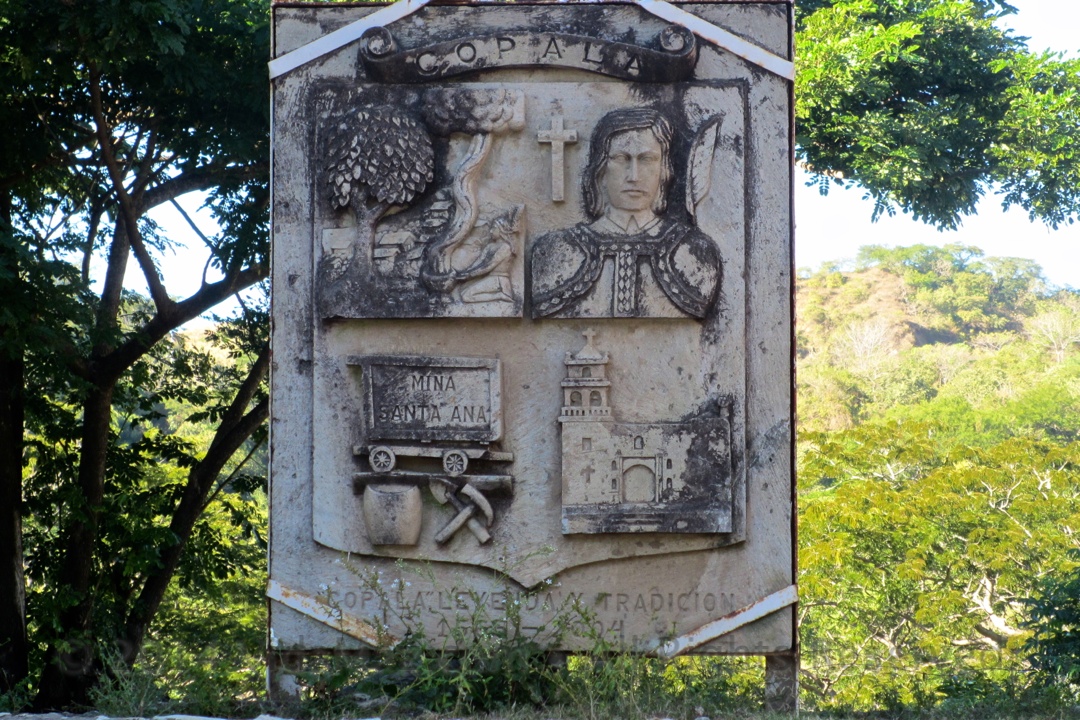
Copala (San José de Copala) is a picturesque little town southeast of Mazatlán, just past Concordia. The smallness of this village, the charm of its winding, hillside cobblestone streets, and the friendliness of its people, make it one of our favorites.
Populated by indigenous people and then “founded” by Francisco de Ibarra, veins of silver were discovered nearby Copala in 1565 and the town grew to serve the mines. It was destroyed during an uprising by the Tepehuan Indians in 1616; its church was built much later, in 1748.
You can tell by the beauty of its church and central plaza how wealthy Copala became, but it has definitely fallen on tough times now. The incredibly lovely church has plants growing from its steeple and facade, and is in desperate need of restoration—though this mix of opulence and ruin does create a thoughtful charm.
Coming into town
Entering Copala
Entering Copala
Along the main street
Church in Copala
Door of the church
At least there’s no Santa Claus…
Interior of the church
The altar
Closeup of the altar
Rain spouts on the church
View from the church
The belltower
Closeup of the belltower
The side door of the church
Over the side door of the church
Window of the church
Over the main entrance
Closeup of the bellower—plants growing
Closeup of the bellower—plants growing
On the town square
Mural on the town square
Town square
Tiled rooves
Tiled rooves
Tiled rooves
Copala architecture
Copala architecture
Copala architecture
Copala architecture
Copala architecture
Copala architecture
Copala architecture
An elderly resident crosses the square
Bougainvillia
Bougainvillia
Typical homes
Typical homes
Lush foliage
Cobblestone streets
House of stone
Old window
Carved stone
Old home
Stone wall
Coming home from school
Coming into town you drive past a small cemetery. Once you are in town, children will likely approach you with hand-carved wooden replicas of the home of Copala, quite nice souvenirs. There are several restaurants in which to eat here. Years ago we always ate at Daniel’s, but that is closed since his death. Chalva’s famous banana coconut cream pie (or a replica of it) is still served in several local places. The last time we went to Copala, we ate at a new restaurant—Alejandro’s—just down the hill from the plaza. The view was outstanding, and the cook (owner’s wife) even more so. For such a small town, it is surprising that Copala also has several places to spend the night.
Cemetery on the east end of town
Cemetery on the east end of town
View from the terrace of Alejandro’s Restaurant
One of the places to eat or stay
Cemetery on the east end of town
Another restaurant
There are souvenir shops and a mining museum that, despite appearances, we are assured still opens regularly. It was not open the last time we visited Copala. While there isn’t a whole lot to see here, we highly encourage a leisurely visit. It’s a very welcome respite in a busy life: a beautiful place to read a book, make some sketches, or just sit, visit, and relax a spell. Copala is also a very worthwhile stopover on the way to or from Durango.
The mining museum
The mining museum
Driving Directions: Copala is just over one hour southeast of Mazatlán. Take highway 15 south pass the airport to Villa Unión (about 13 miles from Mazatlán). Turn east on the free (libre) version of highway 40, towards Durango. After about 15 miles, you will pass through Concordia (read here about this wonderful furniture making town) and another 15 miles later you will see the exit for Copala.The exit is clearly marked, but easy to miss if you are speeding or distracted. As soon as you exit, you will be on a cobblestone road — one of the hallmarks of this magic town. The road splits quickly and you should go to the left. You will pass by a beautiful cemetery and wind your way into town. Just stay on this main road, and you will find yourself in the plaza in front of the old church. The drive is beautiful and easy, as you pass plantations of coconuts, mangoes and bananas. Just don’t get on the new highway.
For those traveling this way from Durango on the new highway, there is a cutoff to the old highway which lands you in Concordia. From there it is a simple 15 minute drive back northeast to Copala. It is a very convenient stopover and well worth a little extra time.
One of the reasons we came to live in Mazatlán is our compadres, the Valverde family. Daniel has been Greg’s best friend since they both were sixteen, working up in the SF Bay area. Daniel and his family are originally from San Ignacio, and many of his family members and dear friends have worked for Greg up north over the decades. Greg began to travel down to Mazatlán with Daniel on holidays, staying in the house Daniel built for his mother. They would often travel out to San Ignacio, to the rancho, to visit family and friends. Over the years they have become family to us. Danny dearly loves his tíos and cousins, and not so long ago we went to San Ignacio with Mariana and Rubén, Daniel’s sister and brother-in-law, to visit the dentista loco and his wife, Irma, also good friends.
The girls of the gang, at the giant statue
Hear no evil, see no evil… Yeah, right.
Pozole!
Hanging out
Cousins
At the river
Love you, tía!
San Ignacio (de Loyola) is a lovely small town about 60 miles north of Mazatlán, entered through the typical scenic gate, and with a walled church on the central square, as is so normal in the small towns of México. It was founded in 1633 by the Jesuit priest, Diego González de Cueto, and is currently home to about 4500 people. San Ignacio was originally called Piaxtla, after the indigenous people who lived there. It is a colonial mission town, with the Jesuit Misión de Santa Apolonia established there in 1748.
Like most of the small mountain towns near Mazatlán, San Ignacio was a mining town, rich in silver, gold and copper. Today, life on Constitution Square and in the streets of San Ignacio is laid-back yet vibrant. Many of the colonial French and Spanish style buildings are still standing, and the landscape is lush. The main church is called, of course, San Ignacio de Loyola, and a second church in town is Our Lady of the Nativity. There are hot springs, though our friends have never taken us to them.
“Door” into town
The municipal palace
San Ignacio de Loyola
Closeup of the clock on the church
Church through palm trees
Church taken from the other side of the square
Kiosk in the central square
An abandoned building on the square
Closeup
Closeup
A bus through town
An ice cream seller
Storefronts
Town architecture
Storefront
Ready to sell papers
View of town
Lovely buildings
Lovely buildings
Lush greenery
Storefronts
What stands out during a visit to San Ignacio is the huge statue of Jesus Christ up on the hill, hands outstretched in a similar manner to the famous statue in Rio. You can easily view this landmark from the main square, and the views out from the statue on top of the hill are truly breathtaking.
The huge statue of Jesus
Closeup of the statue
Incredible views from the statue
Incredible views from the statue
View of the main church from the statue
View of the main church from the statue
Incredible views from the statue
Incredible views from the statue
The statue’s base is surrounded by plaques of all the towns in the municipal
Incredible views from the statue
Incredible views from the statue
The handsome male members of our group
View of the statue from Plaza Constitución
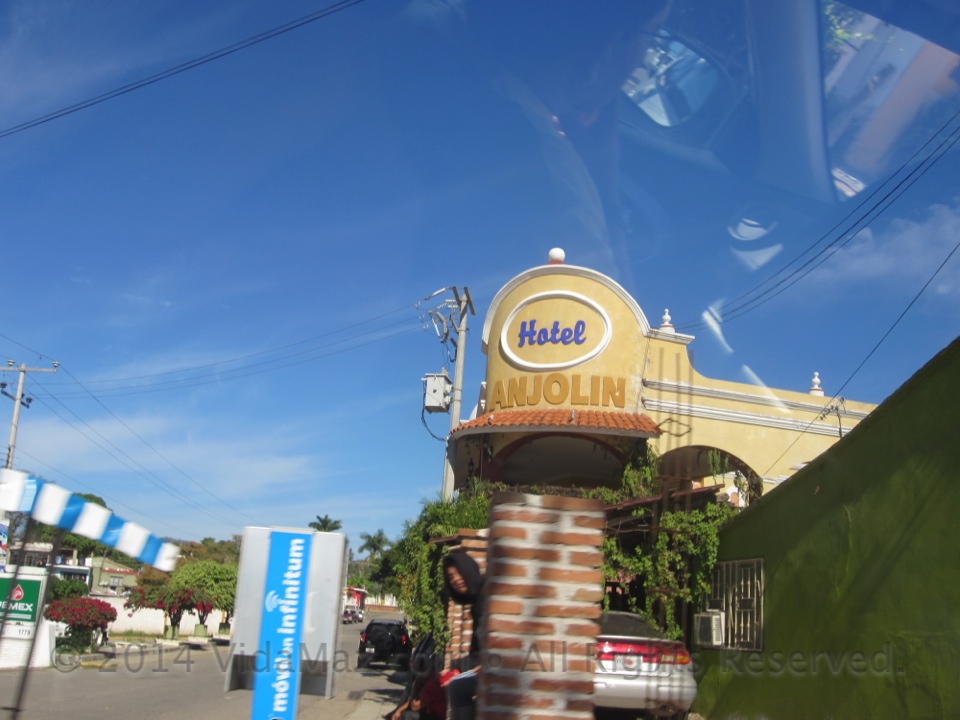
I’ve always wanted to go to San Ignacio for Good Friday. They do a remarkable, community-wide reenactment of the crucifixion. The event attracts hundreds of people, so hotel reservations need to be made far in advance. The one hotel I know of in town is the Anjolin, which is fairly new with modern amenities.
What we have done quite often is to go down to the river. It’s very pleasant, the views are open and the water is crystal clear. In summer the riverfront is one big party: trucks, horses, food carts and stalls, and of course, lots of beer.
The river
Where we hang out
Views from the river
Just drive over to the river
Mermaids at the river?
As you drive into San Ignacio, there’s a great little restaurant on the left side of the road, Cuata’s. I’ve written about this place previously, and we highly recommend it (very rustic, as you can see). We highly recommend a trip to San Ignacio for a change of pace and some beautiful scenery. Next time we are definitely checking out the hot springs!
Driving Directions
Head northwest towards Culiacan on highway 15 — the free (libre) road — for 43 miles to Coyotitán, where there is an exit for San Ignacio. You’ll turn right and proceed about 20 miles up into the lush Sierra Madre foothills to reach San Ignacio.
Over Christmas and New Year’s we had the pleasure of hosting five different sets of visitors to Mazatlán. It felt so incredibly wonderful to spend time with loved ones, and to be able to share the gorgeousness and warmth of our adopted home with them. It was fascinating to us how each group experienced Mazatlán differently. Our city has so many different faces, there is truly something for everyone—the beach bums, the farmers and ranchers, the culture mavens, those who love to eat, party or shop.
During this time we took several trips to our nearby mountain towns. We so love these trips, to a simpler life, a slower and more rural life. It struck me that we have not written that many posts on these day trip towns, so I aim to remedy that. Since we visited at least five, and that’s a whole lot of writing, I trust you’ll permit me to tell you their stories primarily in photos. Photos will give you a sense of the place, and let you know if you’d like to visit—whether for the first time or the 50th.
Let me begin with Concordia, about an hour southeast of Mazatlán, towards Durango. It’s easy to remember Concordia among the many beautiful small towns in southern Sinaloa, because the main plaza in town has that gigantic chair, representative of the solid wooden furniture crafted here. Sit in it, with the gorgeous church behind you, and you feel the joy of childhood again. Concordia is also the birthplace of the famous raspados, or shaved ice flavored with real fruit syrup. Founded as “Villa San Sebastián” in 1565 by Francisco de Ibarra, Concordia today has about 9000 residents. Its history is steeped in the gold, silver and copper mining of this region.
A window on the main square of Concordia
Main square of Concordia, Sinaloa
The Palacio Municipal/City Hall
Main square of Concordia, Sinaloa
Inside the Palacio Municipal
Side view of the Palacio Municipal
Walking the streets of Concordia
Walking the streets of Concordia
Walking the streets of Concordia
Three Kings’ Day parade remnant
The tortilla factory ladies
Walking the streets of Concordia
Walking the streets of Concordia
A second church
Walking the streets of Concordia
Walking the streets of Concordia
Loved this door
Walking the streets of Concordia
Walking the streets of Concordia
Walking the streets of Concordia
Walking the streets of Concordia
Bike awaiting its rider
Flowers along the street
An old window
Giant chair in the main square
The main church, San Sebastián, is really beautiful. Built in 1785, it has an ornate baroque facade.
Iglesia San Sebastián
The altar
The interior
Door to the church
A crucifix
Gorgeous interior doorway
Baby Jesus with some toys
I liked this saint; not sure who he is?
The Virgen
The screen at the front entrance
Detail of the facade
The belltower
View of the belltower
Rain spouts
Founding plaque
Concordia also has hot springs, which are on the left, down a dirt road, just before you get into town.
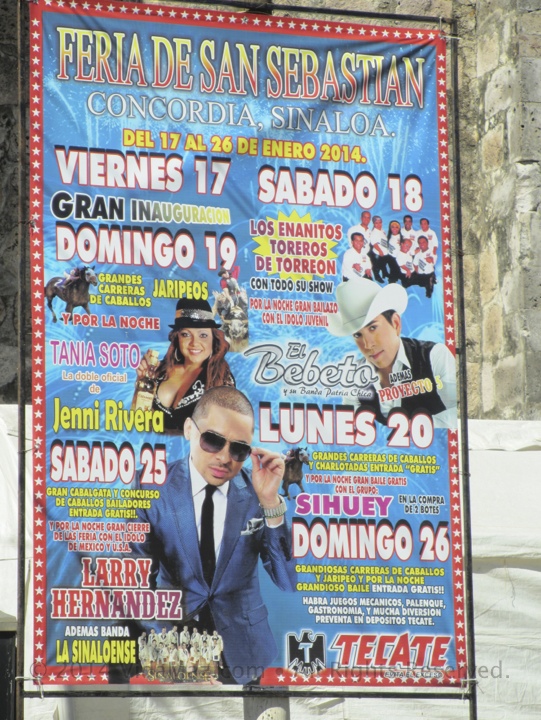
If you’re looking for something to do this weekend, the Féria de San Sebastián takes place over two weekends: from today (Friday January 17th) through Sunday the 26th. This Sunday the 19th is the seventh annual cabalgata or horse race, starting at 11 am and going from Mesillas to Concordia, concluding at the fairgrounds after a march around town. They are anticipating 450 participants in the cabalgata, and you’re sure to see some gorgeous charrería.
My friend Salvador Herrera made a video of Concordia for the “Un Mundo Mágico” project.
Driving Directions:
Concordia is one hour southeast of Mazatlán. Take highway 15 south to Villa Unión (about 13 miles from Mazatlán). Turn east on highway 40, the old free road to Durango, and continue about another 13 miles. The drive is beautiful and easy, as you pass plantations of coconuts, mangoes and bananas. Just don’t get on the new highway. For those traveling this way from Durango, Concordia is also a very convenient stopover.
We have long loved the small town of Cosalá, the first and very well deserved “Pueblo Mágico” (2005) of Sinaloa. It’s history is well preserved in its lovely architecture as well as the lifestyle of its people. This year we were able to take time off work to attend the Fiesta de las Velas, which is held every December 11th, on the eve of Virgin of Guadalupe Day.
The candlelight procession was an absolute delight! It was not a “spectacle” or performance, as so many of these events become in larger cities. Cosalá’s homage to the Virgen is home-spun loveliness. The procession is a tradition that dates back over 300 years, and is the only event of its kind in Mexico or throughout the world! As Cosalá is only 2-1/2 hours from Mazatlán, we highly recommend you make the journey!
Mouse-over any photo to view it larger or see a slideshow, and be sure to scroll down to read the full post—there are lots of pictures in this one, as so much happened in such a very short time!
People all over town began lighting candles at dusk, setting them out in front of their homes and businesses, along the curb, on window ledges, and atop rock walls. We saw a wide variety of different candles: tapers, candles in glass, votives in glass, candles in plastic cups, and even beautiful Virgen de Guadalupe votives, so we supposed that each family buys its own candles to put out on this very special night.
Father and son placing their candles
Some people set candles on the curb for later lighting
Others placed lit candles on the curb
Setting down lit candles
As soon as the candles are lit, the children, of course, begin to have fun with them. What little boy can resist a burning flame? I very much enjoyed watching these three boys light sparklers from the candles their mother had just lit, squealing in delight. The entire night was just a joy.
Lighting a sparkler
The sparkler catches fire
Lighting another sparkler
Wooo!
Very fun!
At 7:00 pm, the electric lights in the city went dark, and the entire pueblo took on the lovely glow of candlelight. It was truly a sight to behold! The streets were nearly empty except for those waiting for the procession to reach them, so they could join in. The winding streets lined with glowing candles, street lights draped and shaded, it was truly magical.
As we walked around the pueblo, marveling at the beauty, we noticed a miniature Christmas village displayed in a window. The lady of the house quickly came out to invite us inside. This very humble-looking-from-streetside home was huge and wonderful inside! And its family was so very hospitable! We entered into a courtyard with a life-sized nativity, through to the living room with a huge Christmas tree and the village we had first noticed, past a large statue of the Virgin to another living room with a tree hung from the ceiling, out to a back courtyard that was strung with beautiful twinkle lights. Later on, we met the ladies of the house again during a procession.
The procession wound around town, lasting perhaps an hour and a half, growing larger and larger as more and more people joined in. The procession is most definitely inter-generational: grandmothers and children, husbands and wives, groups of teenaged friends or middle-aged women, all walking with candles in hand. This event was most definitely a photography challenge! In addition to low light, you have constantly moving targets! How to possibly capture candlelight and people moving? I’m sure many have done better than I did, but at least you’ll get an idea of the beauty and preciousness of it all, I hope.
The painting of the Virgin is held high, on the shoulders of local men, as she is fêted. In addition to the main image in the procession, there are of course images of the Virgen all over town to celebrate her on her special day.
People in the procession were singing and praying as they made their pilgrimage through town, from one church to another and back. There were also two groups of dancers in the procession. One group of mostly young girls carried a candle in each hand and danced in a choreographed way each time La Guadalupana was sung. They had their heads covered and were dressed in gowns, to represent the Virgen, I believe. The drummer accompanying this group was a boy dressed in a shirt with a beautiful image of the Virgen on the front.
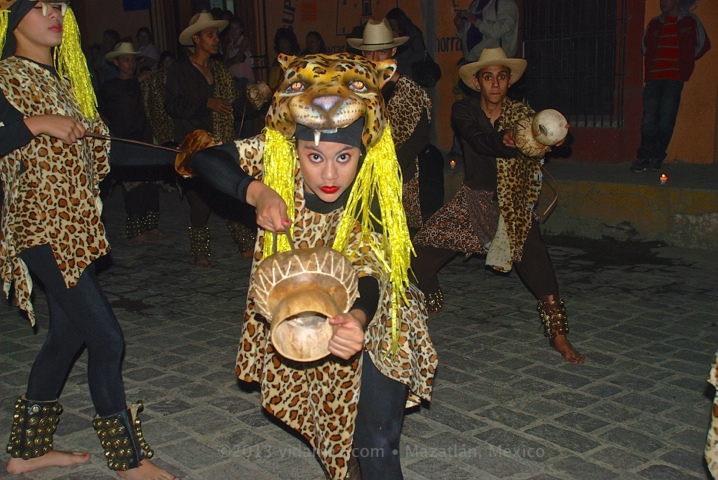
The second dance group of the evening were the teenagers who performed the Danza del Jaguar, native to Cosalá. The young men act as hunters, while the young women act the role of jaguars, hiding, running from, and occasionally leaping at the young men. They play these terrific instruments called rotares: hollow so they’ll reverberate, with a leather cord attached that is pulled to create the sound of a jaguar roaring. Accompanying the dancers was a small band, in the back of a pickup truck, with several drums, more rotares, and other percussion instruments. This group walked immediately in front of the Virgin, and we were told that their dance clears the way of any bad spirits, cleansing and purifying the route for today’s honored guest.
The following morning as we were walking through the plaza, we noticed two of the jaguar dancers from the night before. The young woman, Maribel, had such striking eyes that we immediately recognized her. She was very congenial and outgoing, and was so very pleased when I asked her to tell us the story of the jaguar dance.
The procession ended at one of the town’s churches, where an outdoor Mass had been set up. The painting of the Virgen was proudly displayed on the altar, and Father Nahúm Villalobos said a heartfelt Mass attended by hundreds who crowded into the yard and filled the church proper to overflowing.
During the Mass, Victor Franco debuted a new song he had written for the town, Cosalá Bendita. We felt very privileged to be able to hear it as it was performed for the first time ever, in the presence of so many Cosaltecos who seemed incredibly moved by its words and melody.
After Mass concluded the outgoing Mayor of Cosalá, Mario Cuauhtémoc Padilla, and Francisco Córdova, State Secretary of Tourism, announced that the town had just officially named Fiesta de las Velas as a cultural heritage event. Next steps will be to seek state, then national, and finally, hopefully U.N. designation for this gorgeous event. I can not imagine it will stay small, sweet and uncrowded for many more years.
Following that ceremony was a singing performance, which culminated in singing Las Mañanitas to the Virgin.
Our friends Sandra and Hector took us on this wonderful trip. They seemed to know absolutely everyone in town, so we felt so very welcome, and our friends Jeanette and Emery joined us as well. I will later do a post on the town itself, and our adventures the day following the procession, but let me leave this post here. It is definitely worth planning for next year. There are good restaurants in Cosalá, and several categories of hotels as well. I’d recommend you go up and stay two nights, as on the 12th there were fireworks, a town fair, and a children’s parade.
I put together a two minute video of the procession, including a bit of both dances and the prayers. You can view that below.
About one week ago, we were fortunate to drive to Durango and back on the new Durango-Mazatlán toll road. Why were we lucky? Well, first of all the road is brand new with the key part (a.k.a. the middle) only being open for less than 10 days. Second, the road contains 63 bridges and 115 tunnels – very cool. Third, the road includes the Baluarte Bridge, the highest cable-stayed bridge in the world and the longest in North America. Fourth, two days after we returned, Tropical Storm Sonia hit hard in that area of Mexico, closing the road for 36 hours and doing damage to this beautiful new highway that will be apparent for years to come (watch video in this story to see for yourself). You can read all the facts and figures here and below is a video we recorded through the sunroof.
We were door to door in three hours. By that I mean from our door on the malecón to the door of our hotel in the historic district of Durango in three hours. This includes stopping to pay tolls and one gas station stop. I did not include stopping to take pictures of the Baluarte Bridge which you can look through by clicking on any of the photos below.
The view from around the curve
The state border
Taking it in
Amazing engineering feat.
The cables are awesome
View from the top
Thumbs to the engineers!
This is a great photo spot
Hi Dianne!
The road provides an alternative to the free road, known as El Espinazo del Diablo, or the Devil’s backbone. This road took from five to eight hours for the same journey and includes countless switchbacks and hairpin turns and numerous encounters with busses, trucks, cows, burros and bicycles all on a two lane road with little or no shoulder. It was frequently closed due to accidents and mud slides and was a nightmare when the clouds were thick enough to reduce visibility to near zero. The new road is two lane most of the way, but has ample shoulders for passing or for emergencies and is about as straight as a mountainous road can get.
The tunnels range from short and sweet to awesome. Some have natural daylight “windows” while other rely on electric lights. Only four or five were long enough to lose the satellite connection to our NAV system. The longest is called El Sinaloense and is 2.8 Km long and has such cool lighting it feels like you are passing through or participating in a video game. Here is a video:
According to my passengers, the views were incredible. Passing over the bridges provides an incredible vista and the rock formations around the tunnels are truly awesome. There are no real services on the road yet, but you can see where they are being built. They should be available soon.
I highly recommend this road. It is much safer and efficient. The tolls round trip will be about 1,000 pesos which is not chump change. You will save a lot of gas compared to the old road and arrive sooner. I understand that the high price of the tolls is an issue and the governor of Sinaloa is “looking into it.” Texas is now a one day’s daylight drive thanks to this road – well, at least in summer.
***One important note about safety. The bridge is a huge attraction and many people want to stop and take pictures. Unfortunately, the topography of the land did not allow for a viewing area. So, what people are doing, us included, is simply stopping in the right lane and walking around (the bridge does have four lanes). This is perhaps a little foolish with cars coming out of a tunnel at you going well over 60 miles per hour. But, this is the system, at least for now. Word on the street is that the cruise ships are planning excursions to “see the amazing new bridge.” I can’t wait to see dozens of tourist vans taking up the right lane while tourists pose for pictures. Drive carefully everyone.

 Copala (San José de Copala) is a picturesque little town southeast of Mazatlán, just past Concordia. The smallness of this village, the charm of its winding, hillside cobblestone streets, and the friendliness of its people, make it one of our favorites.








 ¡VidaMaz!