We love what is unique to a place—that which is different from the ordinary—and the incredibly pious, faith-filled, self-mutilating Holy Week traditions of Tzintzuntzan in Michoacán are some of the most remarkable in Mexico.
Tzintzuntzan is a Pueblo Mágico just north of Patzcuaro and south of Quiroga on the lake. Its name means “place of the hummingbirds” in Tarasco and P’urhépecha, and was pronounced “Huitzitzilan” in Nahuatl, the language of the Aztecs. It is the ancient capital of the P’urhépecha and the first capital of Michoacán—the heart of Tarasco. We absolutely loved getting to know a bit about these incredible people! Click on any photo to enlarge it or view a slideshow.


There is a horrible and also encouraging history of cross-cultural impact here. The Spanish conquistador Nuño de Guzmán burned alive P’urhépecha chieftain Tangaxuan II, and then largely dismantled Tzintzuntzan in order to use the stones for the Fransiscan monastery of Santa Ana, modern-day Templo de San Francisco. Fortunately, Don Vasco de Quiroga followed in 1530, a Spanish bishop wise enough to teach each pueblo around the lake a handicraft—lacquerware, copper smithing, wood and rock carving, pottery, basketry, embroidery, furniture making… The P’urhépecha have kept alive and perfected these crafts, and that handiwork supports them to this day, to the delight of artisan-lovers worldwide. It’s difficult to visit this area and not leave with a car-full of artesanía, as we do; it’s all just so gorgeous.


Ask anyone in a small village in the lake region who are the richest people in town, and they will usually say, “the artisans.” One local man told us a story about a “junior,” a wealthy young man from the DF, who contemptuously called a local woman “India.” He said she stood tall, looked him straight in the eye, and said, “Look what you are wearing: mass-produced blue jeans and a shirt. My handmade apron is a piece of art worth 6000 pesos. My skirt is handcrafted and worth 4000. My blouse 2000. My earrings are hand-forged silver worth 5000. These works of art connect me to my ancestors, my heritage and my community.”
Vasco de Quiroga was bishop of the lake region. Frustrated that the P’urhépecha would not come to mass in Tzintzuntzan, he ordered construction of a chapel in each of the town’s twelve barrios. He commissioned artists to make a crucifix or Cristo for each chapel. They are made from pasta de caña, or cane paste. These 16th Century Cristos, all twelve of them, still exist, lovingly cared for by descendants of the same families for generations in each barrio. The Cristos are on display for community members throughout the year, but on Holy Thursday and Good Friday each year they take on a more public role.
Wednesday and Thursday of Holy Week, the espias, or Roman Spies (clad in red hoods), set out looking for Christ, to arrest him. On Thursday find him they do, in twelve different homes around town. At each home, they are given food and drink by barrio members. All but two of the Cristos have been restored, and only one of them has dark skin—the Cristo in the Barrio de Santa Ana.


Holy Thursday is a day of preparation in Tzintzuntzan. Men clean grilletes, or shackles, for the Penitentes to wear the following day. They make and sell disciplinas: knotted lashes or whips covered in nails. They also string lights and put up tents.


Women put out candles and flowers, and cook for all of the others who are helping; this is most definitely a community-wide event. Every time you look around, an altar has appeared or been cleared, a tent has been put up or removed.


The patron saint of the town, El Señor del Santo Entierro, whose extremities are believed to grow, is usually seen in a glass showcase. During Holy Week, however, He lies in a bed, and pilgrims seek His blessing. A crown is held over each pilgrim’s head, in exchange for a small donation.


The normal Lavatoria de los Pies/washing of the feet Mass is said in the old Santa Ana Monastery, now the church in the parroquia complex. Here it is one of the most beautiful that I have witnessed in my 56 years. I noticed several P’urhépecha influences:
- A tall man dressed in a white dress and conical hat with peacock feathers, who road to Mass on a horse, processed into the church after the initial opening, and sat there throughout Mass. He is called “El Centinel.” According to the man in charge, he is based on P’urhépecha tradition. He represents the soldier who pierced Jesus’ side with his spear to verify his death, a blind soldier who then regained his sight. In Tzintzuntzan after Mass a man blew a romanesque horn/bugle while the Sentinel processed out, and the Sentinel sat waiting for Jesus throughout the night outside the church.
- The incense burner was native-made, and really reminded me of the Aztec purification ceremonies we witness to this day. It was a palpable connection between indigenous history and modern liturgy.


Mass is followed by a reenactment of The Last Supper and Judas’ fateful kiss that led to Jesus’ arrest, a full-blown dramatic stage production with costumes and amplified sound, with the crowd organized by the red and white-clad espias.
Good Friday is the most remarkable in Tzintzuntzan, at least for me. In the morning, about 40 barefooted men in white hoods put on the grilletes (shackles) to shuffle around the Olive Garden, with the help of two Cyrenes each, collecting alms from the pilgrims who are gathered there. The shackles mean these men, called Penitentes, have to jump up and down stairs and stumble over the cobblestones, gaining blisters and bloody scrapes in the process.
In the afternoon, eleven of the twelve 400-year old Cristos (one is too delicate to transport) are relocated—a lengthy and very delicate process—to the “atrium” of the Templo de San Francisco complex, an open-air park where olive trees planted by Don Vasco de Quiroga grow to this day. The Cristos are lined up from largest to smallest.


There is a reenactment of the Via Crucis or Stations of the Cross, which in Tzintzuntzan is called La Judea. Once that is finished, El Señor del Santo Entierro is crucified and processed through town with the other Cristos, to later be returned to the Temple for a vigil.
Then, about 9pm, nearly 400 Penitentes begin their own incredible journeys, continuing till Saturday morning. They are each motivated by a manda, a reason for which they commit to being Penitentes for at least three years—perhaps a relative is sick and they pray for a cure, perhaps they are in school or starting a new business or family and want to succeed. After three years, if their manda has been completed, their wish realized, they perform the corrida in reverse—a fourth year of thanks to the Señor del Santo Entierro. These men are so very committed, pious, and serious, it is a blessing to witness them. And so very many!
These evening Penitentes are different than the morning ones in a few respects. First, they are bare-chested. Second, their journeys are much more arduous. Third, they must move on their knees through the church. And fourth, they have a couple of choices to make. Their first choice regards which route will they follow. There are three routes:
- Around the Olive Garden, which has about 14 stations (maybe half an hour)
- Around the town, which has about 24 stations (about 50 minutes)
- To Ojo de Agua, a nearby town, a route that includes about 30 stations (90 minutes to two hours)
The length of time each route takes depends on many factors: how long you pray at each station, whether the crowds let you through, and how fast you can move. Along each route, local families gather to watch, much as they would a parade. They sit in their chairs all night long, till 7:30 am when the Penitentes finish and come out of church to thank the community and God.
The second choice involves how you will make your journey: carrying a cross or wearing shackles. Crosses are very heavy, and cross-carriers are supposed to run at all times. They have one or two Cyrenes, friends to help them on their journey. The Cyrenes may not carry the crosses for the Penitente, but they hold the cross while the Penitente prays at each station, they wield flashlights and guide the hooded Penitente so he stays on track, and they help to part the crowds so the Penitente can get through. They can also clean the glass, rocks and splinters off the Penitente’s feet.
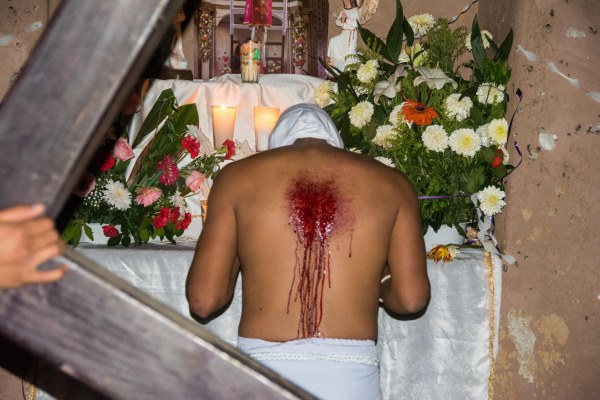
As if carrying the sharp-edged cross while running barefoot with a hood on, or walking hooded while in shackles, weren’t hard enough, each Penitente carries an eight-whipped disciplina full of nails. He is required to whip himself with the nailed lashes at each station, causing prodigious bleeding. Heavier or more muscled, less flexible Penitentes tended to have two bloody spots on their back, as the lashes didn’t reach the center. Teenagers and thinner men tended to have one deeper wound, in the center of their backs. Either way, I would not wish to have a manda and perform this penance anytime soon!
If you stumble or miss a station, or if your Cyrene helps you more than he should, you need to start your journey over from the beginning.


Holy Saturday includes the Easter fire or Fuego Nuevo at night, while Easter of course involves the Mass of the Resurrection.
Tzintzuntzan is about an eight hour journey from Mazatlán. We spent one night in Guadalajara, then a few nights in Uruapan, where on Palm Sunday they hold Latin America’s largest indigenous handicraft tianguis/fair. We stayed in a gorgeous cabin beside the river, and near there (in Parangaricutiro) we also hiked the ruins of a church buried in lava.


From Uruapan it is a three hour journey to Tzintzuntzan. From Tzintzuntzan, any of the villages around the lake are easily reachable, as are the islands in the lake or the state capital of Morelia.
There are cabañas in town, on the lake, or plenty of hotels in nearby Quiroga. Our AirBnB didn’t work out, and we ended up finding a hotel at the last minute. We were invited to stay in at least five different homes, so even if you travel without reservations, you should have no problems.
I like how very informal things are here; I hadn’t brought an Easter dress or shoes, and I fit in at Easter Mass just fine. Makeup isn’t that common, either. We found the people we encountered most welcoming, though perhaps more standoffish/shy at first than in Mazatlán. You definitely need to speak Spanish; many of the locals have trouble even with that, as they speak P’urhépecha natively and Spanish as a second language; English tends to be only spoken by those in Patzcuaro, who work with tourists, or who have lived north of the border. The beauty here is driving into any town and just discovering what it has to offer.
I trust you might visit and, if you do, enjoy your adventure!
 Today Greg and I visited the incredible ruins of a 17th Century church sticking up out of a lava flow! The sight reminds me of Pompeii, yet it’s just outside Uruapan, in the state of Michoacán, where we are for Semana Santa.


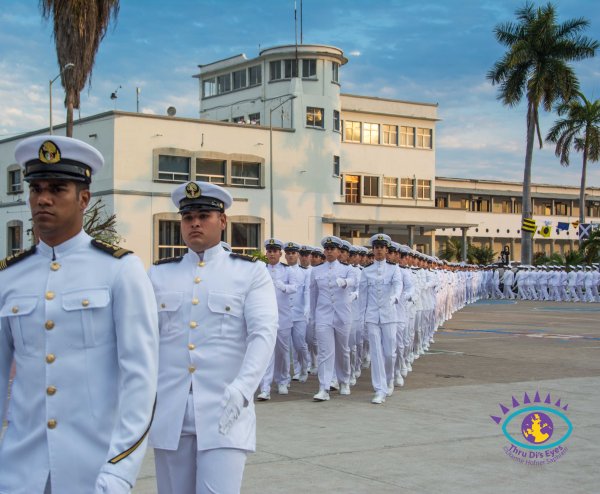 Mazatlán has been renowned since colonial times as one of Mexico’s premier maritime and shipbuilding centers. It is thus quite natural that we are blessed with the country’s oldest merchant marine academy—


 ¡VidaMaz!